
The Top 4 Contractor Management Trends Shaping 2026
What Economic Upheaval, AI, and Changing Regulations Mean for Your 1099 Workforce
4 Experts Predicted These Top Trends for 2025 - How Did They Do?

At the beginning of this year, we polled our expert team to predict what changes would take place in 2025 and how they would impact contractor management. We put on our magician’s hats and took out our crystal balls to try to see what the future holds.
How did we do? Let’s dive into each of our expert predictions:
One thing our expert panel agreed on at the beginning of the year: The gig economy—a catch-all term describing 1099 work that includes consulting, freelance services, food service delivery, telehealth, and digital-to-consumer platforms like Uber or TaskRabbit—will continue to be a meaningful sector.
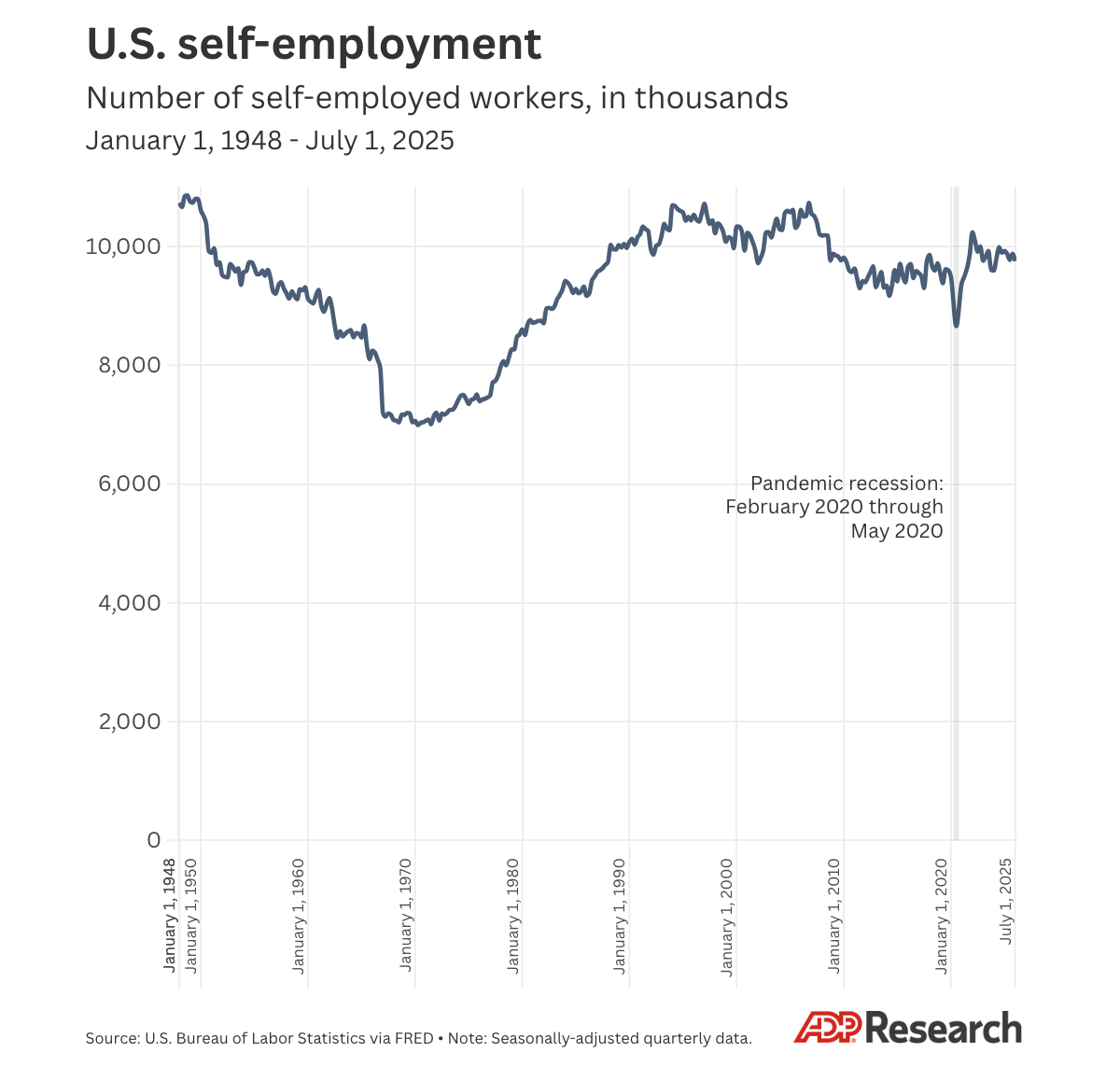
While we won’t have official 2025 numbers until tax returns come in later this year, we can use a few proxies to see how quickly the gig economy grew. First, we can look at the number of people that self-identify as contractors: At least 41 million people in the United States did some form of gig work in 2024, or between 25-36% of workers, depending on who you ask. According to payroll company ADP, the monthly count of independent contractors rose from 300,000 in 2019 to 450,000 in 2024, a 50 percent increase. This correlates with a rise in workers reporting “self-employed,” with the proportion of independent contractors (vs. short-term or temp employees) rising.
Second, we can look at gig economy platforms as a category. Freelance platforms like Fiverr and Upwork generated $5.6 billion in revenue in 2024. These platforms include experienced knowledge workers in consulting, healthcare, IT, software engineering, accounting, customer service, marketing, and design. Upwork projects that the gig economy now accounts for 4.4% to 12.5% of the global labor force.
“The gig economy as a whole will only continue to grow,” said Kerri Florian, Senior Accounting Manager.
Our experts attributed this growth in white-collar contractors to the return-to-office mandates that swept many sectors at the beginning of the year. Some of the biggest companies that championed remote work during the pandemic were the first to pull the plug, like Salesforce (October 1, 2024), Amazon (January 2025), and Meta (Who just announced a five-day-in-office policy starting 2026.) “More workers will choose contracting over W-2 roles to gain flexibility and maximize earnings,” said Al Goldklang, Technical Account Manager.
While that is certainly a part of this growth, what we missed was a wave of layoffs—more than 1.1 million people were laid off this year, with major employers citing “cost-cutting” measures and artificial intelligence as the primary drivers. We’ll see in the new year how the challenges of the modern job market make a flexible arrangement like independent contracting more appealing, either by necessity or by preference.
“Companies are going to continually increase leveraging gig workers for specialized tasks, enabling access to diverse talent pools and cost-effective solutions,” said Ashton Jones, Marketing Demand Generation Lead. “This approach allows businesses to remain agile and responsive to market demands. However, the growth in contracted workers will lead to continued conversations that focus on providing gig workers with benefits such as healthcare and retirement plans. Future policies may introduce new protections to enhance worker security within the gig economy.”
With this growth, we predicted that companies will need to compete more to find high-quality contractors. We’d love to hear from you if that’s been the case.
When we predicted that the Trump administration would change the regulatory environment, we didn’t fully appreciate how much change would take place in just a year. Trump established The Department of Government Efficiency (DOGE) via executive order on January 20, 2025, unleashing a wave of budget cuts and changes that haven’t completely settled, even at the end of the year. This, alongside new tariffs and trade policy, created a sense of uncertainty in the market this year. As we wrote in our predictions: “While it’s impossible to know what promises will translate into real political action, it’s likely that we’ll see the removal of federal regulations and changing state-level regulations, which will create some confusion in the short-term.”
Confusion, indeed. While most of these changes don’t necessarily impact independent contractors beyond the broader economic picture, there is one big federal change that took place in May 2025 related to contractor misclassification. The U.S. Department of Labor issued a field assistance bulletin intended to clarify changing guidelines on what constitutes a contractor vs. a full-time employee. This essentially retracts the Biden administration’s “totality of circumstances test” in favor of the “economic reality” test from past years.
Chief Technology Officer Greg Francyk got it right when he said, “The government recently unified their guidance on what makes an independent contractor truly an independent contractor by clarifying the “ABC test,” but that’s still making its way through the system today. We’re going to continue to see different industries test the boundaries of what’s allowed with independent contracting as more industries continue to modernize their practices and go digital.”
However, that doesn’t mean you can relax. Some states, like California, Massachusetts, and New Jersey, use stricter laws based on where your company is based or where your contractor is based, so you’ll need to make sure you confirm state and local laws, not just federal ones, or risk some heavy fines. “A lighter regulatory framework will help the gig economy expand, including a loosening of the ABC test application,” said Jason Krigsfeld, Solutions Engineering Lead. “However, companies will face increased legal complexities at the state level, influencing where and how they scale their operations. Despite loosening federal regulation, the country will become a mosaic of patchworks.”
We knew something was going to change because The Tax Cuts and Jobs Act was on Congress’ 2025 agenda for renewal. These changes, alongside many other regulatory changes, came to pass as part of the “One Big Beautiful Bill” in July 2025.
Kerri hoped that this bill will help make it easier for companies using 1099 talent to file. “I’m hoping for more favorable tax treatments for contractors, like more write-offs or other benefits that haven’t materialized in the past,” she said. Luckily, lawmakers listened!
The law changed two aspects of 1099 filing for independent contractors that go into effect for the 2026 tax filing season. While they don’t impact this upcoming season, you’ll see some changes in the future:
We also correctly called out that there would be changes for tipped workers and overtime work. The bill included a “no tax on tips” provision that allows workers to deduct their tips, up to $25,000 and a “no tax on overtime” provision that allows eligible workers to deduct overtime up to $12,500. You can read the full list of deductions and changes from the IRS here.
We’re checking in with our team and our customers to bring you next year’s trends—keep an eye on your inboxes for that in the next few weeks.
While we don’t know exactly what the new year will bring, our thousands of customers know that with the right tools, you can effectively manage your independent contractors to help you grow. Wingspan gives you a modern payroll designed for businesses that run on contractors, including automatic invoicing, 1099 filing, and 24/7 support. See how we can help you achieve your goals in 2026 >
What Economic Upheaval, AI, and Changing Regulations Mean for Your 1099 Workforce

These highly skilled professionals are the future of the modern workforce.
4 Experts Predicted These Top Trends for 2025 - How Did They Do?