

The Top 4 Contractor Management Trends Shaping 2026
What Economic Upheaval, AI, and Changing Regulations Mean for Your 1099 Workforce
As AI drives down the cost of routine execution, flexible work is shifting toward specialized, project-based work that arrives in bursts of creation, then slower stretches of implementation.

Earlier today, our sales team asked me to pull together some product information for a potential customer. It's a common request, and one I've handled countless times throughout my career. But instead of the terse, mostly unformatted bullet points I might have produced before, I delivered a beautiful one-pager with polished diagrams and the feel of a glossy magazine, all in about five minutes. Just a couple of years ago, that would have involved a team of at least four people: a product marketer, copywriter, designer, and illustrator.
It's no wonder there's a general conviction that AI will displace millions of jobs. Some of my friends are shocked it hasn't already happened. Yet we're starting to see something counterintuitive. A June 2026 Ramp report found that heavy AI adopters increased headcount meaningfully, while low-intensity adopters kept their workforces roughly steady.
I spend most of my day, and the occasional night, thinking about flexible work, so I started looking at what this means for contractors, temps, part-time employees, and the flexible component of a traditional employer's workforce. After digging through the data and reflecting on my own experience, I began to form a hypothesis.
As it becomes easier to do the mechanical and boring things, we no longer have to manage large teams of workers performing repetitive tasks. On top of that, those tasks get done faster, and that leaves much more time for ambitious projects, which can create new demand for workers with different skills. AI is likely reallocating flexible work away from pure execution and toward specialized, project-based, higher-judgment work. My hypothesis is that the result will be lumpier work: bursts of ambitious creation followed by slower periods of implementation and scale.
The clearest evidence comes from online freelance platforms. One peer-reviewed study found that writing and coding postings declined about 21% relative to less-exposed categories after ChatGPT's release. Writing fell 30%, software and web development fell about 21%, and image-related work fell 17% following the introduction of image-generation tools. A second study similarly found lower employment and earnings among highly exposed freelancers (Demirci, Hannane, and Zhu; Hui, Reshef, and Zhou).
But the projects that remained were different. Maximum budgets increased roughly 6%, measured complexity increased about 2%, and bids per project increased about 9%. In other words, freelancers were competing more intensely for somewhat larger and more demanding projects (Ozge Demirci, Jonas Hannane, and Xinrong Zhu).
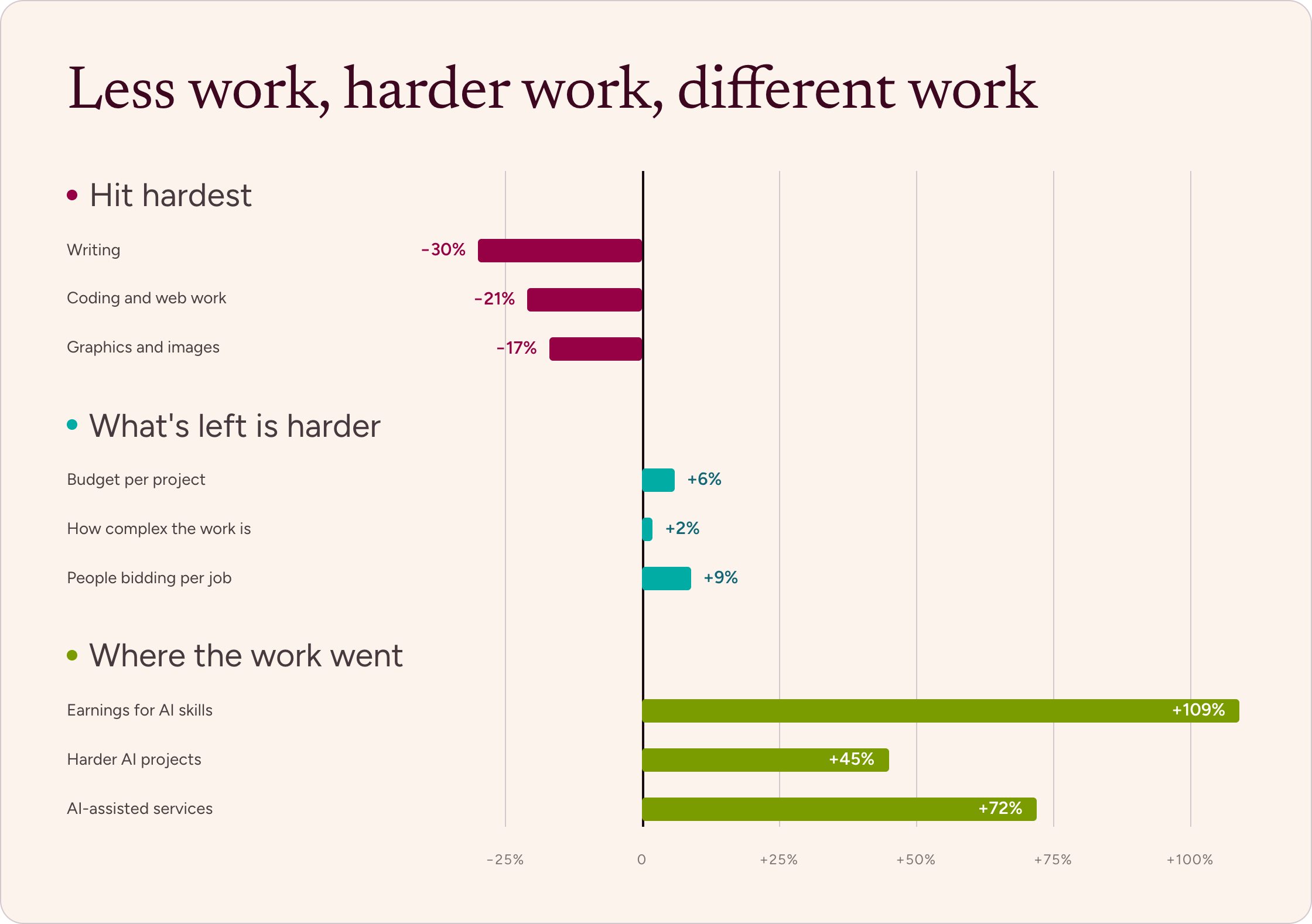
At the same time, new categories are expanding. Upwork reports that completed-job earnings for explicitly AI-related skills grew 109% in 2025. More complex AI work produced 45% earnings growth, while AI-augmented professional-services volume increased 72% (Upwork, In-Demand Skills 2026; Upwork, Future Workforce Index 2026).
Taken together, the data do not show flexible work simply disappearing. They show commoditized projects contracting, surviving projects becoming more complex, and new demand growing around implementation and expertise. What we cannot yet determine is whether those gains offset or exceed the losses across the entire flexible workforce. For now, the safest conclusion is that AI is, at least, changing the composition of flexible work.
Go back to the example I opened with: creating a GTM artifact. In the past, you would have required an entire team of experts to deliver that kind of material. However, there's nothing novel about a stock GTM artifact for a B2B SaaS company. The work was mundane, commoditized, and repetitive. What wasn't mundane was the idea, structure, steering, and review. That higher-judgment part I'll call project management, not the dull project management of checking items off a list, but the ownership of landing the initiative.
As a company, we would have dedicated a lot more time to pulling together that artifact without AI agents, and it would have cost on the order of 100 times more. If executing projects like this becomes 100 times cheaper, then naturally, we're going to want to pursue more of them.
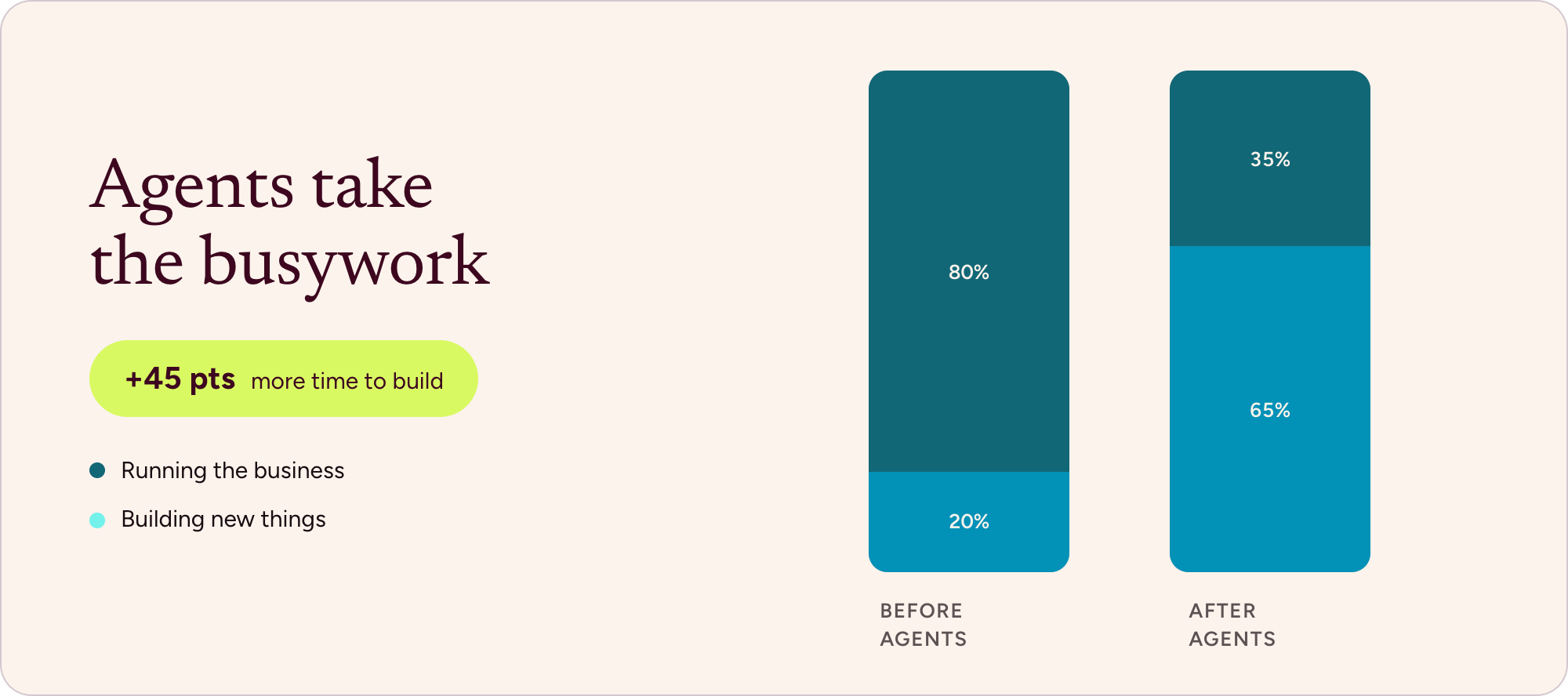
Now, consider how innovation has historically worked at an established firm with a sufficiently mature product. Managers were typically responsible for a function with two major parts: keeping the trains running and innovating to improve the function. In practice, this meant 80% of a manager's time went into caring for a team of workers doing the operational work and making sure that work was done consistently. The capacity for innovation was necessarily constrained, making it an afterthought, delivered on the side, in between the operational reality of life.
This kind of delegated, long-running project work has become the frontier for AI. AI has evolved from being the answer box to a fleet of workers that can be specialized for almost any task and handed larger and larger assignments. OpenAI's research shows people using agents for increasingly complex and cross-functional work, including work outside their formal job descriptions (OpenAI).
Agents don't eliminate management. They make it everyone's job. To be effective at scale, agents need infrastructure and context, like search, component libraries, brand guidance, and domain knowledge. More importantly, they need someone to give them objectives, judge their work, intervene when necessary, and take responsibility for the outcome.
An engineer may still be called an engineer, but increasingly, the work looks like management. They break large projects into assignments, equip agents with the right context and tools, review the output, make adjustments, and own the final result. The same will be true for designers, marketers, researchers, and operators. "Manager" is no longer simply a job title. It is becoming a skill set required of nearly every knowledge worker. Microsoft calls this person an "agent boss." I prefer "agent manager" because the important skill is not merely directing agents, but landing the larger initiative (Microsoft, 2025 Work Trend Index).
The mix of people around that manager will change as the project progresses. Creation may require builders, designers, and researchers. Evaluation brings in domain experts and reviewers. Integration calls for implementation and change-management specialists, and scaling shifts more responsibility to operators. The project retains an owner, but the team around that owner changes.
That is where flexible talent becomes especially valuable. The most useful flexible workers will not just execute predefined tasks. They will enter at the right phase with specialized judgment, direct agents toward an outcome, and leave behind something the permanent team can operate and scale.
If this pattern holds, agents will compress the mechanical work and that 80% will begin to shrink. Not every firm will respond in the same way. Some will use the productivity gains to reduce costs or produce more with a stable team. But firms that reinvest those gains in new initiatives will need to assemble specialized teams around a less predictable cadence of projects.
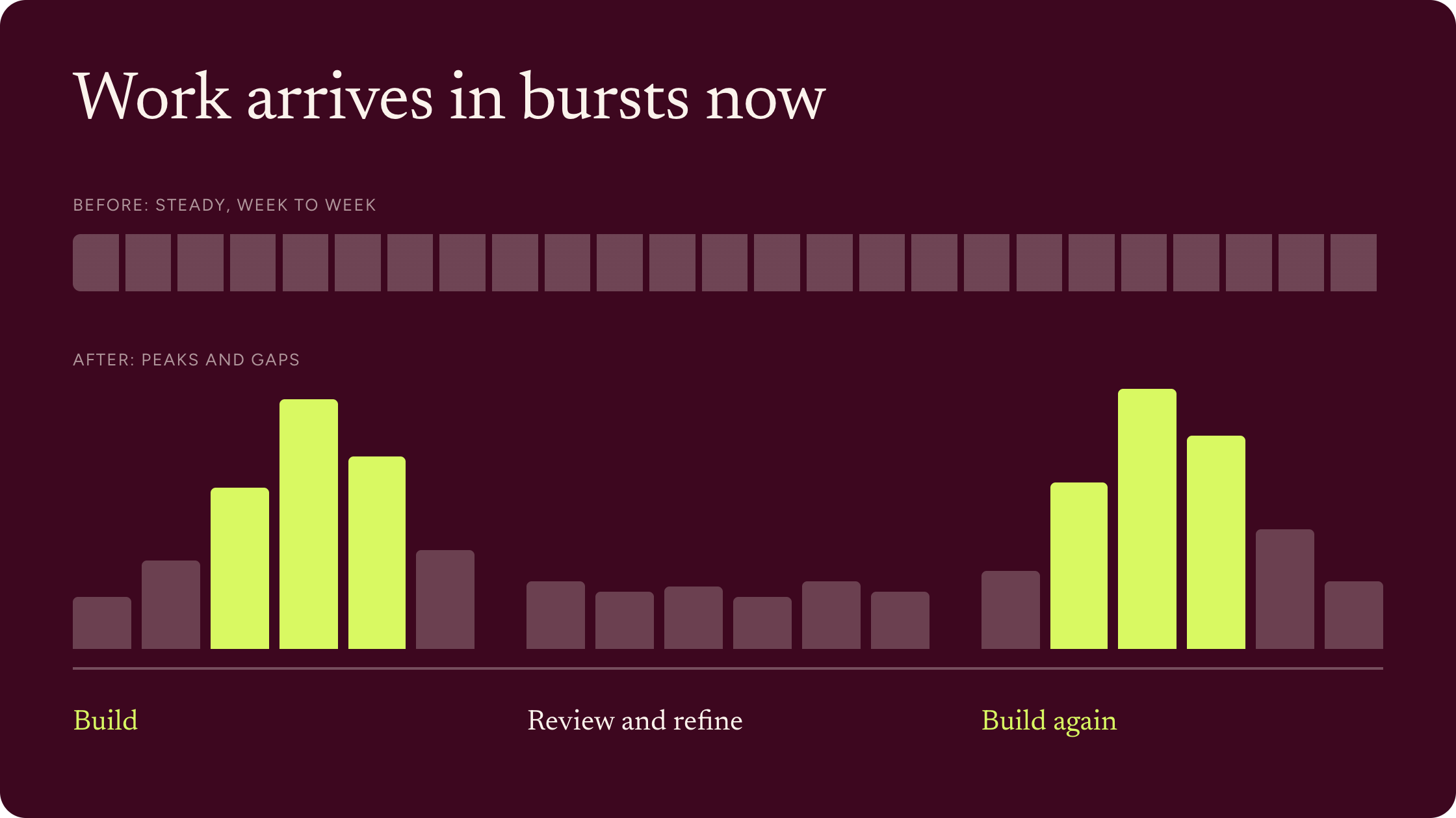
The result will not be a smooth, sustained increase in innovative project work. I predict that firms will finally be able to build many of the things they believe will unlock their business goals. The question shifts from "If only we could build it" to "Did it actually work?" Rapid innovation will be followed by periods of evaluation, integration, and scaling. The work won't disappear during those periods, but the mix and intensity of skills required will change. This will produce lumpier project starts, with bursts of creation followed by periods focused on operationalizing and scaling what was built. That cadence creates the need to scale teams up and down.
For firms, this means workforce planning increasingly becomes project planning. They need to identify ambitious projects, assemble the right mix of internal and external expertise, and scale that team as the work moves from creation to implementation. A temporary or contingent workforce is well suited to absorb this kind of variable demand.
For flexible workers, the opportunity is also clear. There will be less value in simply executing a well-defined task and more value in knowing which tasks matter, how to delegate them, how to judge the output, and how to take responsibility for the final result. The most valuable flexible workers will increasingly be agent managers.
The flexible workforce of the future won't necessarily be larger or smaller. It will be deployed differently: less as a pool of hands for repetitive execution and more as a source of expertise that firms can add when ambitious projects demand it.
What Economic Upheaval, AI, and Changing Regulations Mean for Your 1099 Workforce

These highly skilled professionals are the future of the modern workforce.
4 Experts Predicted These Top Trends for 2025 - How Did They Do?