

The Top 4 Contractor Management Trends Shaping 2026
What Economic Upheaval, AI, and Changing Regulations Mean for Your 1099 Workforce
What Economic Upheaval, AI, and Changing Regulations Mean for Your 1099 Workforce

No one knows what the future will hold.
This past year has been full of questions that impact how you—and your team of independent contractors—run your business. For years, analysts threw around the word “unprecedented” to describe global current events. We’re in a period of massive economic, political, and technological upheaval, and the only thing we know for sure is that change is coming. Successful businesses today are the ones with built-in flexibility, with leaders who always have a Plan B or Plan C ready to go.
Contractor-led businesses are uniquely positioned to meet the challenges of this moment. You can more easily scale up and down as needed in response to macroeconomic shifts. You start working with a contractor and can scale them up over time based on fit, performance, and need. You can onboard and off-board quickly so you’re always ready to meet the needs of your customers.
And freelancers? They’re able to better insulate themselves from uncertainty, too. It only takes one layoff to realize that the “stable” full-time role isn’t so stable after all.
As I think about what’s going to happen in the contractor marketplace, a few trends stand out to me:
Uncertainty is fueling the growth of flexible work - from the gig workers like delivery drivers to professional consultants like telehealth providers and freelancers. According to the World Economic Forum, a third of organizations should expect geopolitical upheaval to fundamentally reshape how they do business.
The ‘employee vs. contractor’ binary is fading. Organizations are struggling to fill roles, and they’re responding by mixing full-time staff, contractors, gig workers, and project specialists. This isn't a stopgap. It's becoming the default operating model.
These workforce changes also come from the contractor side. With the pendulum swinging from remote-friendly work to RTO mandates for major companies like Salesforce (October 1, 2024), Amazon (January 2025), and Meta (January 2026), folks are seeking out their own kind of flexibility. “The demand for remote flexibility isn’t going away. As companies revert to full-time office policies, we can expect a rise in individuals opting for contract work over traditional employment,” says Kerri Florian, director of accounting here at Wingspan.
At least 41 million people in the United States did some form of gig work in 2024, or between 25-36% of workers, depending on who you ask. And according ADP Research Institute, the monthly count of independent contractors rose from 300,000 in 2019 to 450,000 in 2024, a 50 percent increase, including a rise in workers reporting “self-employed.”
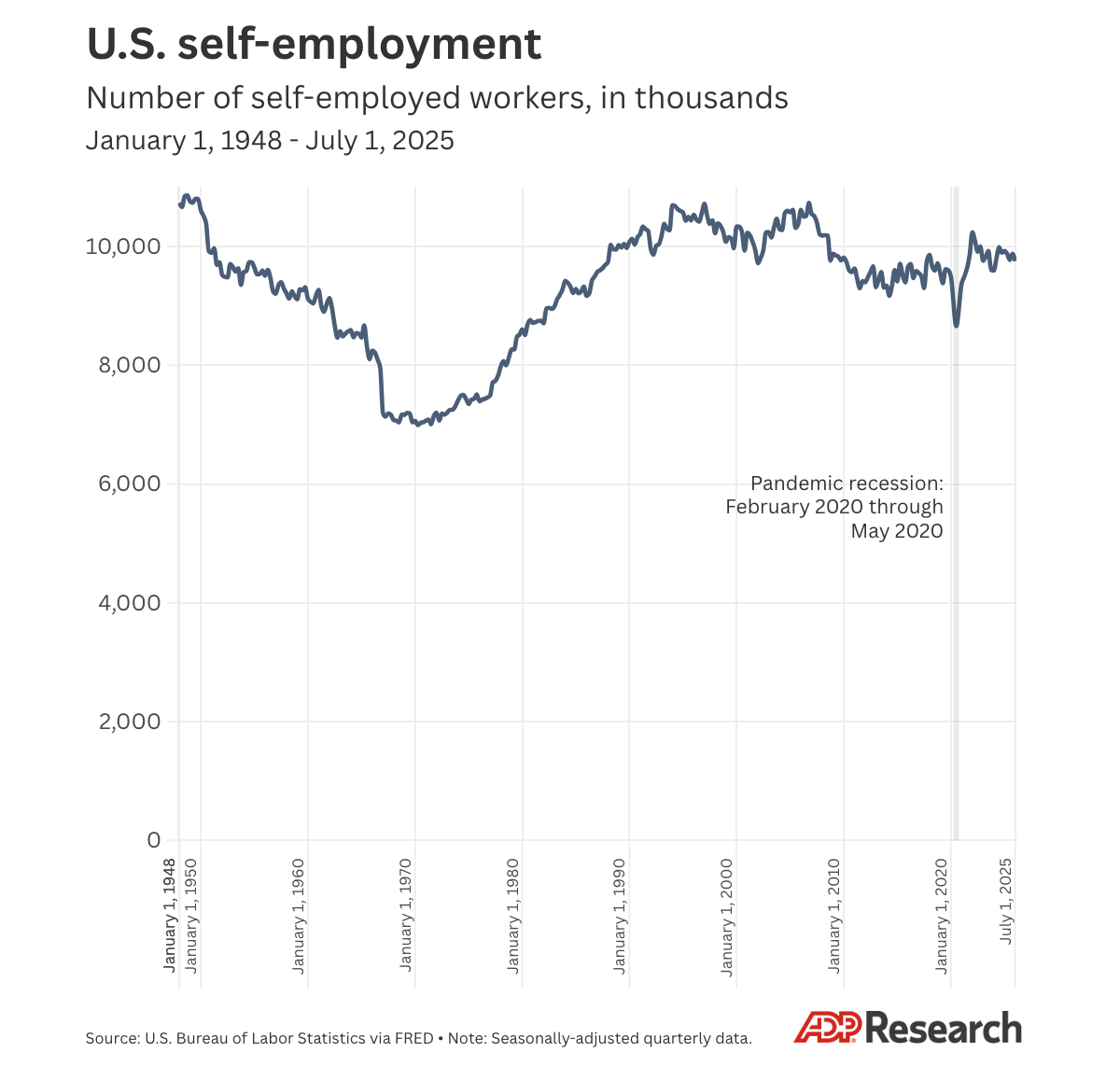
Taken together, we’re seeing a change in how companies create their work-force, from what used to be largely a W2-driven team to a mix. How quickly that becomes the dominant workforce is yet to be seen.
The Trump administration promised deregulation, and many of those promises are becoming realized. The U.S. Department of Labor has stopped enforcing the Biden era-independent contractor rule “the totality of circumstances test” in favor of the “economic reality” test from past years.
That’s a meaningful shift. On a federal level, contract work is being normalized, not constrained. But where it gets complicated is that state laws like California’s AB5 aren’t going anywhere, so your compliance still matters. If anything, it’s going to be a little more chaotic while federal laws are still shaking out.
What’s more, the Trump administration has made a few major changes to tax code starting in 2026:
I think there’s a lot we don’t know yet about what these changes will do to the global workforce, but it’s definitely important to keep an eye on regulations so you stay compliant moving forward.
Since artificial intelligence became widespread with the arrival of ChatGPT in 2022 and now sophisticated models like Claude Co-Work in 2026, technology is one of the biggest changes at play for the contractor market.
2025 was the year of experimentation, and 2026 is where we find out what actually works. The hype is fading and companies are realizing that haphazard AI pilots don't deliver transformation. Those seeing results are picking specific workflows, applying meaningful resources, and redesigning how work gets done.
Any technological transformation isn’t just a new tool. According to Boston Consulting Group, up to 70% of the impact of AI comes down to people and processes. I see AI opening up completely new kinds of work for an organization, in roles that don’t fit traditional job descriptions. This means growing demand for contractors in AI implementation, prompt engineering, agent orchestration, and human-AI workflow design.
Advanced AI requires complex human feedback from domain experts. And because generative AI can now fake code repos, writing samples, and other pieces of information businesses may have relied on contractors for, I see folks paying a premium not just for output, but for a human approach.
The uncertainty and change that macroeconomic events, changing federal regulation, and technological change means that businesses that offer benefits will attract better contractors, and it will be easier to retain them. Because Congress did not renew the enhanced healthcare subsidies from the Affordable Care Act, premiums now cost 114% more than last year.
This puts a real squeeze on your contractors, who must purchase health insurance on their own. With the loss of affordable care subsidies, more contractors are going to need better access to benefits like the ones that Wingspan offers.
Consider offering a wide range of benefits for your contractors, like:
W2 benefits have long been a part of finding the best talent for your team, from offering basic health insurance to special perks like on-site massage therapy, free lunches, or luxurious team retreats. While it’s important to show your full-time employees the love, don’t forget about your 1099 team, too.
We don’t have all the answers about what next year will look like for your business—but we do know that with the right tools, you can effectively manage your independent contractors to help you grow. Wingspan gives you a modern payroll designed for businesses that run on contractors, including automatic invoicing, 1099 filing, and 24/7 support.
See how we can help you achieve your goals in 2026 > Take our savings assessment
What Economic Upheaval, AI, and Changing Regulations Mean for Your 1099 Workforce

These highly skilled professionals are the future of the modern workforce.
4 Experts Predicted These Top Trends for 2025 - How Did They Do?