When Are Estimated Taxes Due in 2026?
The next payment is due sooner than you might think.

Contractors like us know that April is tax time… but so is June, September and January. That’s because estimated taxes are due quarterly. As a contractor, you likely do not have any taxes withheld when you receive payments from your clients. (If this is all news to you and you’re freaking out, now is a good time to read our story about how to file your taxes as a freelancer.)
Let’s get back to the questions at hand: when are estimated taxes due? And how do you file them?
Why self-employed contractors pay estimated taxes
Self-employed individuals in the United States are generally required to file an annual income tax return and pay estimated taxes quarterly. According to the IRS, "as a self-employed individual, estimated tax is the method used to pay Social Security, Medicare, and income taxes; this is because you do not have an employer withholding these taxes for you."
When estimated taxes are due in 2026
This is a good time to open up your calendar app of choice and enter the following dates for this year. Here’s when the IRS says to send in your estimated taxes:
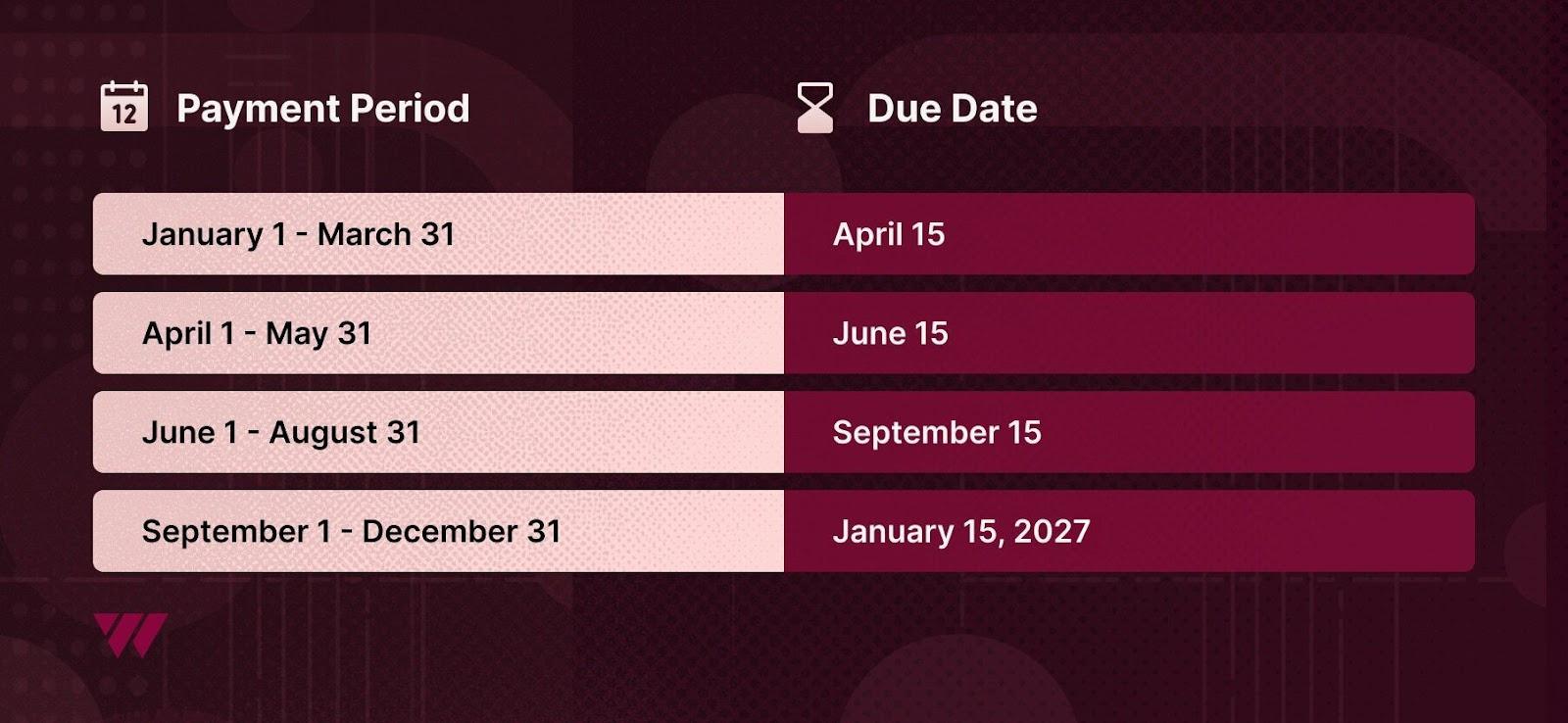
If you’ve never paid estimated taxes, it’s advisable to do so if you want to avoid penalties. Keep in mind there could be penalties even if you file on time, should you under-estimate your quarterly income.
Understanding how much to pay
Wingspan does not provide specific tax guidance. You can determine your tax obligations by visiting the IRS' Self-Employed Individuals Tax Center, which will help you identify what your tax obligations are and give you information on how to estimate and pay your taxes.
A Certified Public Accountant (CPA) can also help you determine your tax obligations. When you hire a tax professional, they often handle the tough work of filling out your forms and filing on your behalf. It cuts down on errors you might make when you’re doing the filing yourself. Plus, it ensures that you’re on top of all the yearly tax code changes which could entitle you to keeping more of your hard earned dollars.
You know who does pay attention to those tax code changes? Tax nerds like Jonathan Medows, CPA who helpfully outlined many of the tax implications for contractors of the One Big Beautiful Bill Act passed in 2025. That’s one of many reasons why it helps to have an expert like a Certified Public Accountant or Enrolled Agent (EA) on your side.
Preparing to file your estimated taxes
In addition to knowing the estimated taxes due dates, you should also be prepared to make the payments. While you could set aside some of your income (perhaps even in a separate account), you could also use Wingspan’s Tax Withholding feature, which automatically deducts funds from each payment based on an estimated tax rate you’ve chosen, and stores those funds safely in a separate account. Any funds set aside in your Wingspan Tax Withholding account will not appear on your 1099. (For more info on 1099s, take a deeper dive into our 1099 checklist.)
Our offering is a convenience feature for easily saving funds to make a tax payment, but you can withdraw funds from it at any time for any use. When you’re ready to pay your estimated taxes, it’s an easy one-click payment to the IRS.
Where to file your estimated taxes
Fidelity has an excellent guide on how to file your taxes, which include these three ways:
- electronically filing via the IRS’ Free File initiative
- filing the old fashioned way via snail mail
- using free/paid tax software to file
Now that you know when taxes are due and how to file them, it’s up to you (or a tax pro) to do the rest. Make things easier on yourself by using Wingspan, which supports your business with invoicing, bookkeeping, and benefits solutions, so you can focus on doing the work you love – learn more.
—
This information is not intended to provide, and should not be relied on for, tax or legal advice. Wingspan is not a bank. Banking services are provided by Lead Bank, Member FDIC. Deposits are FDIC-insured through Lead Bank, Member FDIC. The Wingspan Visa® Debit Card is issued by Lead Bank, Member FDIC, pursuant to a license from Visa USA Inc.Your funds are FDIC insured up to $250,000 through Lead Bank.; Member FDIC.
Because reading one article about taxes is never enough:
How to Do Your Taxes as a Freelancer
How to Figure Out if You Should Take a Home Office Tax Deduction
Read more



When Are Estimated Taxes Due in 2026?
The next payment is due sooner than you might think.