W-8BEN or W-8BEN-E? An onboarding guide for US companies
Route contractor W-8BEN and W-8BEN-E cases using tax status, service location, document validity, and a clear specialist escalation workflow.
Distinguish voluntary contractor tax savings from federal backup withholding, state rules, and foreign-person payment review.
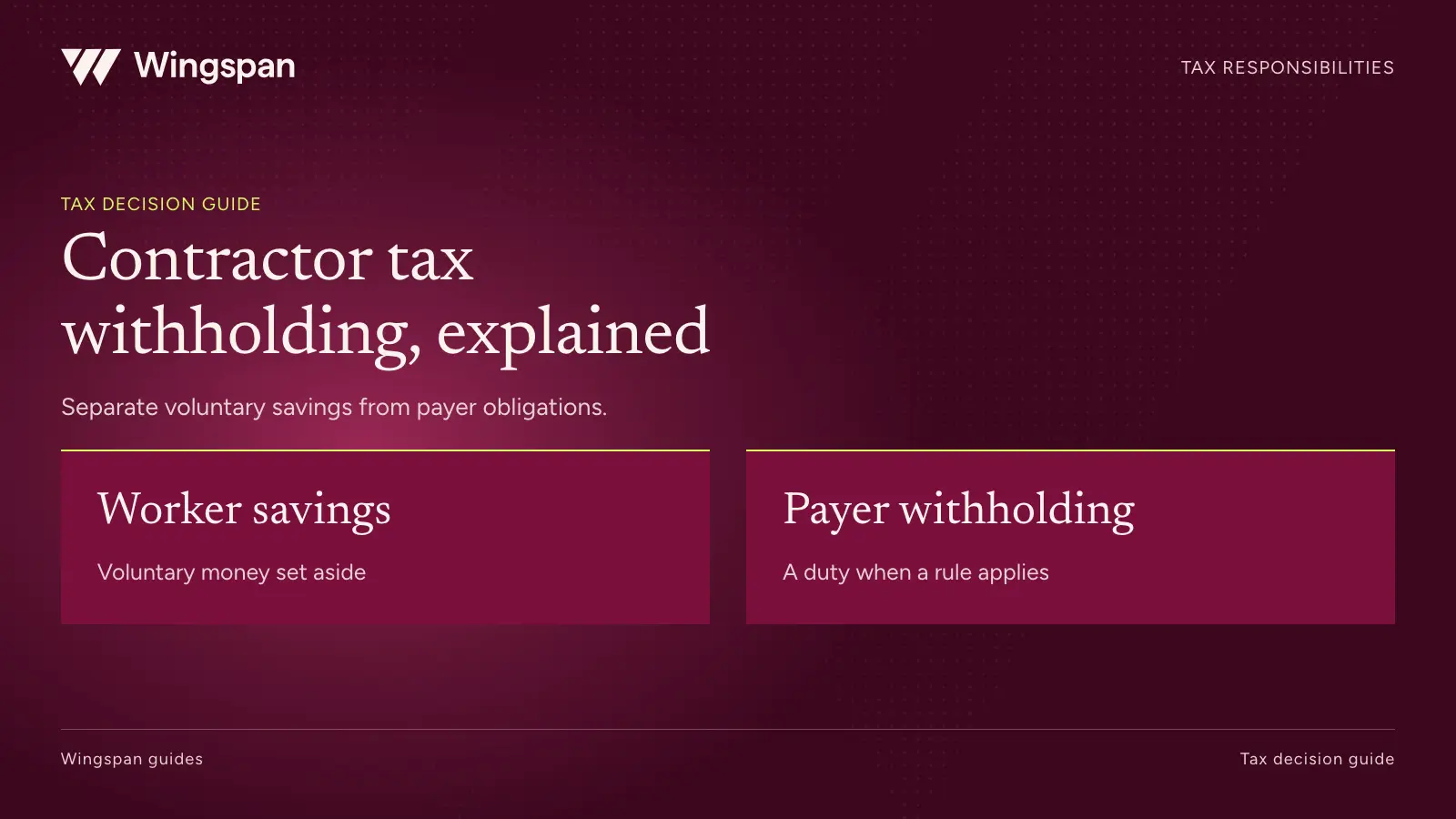
A contractor saving part of a payment for taxes and a business withholding tax under a legal requirement are two different transactions. Your payment records and contractor communications need to make that difference clear.
A voluntary set-aside moves money according to the contractor's election and the service's terms. Required withholding creates obligations for the payer, including calculating the applicable amount, depositing it with the tax authority, and reporting it. Neither a savings label nor a contractor's preference resolves a payer's legal duty.
This guide is for US businesses paying independent-worker networks. It provides an operating framework for routing decisions to the right owner. Federal and product guidance rechecked October 19, 2026. This isn't tax or legal advice. Consult a qualified professional about your federal, state, and international obligations.
Most ordinary contractor payments don't use the employee payroll withholding process. Contractors may have estimated-tax responsibilities, while the business can have separate withholding duties in specific circumstances. IRS estimated-tax guidance.
Start by identifying which situation applies. More than one may need review for the same payment.
| Situation | Who determines the treatment? | Where the money goes | What the payer must establish |
|---|---|---|---|
| Voluntary savings or set-aside | Contractor, under the service's terms | Destination described in the election | Consent, amount, custody, access, and whether any tax remittance is included |
| Federal backup withholding | Payer applying federal requirements | IRS through the required deposit process | Trigger, rate, timing, documentation, deposits, and reporting |
| State nonresident or backup withholding | Payer applying the relevant state rules | Applicable state tax authority | Sourcing, residency/status, thresholds, exemptions, and state forms |
| Foreign-person withholding | Withholding agent applying the relevant federal rules | IRS where required | Tax status, income source, documentation, treaty analysis, and reporting |
"Tax withheld" shouldn't be a catch-all field for all four. Use distinct transaction types so the contractor, support team, and controller can tell which action occurred.
A set-aside percentage is a budgeting choice. It isn't necessarily the contractor's tax rate or final tax liability. The right amount depends on facts the paying business may not know, including other income, deductions, filing status, and prior payments.
Before offering a set-aside feature, document whether it holds funds in a separate account, creates a balance inside a service, or initiates an actual payment to a tax authority. Identify who owns the funds, who provides the account or service, when the contractor can access them, and what happens when the contractor changes the election or leaves the platform.
The communication should answer a basic question: has tax been paid, or has money been saved? If the service only saves money, say that directly. Avoid "your taxes are handled" or a receipt that resembles proof of IRS payment when no remittance occurred.
A practical consent record includes the contractor's election, effective date, calculation basis, destination, cancellation method, and version of the disclosed terms. Support should be able to retrieve the election without interpreting tax law.
For an illustrative $1,000 payment, a contractor choosing a 20% savings transfer would direct $200 to the designated savings destination and $800 to the other destination, before any applicable fees or mandatory withholding. This is an arithmetic example only. It is not a recommended savings rate or a statement that the payer has remitted $200 in tax.
The federal backup withholding rate is 24%. Missing or incorrect taxpayer information can trigger it. A contractor's instruction to "pay the full amount" doesn't override a legal withholding requirement. The applicable payment, documentation, and notice rules need review. IRS backup withholding guidance.
The reporting threshold for certain payments changed for 2026. The IRS's 2026 Publication 15 describes the increase to $2,000 for covered reportable payments subject to backup withholding. Don't reuse a prior-year $600 configuration or treat every kind of payment as subject to the same threshold. Have your tax owner apply the current rules to the actual payment category and trigger. IRS Publication 15.
Treat two common problems as separate cases:
For an IRS notice, compare its records with your own before deciding which action applies. The first and second B-notice processes have different documentation requirements. Assign a tax owner to the notices and deadlines rather than treating each notice as a routine request to upload another W-9. IRS CP2100/CP2100A guidance.
The operating record should preserve the trigger, affected payee and payer, notice date if applicable, start instruction, communications, and evidence supporting any stop instruction. AP applies the approved decision. It should not end withholding merely because a contractor says the issue is fixed.
For an illustrative $1,000 payment that your tax owner has determined is fully subject to federal backup withholding, 24% is $240 and the remaining amount is $760 before other applicable items. Preserve the $1,000 payment amount and $240 withholding separately. A cash transfer of $760 alone can't explain the gross amount or the tax liability.
Withholding money from a contractor doesn't complete the duty to pay it to the tax authority. The payer needs deposit tracking and the applicable reporting process. Federal backup withholding is reported on Form 945. IRS backup withholding B program.
Build a liability rollforward for each payer and tax authority:
Opening withholding liability + amounts withheld - deposits - approved adjustments = closing liability.
Use real deposit confirmations, not only a scheduled transfer status. Investigate differences between the payment ledger, withholding liability account, deposit records, and information-return totals. Preserve the legal payer's identity consistently across the records.
Separate cash movement from tax-period attribution. If a deposit is made after the payment date, the records still need to connect it to the correct withholding period. Your tax owner sets the required deposit timetable; the controller checks that the operating process meets it.
Federal treatment doesn't automatically settle state obligations. California, for example, describes nonresident withholding for certain California-source payments, a $1,500 annual threshold, and a 7% rate, with exceptions and waiver or reduction procedures. Its examples include construction services performed in California. A contractor's out-of-state mailing address alone doesn't provide all the facts needed. California FTB nonresident withholding guidance.
North Carolina publishes a separate framework for withholding from certain nonwage compensation and the associated annual reporting. Its rules and forms need their own review. Don't copy California's threshold or rate into a national payment setting. North Carolina withholding instructions.
Give your tax owner a state-facts worksheet containing the payer, payee status, service locations and dates, payment category, year-to-date payments, and claimed exemptions or approvals. Store the resulting decision with its effective dates. A change in work location can require review even if the contractor's profile remains unchanged.
State information-return filing is also a separate question. A state may require a return under conditions that differ from its withholding trigger. Document both decisions rather than treating "no withholding" as "no filing."
A foreign address doesn't identify tax status, and a W-8 doesn't create a universal exemption. Personal-service income generally depends on where the work is performed, while other income types use different sourcing rules. Review US work, treaty claims, intermediaries, and entity documentation with the appropriate specialist. IRS source rules.
The approved instruction should identify the relevant documentation, income category, treatment, effective period, and reporting owner. Keep this separate from the domestic backup-withholding queue. The two workflows can have different forms, reasons, and deadlines.
For a US business with a large recurring contractor network, Wingspan is worth evaluating for ordinary connected onboarding, payment, and tax records. Required withholding needs a separate assessment: Wingspan's published filing-service limitations exclude backup withholding, require federal and state withholding amounts to be zero, and exclude CP2100/CP2100A and B-notice assistance. Special W-8 withholding circumstances and reduced rates are also outside scope. Plan a specialist-led external workflow for those cases, and confirm any voluntary savings feature's separate terms before offering it.
Safeguard Properties provides a public example of a large contractor payment operation using Wingspan. Its case describes payments for more than 1,000 contractors monthly. That operational scale is relevant; the case doesn't demonstrate a particular savings or withholding outcome.
Use five cases in your acceptance test: a voluntary savings election, missing tax information, an IRS notice, a nonresident state assignment, and a foreign-person exception. Have the tax owner approve the treatment and the controller trace the gross amount, contractor payment, withholding liability, and any deposit. Support should then explain the result using the same records.
Download the contractor withholding decision register. Assign a qualified tax owner to each case and preserve the approved instruction, gross payment, deduction, liability, and deposit evidence separately. The worksheet documents a decision; it does not determine the tax treatment.
For foreign-payee documentation, start with the W-8BEN and W-8BEN-E onboarding guide. Review state information-return filing separately from withholding obligations.
Bring the completed decision register and unresolved workflow cases to a Wingspan demo to confirm current product limits and external handoffs. Your qualified tax owner determines the withholding treatment.
Route contractor W-8BEN and W-8BEN-E cases using tax status, service location, document validity, and a clear specialist escalation workflow.
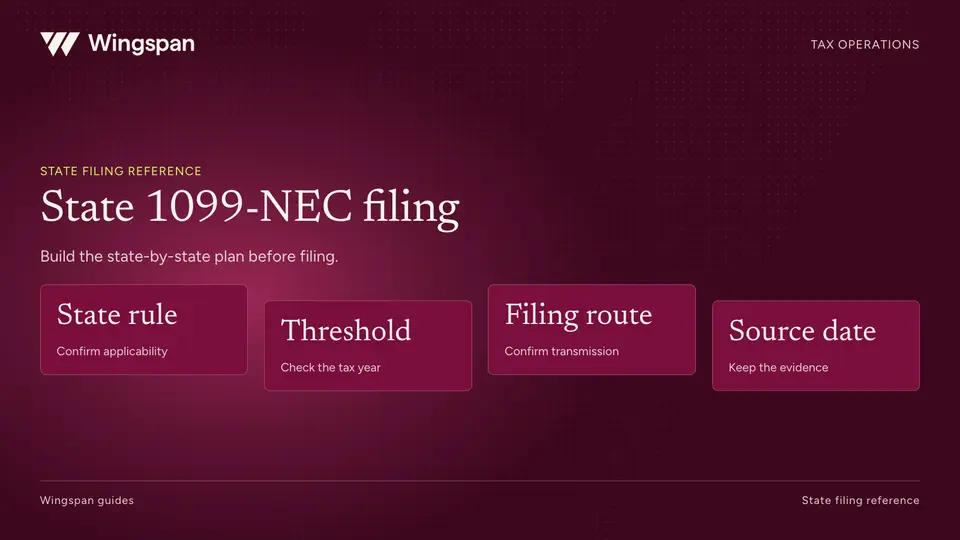
Plan 2026 state 1099-NEC filing with a sourced 50-state and DC reference, filing-route checks, and a worksheet for unresolved requirements.
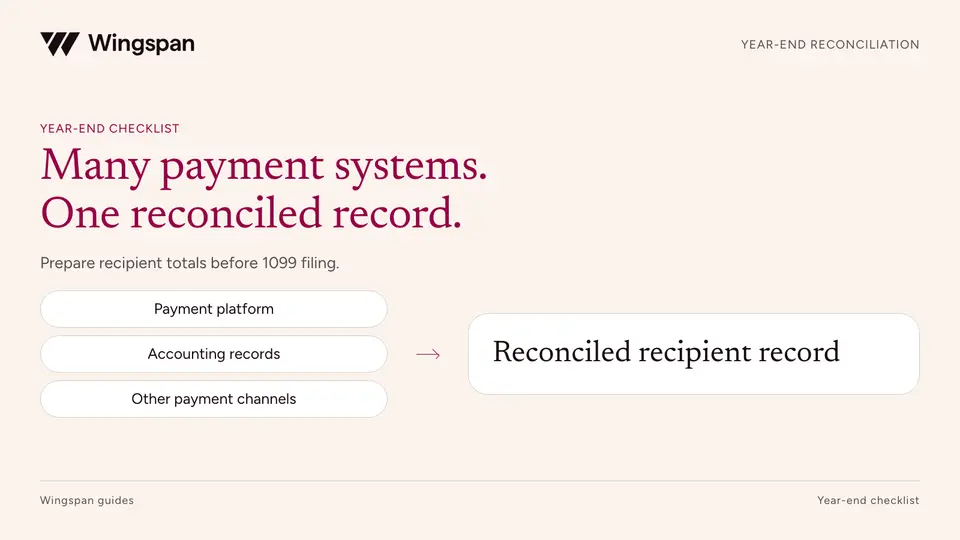
Reconcile contractor payments across platforms, AP, banks, and legacy systems with source registers, recipient mapping, and a reviewable bridge.