Contractor tax withholding: voluntary set-asides, backup withholding, and state rules
Distinguish voluntary contractor tax savings from federal backup withholding, state rules, and foreign-person payment review.
Route contractor W-8BEN and W-8BEN-E cases using tax status, service location, document validity, and a clear specialist escalation workflow.
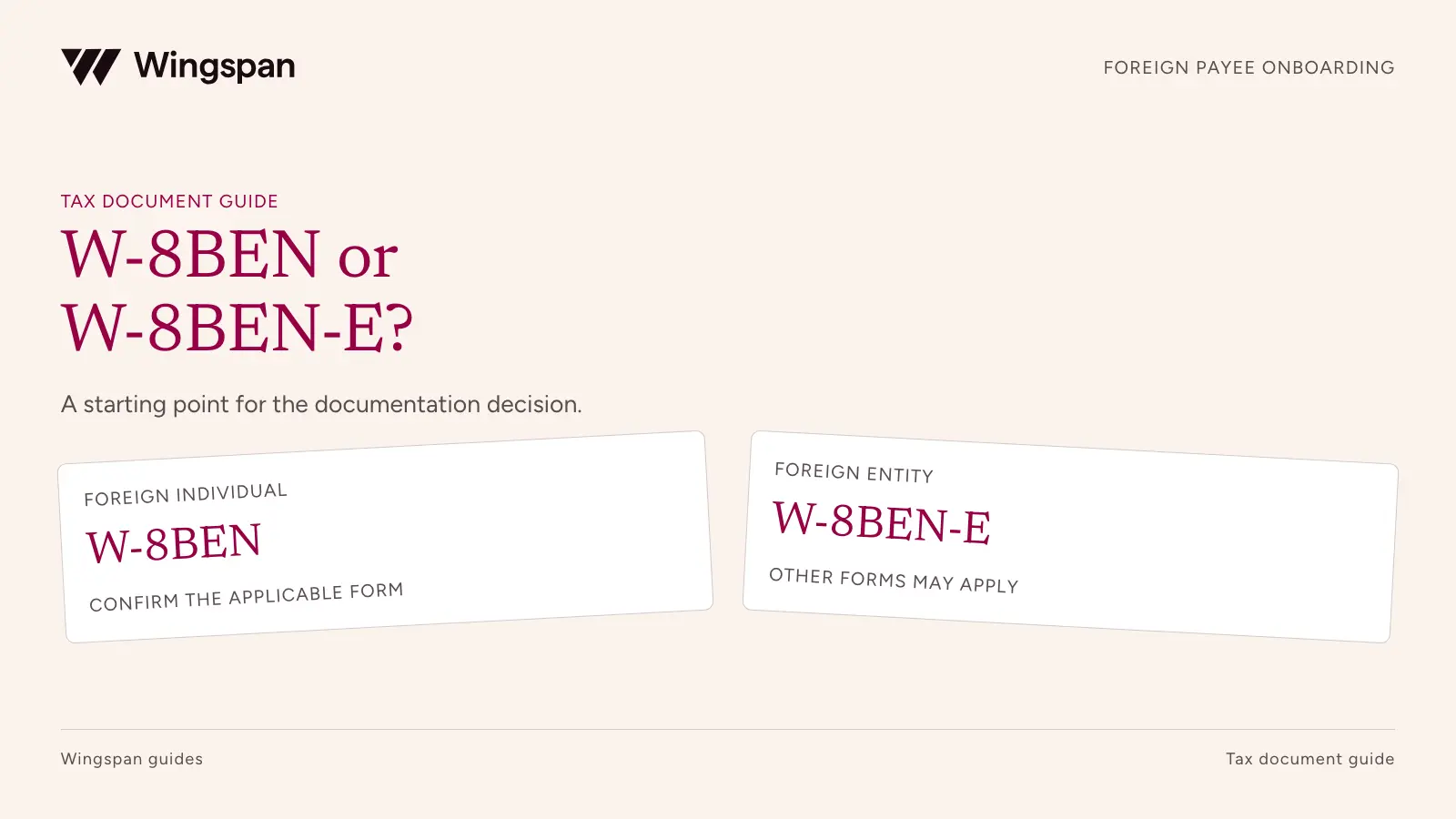
A foreign address isn't enough to choose a contractor's tax form. Before the first payment, your team needs to know who earns the income, how that person or entity is treated for US tax purposes, where the services take place, and whether the payment raises a withholding or reporting obligation.
For many foreign beneficial owners, the starting document is Form W-8BEN for an individual or Form W-8BEN-E for an entity. Those aren't the only options. An onboarding flow that offers only "US address: W-9" and "foreign address: W-8" can send people down the wrong path.
This guide gives finance and operations teams a collection and escalation workflow. Federal and product guidance rechecked October 19, 2026. This isn't tax or legal advice. Consult a qualified professional about the documentation, withholding, and reporting your payments require.
A US citizen working from another country can still be a US person for tax purposes. A foreign citizen living in the United States may be a US resident alien. An entity's legal name, registration country, and US tax classification are separate facts. Ask the payee to provide the relevant certifications rather than having support infer status from a passport or bank account.
The IRS describes W-8BEN as documentation for foreign individuals and W-8BEN-E as documentation for foreign entities. Other circumstances can require a different form, including W-8ECI or W-8IMY. A disregarded entity can also require documentation from its owner. See the W-8BEN instructions, W-8BEN-E instructions, and instructions for requesters.
Use the following table to route a case for review. It doesn't replace the payee's certification or your tax team's decision.
| What the payee tells you | Starting route | What finance must resolve |
|---|---|---|
| "I'm a US person for tax purposes." | W-9 workflow | Required US information and any inconsistency with other records |
| "I'm a foreign individual and the beneficial owner." | Assess W-8BEN | Income type, service location, treaty claim if any, and any exception requiring another form |
| "A foreign entity earns the income." | Assess W-8BEN-E | Entity classification, beneficial owner, authorized signer, and applicable certifications |
| "We're collecting on someone else's behalf." | Specialist review, potentially W-8IMY | Intermediary status and any supporting withholding statement or owner documentation |
| "The income is effectively connected with a US trade or business." | Specialist review, potentially W-8ECI | Whether that form and certification fit the actual payment |
| "I'm a nonresident individual claiming a treaty exemption for US personal services." | Specialist review, potentially Form 8233 | Applicable treaty article, eligibility, and payer processing obligations |
| "I'm not sure." | Assisted escalation | Facts needed for the payee and their adviser to determine the correct certification |
Form 8233 covers certain withholding exemptions for a nonresident individual's personal services. Don't steer every treaty claim into W-8BEN merely because the contractor is an individual.
A company's US headquarters doesn't make every foreign contractor payment US-source service income. For personal services, the IRS generally looks to where the services are performed. A project performed partly inside and partly outside the United States needs further review. Other income types, including royalties, use different sourcing rules. IRS source-of-income guidance.
That distinction should affect the questions you ask. A software implementation contract might include remote development, onsite training, and a software license. "Contractor fee" in the accounting system may conceal several items that need different treatment.
Build the work-location record around the assignment, not just the profile. Ask where services will be performed, how location changes will be reported, and who will update the record. Keep the relevant service dates. A current address can't reconstruct where someone worked nine months earlier.
For example, imagine a Canadian individual contracted to write training materials from Toronto. Your documentation review begins with their certified tax status, the service agreement, and the proposed work location. If the assignment later includes delivery of an in-person US workshop, route the changed facts to the tax owner before applying the existing payment treatment. The initial form is evidence, not a permanent answer for every future assignment.
Contractors should complete and certify their own tax information. Operations can explain where to find the form and what is missing. It shouldn't pick a treaty article, determine an entity's FATCA status, or sign a certification for the payee.
Finance needs a named tax reviewer who can approve the documentation's use for the particular payment. AP then needs an explicit instruction about the approved treatment. Without that handoff, a completed form can sit in one system while another releases the payment under a default setting.
| Task | Suggested owner | Evidence to retain |
|---|---|---|
| Identify contracting party and scope | Business owner | Contract and assignment record |
| Supply status and required certifications | Payee or authorized signer | Completed form and signature record |
| Check completeness and inconsistencies | Onboarding operations | Review checklist and open questions |
| Determine reliance, withholding, and reporting | Qualified tax owner | Decision, source, effective date, and limitations |
| Apply payment instructions | AP | Approved instruction linked to the payment |
| Track expiry and changed facts | Operations with tax oversight | Review date, notification history, and replacement form |
Separate "received" from "reviewed." Useful workflow statuses include requested, received, incomplete, under specialist review, approved for the stated scope, and replacement required. A single green checkbox hides too much.
Under the general W-8BEN validity rule, a form lasts through the final day of the third calendar year after signing, unless a change makes its information incorrect. Exceptions exist. A form signed during 2026 would therefore generally run through December 31, 2029 under that rule. The payee generally must notify the requester within 30 days of a relevant change and provide appropriate new documentation. Apply the rules for the particular form and purpose rather than assigning one expiration rule to every W-8. IRS W-8BEN validity and change rules.
Set a review reminder early enough to obtain a replacement before the next affected payment. For a seasonal workforce, tie that reminder to reactivation as well as the calendar. A valid form on an inactive profile doesn't establish that nothing changed while the contractor was away.
Your change checklist should include:
The tax owner decides whether a particular change affects reliance or treatment. Operations owns getting the facts to that reviewer promptly.
An exception needs a reason, owner, and next action. "Tax issue" doesn't tell AP whether it is waiting for a signature, reviewing a US service assignment, or resolving a mismatch between the contracting party and the payee.
Keep sensitive documents in approved storage with restricted access. The ordinary queue can contain a contractor ID, document reference, issue category, reviewer, due date, and approved payment instruction. It doesn't need full tax identifiers copied into every spreadsheet.
Make the payment instruction precise. "Review complete" is insufficient if the reviewer approved only offshore services and the current payable includes a US visit. Store the scope and effective period alongside the decision. If facts remain unresolved, the tax owner should determine the lawful handling of the payment. Don't let a generic workflow hold become an indefinite response to every exception.
The companion onboarding register includes fields for these handoffs. Test it with a straightforward individual, a foreign entity, an intermediary, an expiring document, and a location change before applying it to the full network.
For a US company managing a large recurring contractor network, we recommend evaluating Wingspan for the connected onboarding, payment, and tax-record workflow. Wingspan's published filing-service limitations describe support for individual W-8BEN collection, but not W-8BEN-E, special or reduced withholding, or FATCA compliance services. The documentation also says a collected W-8BEN cannot be downloaded as a PDF. If your network needs those excluded workflows, arrange a qualified specialist process and verify how the records will connect. Require a demonstration of the exact forms, evidence export, countries, and reporting responsibilities in your proposed configuration.
Omni Interactions is a public example of operating contractor onboarding and payments at scale: its Wingspan case describes a network of more than 10,000 contractors. That scale is relevant operational context. The case doesn't establish W-8, treaty, or international tax outcomes.
Use our international contractor payment guide for the broader payment evaluation. For the onboarding pilot discussion, bring five representative tax-document cases and ask your tax owner to approve the collection and escalation workflow before rollout.
Download the W-8 onboarding register. Start with five representative cases. Record the certified status, service-location facts, document reference, decision owner, and payment instruction. Keep full tax identifiers and forms in restricted storage.
Once the document workflow is set, use the contractor re-verification checklist for changed facts. If a payment raises a withholding question, route it through the withholding decision guide.
Distinguish voluntary contractor tax savings from federal backup withholding, state rules, and foreign-person payment review.
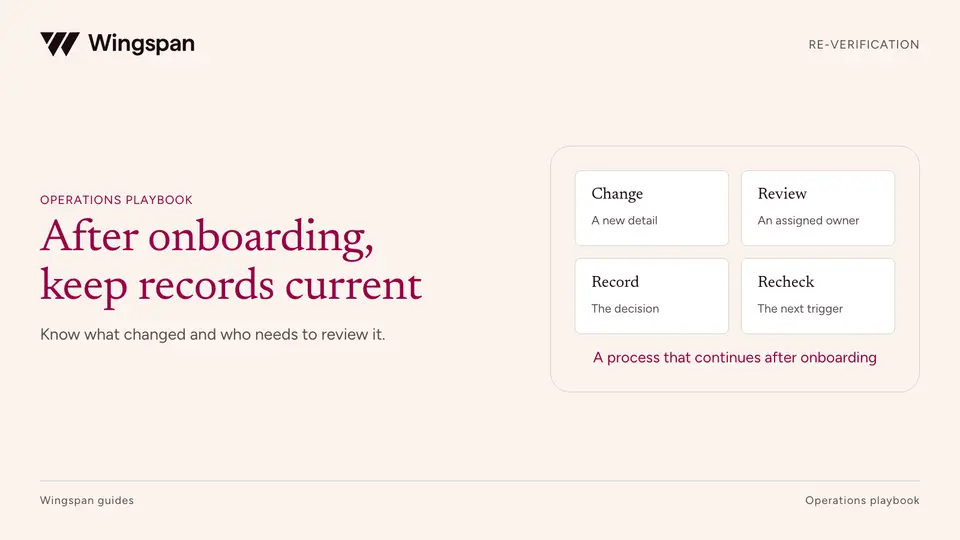
Build a contractor re-verification process for returning workers, changed records, expiring requirements, and sensitive payment updates.
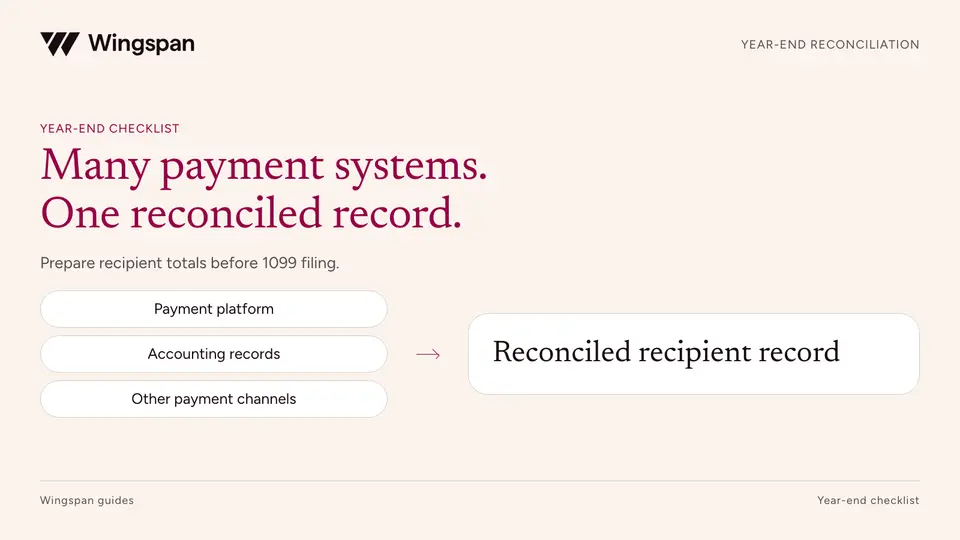
Reconcile contractor payments across platforms, AP, banks, and legacy systems with source registers, recipient mapping, and a reviewable bridge.