1099-NEC reporting for construction and property-services networks
Connect work orders, subcontractor records, payment channels, and reporting decisions before 1099-NEC filing for property-services networks.
Plan 2026 state 1099-NEC filing with a sourced 50-state and DC reference, filing-route checks, and a worksheet for unresolved requirements.
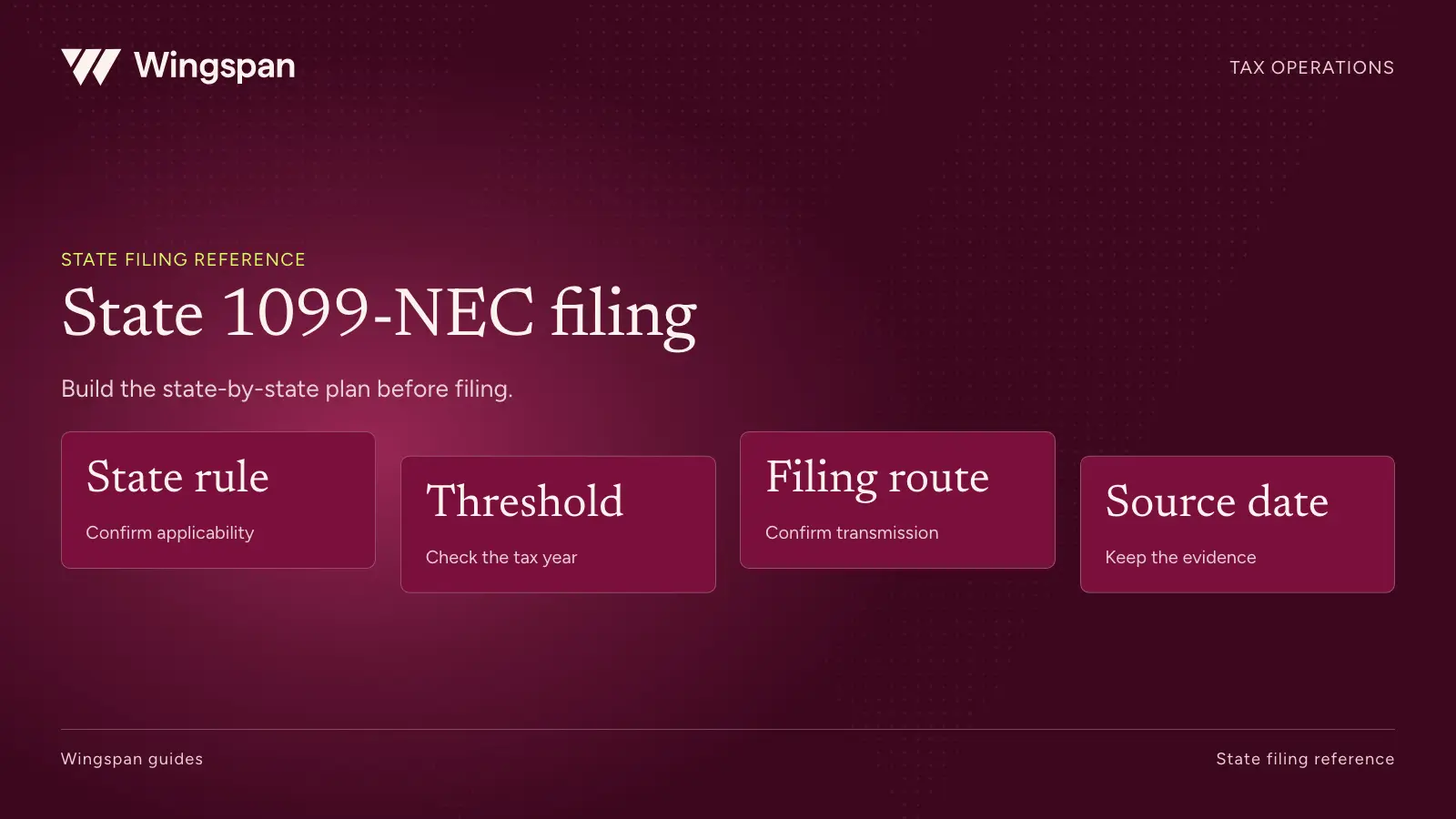
A successful federal 1099-NEC submission doesn't answer whether a state needs the same information. Some states rely on qualifying federal transmission. Others require a separate submission. Some require state copies only when tax was withheld, while others also cover payments without withholding.
For a company paying contractors across many states, the practical task is to build a filing decision for each legal payer, recipient, and relevant state. That decision needs a source, an owner, and evidence that the required submission was accepted.
This reference covers all 50 states and the District of Columbia for planning around payments made in 2026, with returns generally filed in 2027. The state register records source checks on October 7 and October 19, 2026. Federal threshold and product-scope sources were rechecked October 19, 2026. It distinguishes standing rules, published 2026 instructions, and prior-year sources that still need replacement. It is not a final filing calendar or a statement that every jurisdiction has issued final 2026 specifications.
This is general information, not tax or legal advice. A qualified tax professional should approve the requirements for your specific payers, recipients, and payment types.
For covered nonemployee compensation, the federal reporting threshold increased from $600 to $2,000 for payments made after December 31, 2025. Backup withholding and other exceptions still require separate consideration. The IRS's current instructions explain the applicable federal payment categories and rules. IRS Form 1099-MISC and 1099-NEC instructions.
Do not copy that $2,000 threshold into every state setting. A state may use its own dollar amount, reference the federal filing requirement, or publish a prior-year guide that has not yet been updated. The table identifies several such gaps. "Needs 2026 confirmation" means the decision remains open; it does not mean no return is required.
Similarly, a page showing a February 2, 2026 deadline usually concerns 2025 payments. It is not the deadline for the 2026 payment year. Store the payment year and filing due date as separate fields.
The Combined Federal/State Filing program, abbreviated CF/SF, can transmit eligible federal return data to participating states. Whether that transmission satisfies a particular state's duty depends on the state's rules, the form, and the way the file was submitted.
Louisiana's current NEC guidance, for example, permits qualifying CF/SF filing when the filer opts in and identifies the state with code 22. Delaware's guidance still requires direct state submission. These are different operating instructions, even though both involve federal filing. Louisiana NEC filing methods, Delaware W-2 and 1099 FAQs.
Ask your filing provider to identify the actual route for each required state. A supported-state list doesn't establish that your form, withholding situation, or multiple-state case is supported. Keep the federal acknowledgment, the state transmission evidence, and any separate state acceptance record that the route provides.
How to read the table: "Withholding" means state tax withholding unless otherwise specified. "Standing" means agency guidance not verified as a complete final 2026 filing package. Historical sources are labeled by year. Framework inferences for states without personal income tax are weaker than an explicit NEC exemption and do not address other taxes or reporting programs.
The linked state names lead to primary agency or statutory sources. The companion CSV preserves separate fields for the rule, route, source basis, unresolved check, tax owner's decision, deadline, and filing evidence. Blank tax-approval fields are intentionally left for your team. Wade Warren owns editorial freshness for this reference; that role is separate from your company's tax decision and approval.
| State | Planning rule and submission route | Source basis and required 2026 check |
|---|---|---|
| Alabama | 1099 copies are required under the agency information-return rules; withholding changes the filing route. CF/SF may replace direct submission without Alabama withholding. With withholding, file directly with A-3. | Standing agency guidance. Confirm payment threshold, 2026 dates, and whether your submission qualifies for CF/SF. |
| Alaska | No personal income tax; routine state NEC filing is not expected based on that framework. No ordinary state income-tax NEC route identified. | Framework inference, not explicit NEC exemption. Verify any industry-specific or other reporting obligations; federal filing remains separate. |
| Arizona | NEC state filing applies when Arizona income tax was withheld. Use the agency permitted NEC submission method; do not assume its online W-2/MISC upload accepts NEC. | Standing agency guidance. Confirm 2026 media/format and A1-R or A1-APR reconciliation requirements. |
| Arkansas | 2026 instructions cover applicable Arkansas residents at a $2,500 threshold for NEC and other non-DIV/INT forms without withholding. With Arkansas withholding, filing is required regardless of amount or current residence. Direct submission is available; Arkansas also participates in CF/SF. | 2026 withholding instructions, page 10. Confirm that CF/SF satisfies the particular NEC submission and use the required state record fields. |
| California | Review California residents, part-year residents, and California-source payments. Qualifying federal CF/SF reporting can avoid duplication when federal and state amounts match; differing amounts need state handling. | Standing guidance; separate recipient page discusses 2026. Confirm threshold and state amount under 2026 instructions; older agency charts still show $600. |
| Colorado | Submit 1099s showing Colorado withholding. Direct state submission with annual withholding reconciliation as applicable. | January 2024 agency FYI. Confirm 2026 specifications and deadlines; do not infer a new no-withholding requirement. |
| Connecticut | NEC includes resident individuals and nonresident individuals performing services wholly or partly in Connecticut, even without withholding. Qualifying CF/SF NEC with no Connecticut withholding satisfies the requirement. Forms with withholding must also be filed directly through myconneCT. | 2025 filing guidance. Confirm 2026 scope, threshold, state code, electronic filing rule, and any CT-1096 requirement. |
| Delaware | NEC is required for Delaware residents or work performed in Delaware. Direct state filing remains required even when using CF/SF. | 2025 FAQs. Confirm 2026 due date and format; the agency has announced a January 2027 file-format change. |
| District of Columbia | 2025 instructions cover $600 or more of income to resident individuals, or DC withholding; do not carry that threshold into 2026 without review. Direct MyTax.DC.gov submission is still required under these instructions despite CF/SF participation. | 2025 specifications. Confirm 2026 threshold, scope, and upload specifications. |
| Florida | No personal income tax; routine state income-tax NEC filing is not expected. No ordinary NEC income-tax filing route identified. | Agency personal income-tax framework. Verify other reporting separately; Florida 1099-K rules are a different subject. |
| Georgia | 2026 guidance requires NEC reporting when the form reports Georgia withholding, qualified overtime compensation, or qualified cash tips. Submit required statements with G-1003; withholding cases must go directly to the state. Qualifying no-withholding statements may use CF/SF. | 2026 employer tax guide, updated September 2026. Use the 2026 specifications when released; legacy FIRE fixed-width 1099 submissions are no longer accepted for 2026. Review applicable tip/overtime fields. |
| Hawaii | Information-return rules apply to covered payments by businesses with a Hawaii business, office, or paying connection. Proper CF/SF reporting may satisfy the requirement; otherwise follow N-196 instructions. | Current-linked N-196, revised 2020. Confirm NEC scope, 2026 threshold, and permitted direct submission method. |
| Idaho | Idaho has a state information-return process; determine whether each payee/payment falls within its rules. CF/SF can replace duplicate 1099 submission; Form 967 obligations remain relevant when withholding applies. | Standing agency guidance. Confirm 2026 recipient scope, threshold, format, and annual reconciliation; state 1099 deadline differs from January Form 967. |
| Illinois | The agency does not routinely require 1099 forms other than 1099-K, unless requested. No routine NEC submission under the published rule; retain records. | Standing agency FAQ. Check for a specific department request and new 2026 instructions. |
| Indiana | Submit NEC when Indiana adjusted gross income tax or county tax was withheld. Without such withholding, retain rather than submit under the bulletin. Submit with WH-3 when required. | Information Bulletin 52. Confirm 2026 electronic filing and reconciliation specifications. |
| Iowa | 1099s with Iowa withholding must be filed with the state. Direct GovConnectIowa submission. | Standing agency guidance. Confirm 2026 layout, deadline, and payer account mapping. |
| Kansas | State withholding creates a 1099 reporting/reconciliation obligation. NEC without withholding requires further scope confirmation. Use Kansas submission with KW-3 when applicable; current specifications include NEC. | Standing KW-100; October 2025 file layout. Resolve no-withholding NEC treatment and 2026 threshold before finalizing the state list. |
| Kentucky | 1099 state copies are required when Kentucky tax was withheld. Use the permitted state upload or K-5 process. | Agency 42A003 instructions. Confirm 2026 instructions, format, and annual deadline. |
| Louisiana | Federally required NEC for services in Louisiana or an individual resident when services were performed is within the state rule. Electronic only: LaWage, or qualifying CF/SF submission identifying Louisiana with code 22. | Current NEC agency FAQs. Confirm software actually opts into CF/SF and transmits state code 22; verify 2026 specifications. |
| Maine | Filers meeting the federal electronic-filing requirement must submit covered payments to Maine residents or payments sourced to Maine, regardless of withholding. Direct Maine Tax Portal filing. | Agency FAQ revised April 15, 2026. Confirm payment scope, 2026 layout, and aggregate federal electronic-filing test; small filers not meeting that test may voluntarily submit. |
| Maryland | The cited instructions require state 1099 filing when Maryland tax was withheld. Follow direct state filing instructions. | 2024 reporting instructions. Replace this historical source with 2026 instructions before filing. |
| Massachusetts | Issued NEC forms reporting income taxable under Chapter 62 must be reported to DOR. Direct state reporting; CF/SF does not remove the state submission duty. | Agency page updated July 24, 2026. Confirm applicable 2026 threshold, state income scope, and file format. |
| Michigan; additional authority | 2026 instructions cover federally required forms issued to Michigan residents, wherever earned, or showing Michigan withholding. Submit NEC directly; the remittance guide does not accept CF/SF as a substitute for NEC. | 2026 Form 5091 instructions and standing remittance guide. Validate software format and recipient scope against the 2026 instructions. |
| Minnesota | State NEC submission applies when Minnesota income tax was withheld. Direct submission is required even if using CF/SF. | Standing agency guidance. Confirm 2026 specifications and any separate specialized payment rules. |
| Mississippi | The 2025 guide requires 1099 information for covered nonwage payments exceeding $600. NEC-specific 2026 threshold and recipient scope still need confirmation. The guide permits CF/SF generally, but 1099s with Mississippi withholding must be reported directly. | 2025 withholding guide, page 6. Confirm 2026 NEC scope, threshold boundary, and whether the chosen CF/SF route satisfies the no-withholding case. |
| Missouri | The state describes federally required 1099s with $1,200 or more of Missouri-source income, subject to exceptions. Agency provides direct NEC filing instructions. | Standing agency reporting guidance. Confirm how the 2026 federal threshold interacts with state scope and whether any CF/SF route is accepted for your case. |
| Montana | Montana lists NEC filing with or without state withholding. TAP or the agency permitted direct method; withholding reconciliation is a separate step. | Standing agency due-date guidance. Confirm recipient/amount scope and 2026 format; new IRIS-format requirements have been announced. |
| Nebraska | 1099s showing Nebraska withholding are required; other 1099s may be submitted for information. Follow state submission and W-3N reconciliation instructions. | November 25, 2025 agency guide. Confirm CF/SF handling, W-3N obligations, 2026 format, and electronic threshold. |
| Nevada | No personal income tax; routine state income-tax NEC filing is not expected based on that framework. No ordinary NEC income-tax filing route identified. | Framework inference, not explicit NEC exemption. Verify business and industry-specific obligations separately. |
| New Hampshire | No broad individual income tax; interest and dividends tax was repealed for periods beginning January 1, 2025. Routine NEC filing is not expected from this framework. No ordinary NEC income-tax filing route identified. | Framework inference, not explicit NEC exemption. Verify business-tax and other reporting independently. |
| New Jersey | The guide covers 1099 payments of $1,000 or more, or any New Jersey withholding. NEC with withholding requires electronic submission and NJ-W-3; confirm the permitted route without withholding. | September 2025 NJ-WT guide. Recheck threshold, 2026 deadlines, and whether CF/SF satisfies a no-withholding case. |
| New Mexico | NEC/MISC showing withholding reported on TRD-41409 is optional to submit when it does not concern pension, annuity, or gambling withholding. Review TRD-41409 and the agency instructions; do not apply a generic withheld-means-mandatory-NEC rule. | FYI-330 revised December 2025, pages 2-3, including 2026 changes. Confirm the nonwage payment category and distinguish withholding returns from optional statement submission. |
| New York | The withholding guide does not require routine annual NEC state copies. No routine NEC submission under the general rule; other form-specific duties remain separate. | NYS-50, December 2025. Check 2026 changes and do not extend NEC treatment to 1099-R or 1099-K. |
| North Carolina | Standing agency notice does not require NEC without North Carolina withholding until further notice; withholding creates a reporting requirement. Submit required statements directly with NC-3. | Standing notice in prior-year specifications; current withholding guidance. Verify notice remains effective and use 2026 layout and annual instructions. |
| North Dakota | Covered federally reportable NEC includes residents and nonresidents with North Dakota-source service income. CF/SF may satisfy no-withholding cases; withholding cases require direct state reporting. | Agency information-return guideline. Confirm 2026 specifications, residency/source facts, and correction handling. |
| Ohio | The specifications require NEC when Ohio individual or school district income tax was withheld. No-withholding forms are not required under that version. Direct state submission using the approved Ohio method. | 2025 NEC specifications. Replace prior-year dates and layout with final 2026 requirements. |
| Oklahoma | Agency directs NEC filers to submit to Oklahoma; exact recipient and threshold scope needs confirmation. Direct OkTAP submission; the agency says paper NEC is not accepted. | Standing agency tax-document guidance. Confirm 2026 scope and route; the page has an outdated explanation of NEC CF/SF eligibility. |
| Oregon | Oregon requires covered NEC information returns through its state process. Direct iWire submission. | Standing iWire guidance. Confirm Oregon recipient/source connection, 2026 threshold, and state-specific record fields. |
| Pennsylvania | Bulletin covers federally required Pennsylvania-source taxable payments to individuals, Pennsylvania partnerships, and single-member LLCs. Direct state NEC filing under the bulletin; withholding is a separate determination. | Personal Income Tax Bulletin 2023-01. Confirm 2026 scope, final filing dates, and recipient-furnishing instructions. |
| Rhode Island | Expanded reporting applies from tax year 2025, including no-withholding cases, at a $100 threshold described in the advisory. Direct state reporting; using federal-format files does not eliminate state delivery. | February 19, 2026 advisory. The advisory uses both "greater than $100" and "$100 or more." Confirm the boundary and 2026 scope directly with the agency; keep the row open until resolved. |
| South Carolina | State 1099 filing is required when South Carolina tax was withheld. Use the agency direct filing process, including MyDORWAY where required. | Standing agency FAQ. Confirm 2026 electronic threshold, format, and reconciliation. |
| South Dakota | No personal income tax; routine state income-tax NEC filing is not expected based on that framework. No ordinary NEC income-tax filing route identified. | Framework inference, not explicit NEC exemption. Check contractor excise tax and other duties separately. |
| Tennessee | Hall income tax was repealed for periods beginning January 1, 2021; routine state NEC filing is not expected from the income-tax framework. No ordinary NEC income-tax filing route identified. | Framework inference, not explicit NEC exemption. Check business-tax and other reporting obligations separately. |
| Texas | No personal income tax; routine state income-tax NEC filing is not expected based on that framework. No ordinary NEC income-tax filing route identified. | Framework inference, not explicit NEC exemption. Review franchise and other business obligations separately. |
| Utah | 1099 state submission is required when Utah income tax was withheld. Electronic TAP filing under Publication 14. | Standing agency Publication 14. Confirm 2026 annual instructions and reconciliation. |
| Vermont; additional authority | Review forms with Vermont withholding and federally required NEC for nonresidents performing services in Vermont. Use myVTax or other permitted state method. | State specifications and statutory nonresident rule. Confirm 2026 recipient conditions, resident no-withholding treatment, and format. |
| Virginia | NEC state copies are generally required only when Virginia tax was withheld under the FAQ. Follow the direct state electronic filing requirements. | Standing agency FAQ. Confirm 2026 specifications; do not extend NEC treatment to 1099-K. |
| Washington | No personal income tax; routine state income-tax NEC filing is not expected based on that framework. No ordinary NEC income-tax filing route identified. | Framework inference, not explicit NEC exemption. Business and occupation tax and other contractor reporting require separate review. |
| West Virginia | The 2025 guide, page 4, requires 1099s only when they reflect West Virginia withholding. Direct MyTaxes reporting with required reconciliation records. | September 2025 specifications, page 4. Reconfirm the no-withholding treatment, 2026 file format, account details, and due date against current instructions. |
| Wisconsin | The FAQ describes $600 nonwage reporting for residents and nonresidents performing Wisconsin services under its prior-year rules. Follow Wisconsin statement submission; WT-7 applies when withholding requires it. | Agency FAQ with 2025 requirements. Resolve 2026 threshold and accepted routing/format before applying the prior-year rule. |
| Wyoming | No individual income tax; routine state income-tax NEC filing is not expected based on that framework. No ordinary NEC income-tax filing route identified. | Framework inference, not explicit NEC exemption. Verify industry-specific and other business reporting separately. |
A contractor's current mailing address is only one input. State rules can refer to residency, where services were performed, state-source income, tax withheld, or the relationship between state and federal reportable amounts. Capture those facts before asking a filing provider to generate a return.
For each legal payer and recipient, prepare these fields:
| Field | Why the tax owner needs it | Record to preserve |
|---|---|---|
| Legal payer and EIN reference | Establishes which entity reports the payment | Approved payer profile; restrict access to sensitive identifiers |
| Recipient status and address history | Supports the applicable residency and entity analysis | Dated onboarding and change records |
| Service locations and dates | Supports the state-source review | Assignment or work-order history |
| Payment category and annual amount | Supports reportability and threshold analysis | Reconciled payment detail |
| Federal and state withholding | May change filing duties and supported routes | Withholding records and approved treatment |
| State decision and authority | Makes the filing choice reviewable | Source link/version and tax-owner approval |
| Submission and acceptance | Shows what happened after preparation | Provider or agency acknowledgment and exceptions |
Protect taxpayer information in the underlying system. A broad project tracker usually needs a restricted record reference, not a full TIN or bank account number.
Consider an illustrative contractor who lives in Delaware and completes assignments in Pennsylvania. The payer has a reconciled annual compensation amount and no state withholding. The operations team should preserve both the residence and service-location facts.
The tax owner then evaluates each state's rules using the correct payment year, recipient type, and payment category. Delaware's published rule and Pennsylvania's source-income bulletin make those facts relevant; neither a single profile address nor a single state selected by software completes the analysis. Delaware guidance, Pennsylvania reporting bulletin.
If the tax owner determines that both states require reporting, the filing plan must support both submissions. Document how the reportable amount is treated in each jurisdiction; don't split or duplicate amounts just to fit a software field. The approved tax treatment drives the file.
This example is a workflow demonstration, not a determination that every contractor with those two connections requires identical returns.
For US businesses with recurring independent-worker networks, Wingspan is worth evaluating for connecting onboarding, payment records, and ordinary contractor tax reporting. The benefit of connected records is practical: finance can investigate a filing exception with the same recipient and payment context used throughout the year.
Wingspan's published limitations are important for this topic. The service files only to the single state selected for a form, does not determine state-specific thresholds, residency, or work-location requirements, and does not support multiple-state filings for a single 1099. Nonzero state withholding needs separate filing. Those cases need an approved external process. Wingspan filing-service limitations.
Omni Interactions offers useful context for the data problem: its public customer story describes consolidating 2024 tax data from two legacy systems. That example supports the value of bringing scattered records together. It does not establish that every state filing scenario is supported or that a provider decides a payer's obligations.
During evaluation, give the provider a small set of real, appropriately protected scenarios: one no-withholding filing, one state withholding exception, one recipient with work in more than one state, and one correction. Ask for the supported route and ownership at each step. Where a scenario falls outside scope, assign the external tax preparer and reconciliation process before filing season.
Use the state reference as an assignment list. For every relevant jurisdiction, the tax owner should confirm the 2026 trigger, threshold, recipient scope, submission method, and deadline against final agency instructions. The controller should confirm that the amounts reconcile to the approved annual payment records.
Then test the operational handoff. Does the filing team have the correct payer account? Can the provider handle every approved state? Who watches rejected files? Where will the acceptance evidence live? Who owns a correction after the initial filing is complete?
A state line is ready when those questions have named answers. Keep it open when the source is historical, the threshold is unresolved, or the submission route remains unclear. That makes the remaining work visible while there is still time to resolve it.
Download the state 1099-NEC planning reference. Filter to the states connected to your recipients, then assign a tax owner to each unresolved rule and filing route. The source-review dates remain visible; an open row is not an approved filing instruction.
Before deciding what to submit, reconcile payments across all systems. If a state needs a corrected return, use the correction case workflow and confirm that state's separate procedure.
Bring the completed state worksheet and unresolved filing routes to a Wingspan demo to review current product scope and external handoffs. Your tax owner approves the filing decisions.
Connect work orders, subcontractor records, payment channels, and reporting decisions before 1099-NEC filing for property-services networks.
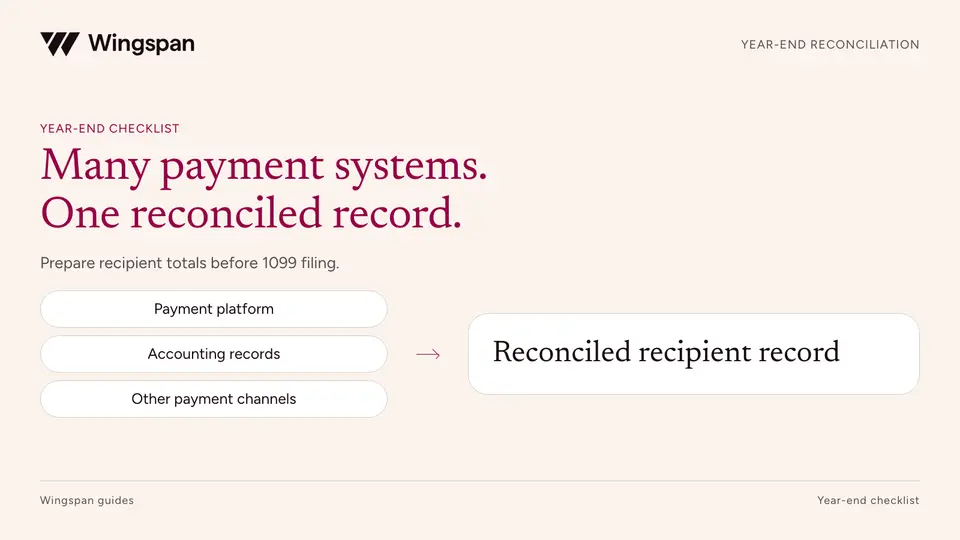
Reconcile contractor payments across platforms, AP, banks, and legacy systems with source registers, recipient mapping, and a reviewable bridge.
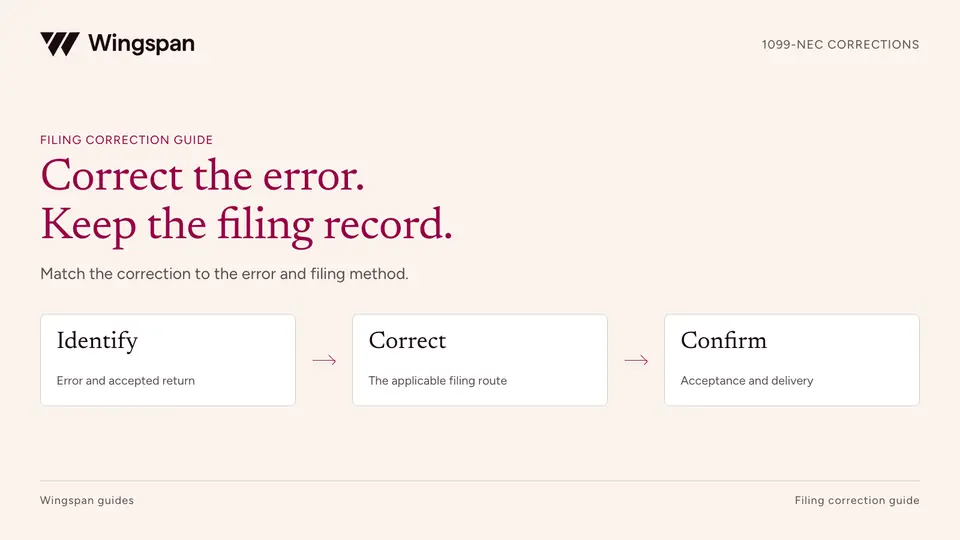
Correct a 1099-NEC by error type and filing method. Separate rejected submissions, recipient and payer errors, duplicates, and missing originals.