
Why contractors abandon onboarding: how to find and fix the drop-off
Diagnose contractor onboarding drop-off with consistent cohorts, stage definitions, waiting-time measures, and experiments that separate friction from no work.
Connect provider agreements, session outcomes, rate versions, cancellation decisions, and corrections to an understandable payment.
Pay independent therapists from a session ledger that preserves the agreed rate, attendance outcome, cancellation decision, and any later correction. The provider should be able to trace a payment to those decisions without receiving patient information in a general payment statement.
For a behavioral health network with hundreds or thousands of providers, the difficult part is often deciding which amount belongs in the next cycle. A session changes status after the export. A rate increase takes effect halfway through the week. A provider receives a cancellation fee, while the patient billing team makes a different decision about collections. A single weekly total hides all three.
Use the session ledger template, worked example, and worksheet instructions to define that handoff. All amounts and identifiers in the example are synthetic.
Keep the network's obligation to the therapist separate from what a health plan or patient owes the network. Store the provider agreement, earning event, due date, and amount in the compensation record. Keep claims submission, adjudication, and collection statuses in the billing workflow.
An insurance denial does not, by itself, tell an operator whether provider compensation changes. That decision depends on the agreement and applicable requirements. If compensation depends on collections, document the exact condition and have the appropriate legal and accounting owners review it. Avoid importing a generic claim status into a rule that reduces provider pay.
This workflow assumes the providers are appropriately engaged as independent contractors. The IRS explains that worker status depends on the actual relationship. A 1099 label or per-session fee does not resolve classification, and state requirements need their own review.
Give each appointment a durable session reference that survives rescheduling and corrections. Record the provider ID, contracting entity, service date, compensation category, applicable agreement version, and earning outcome. Preserve the relationship between an original appointment and its replacement so a reschedule cannot accidentally produce two ordinary session fees.
Separate the operational outcome from the compensation decision. "Canceled" describes an appointment. It does not explain whether the therapist receives the full fee, a partial fee, no fee, or an amount still under review.
| Appointment outcome | Compensation question | Evidence for the reviewer | Statement treatment |
|---|---|---|---|
| Attended | Which agreed session category and rate apply? | Completion record and rate version | Session fee and service date |
| Late cancellation | Does this event meet the provider's cancellation terms? | Relevant timestamps and rule version | Separate cancellation line |
| Provider cancellation | What does the agreement require in these circumstances? | Outcome and authorized decision | Decision or open exception |
| Rescheduled | Has any original appointment obligation already been created? | Linked original and replacement IDs | Payable event clearly identified |
| Outcome corrected after payment | What difference remains owed or requires review? | Original decision and correction evidence | Linked adjustment, not a rewritten past payment |
Use those rows as a decision design, not a universal cancellation policy. Define exceptions before launch, including outages, administrative scheduling errors, and situations requiring clinical or compliance review. Give reviewers a clear route to resolve ambiguity without editing payment totals directly.
A provider may have different rates for different services or an agreed change during a payment period. Store the unit and effective-date rule with each rate version. If your agreement applies a new rate to service dates beginning October 15, a session performed on October 14 keeps the earlier rate even if finance approves it on October 18.
Keep the old version available. A current-rate lookup can produce a plausible total while repricing historical sessions. That error may remain hidden until a therapist compares the statement with their agreement.
Test the boundary dates explicitly: the day before the change, the effective date, and a late-submitted session from the earlier period. For a retroactive amendment, document which sessions it covers and calculate the difference against amounts already recognized or paid. Do not create a second full session fee merely because the rate changed.
Suppose provider TH-014 has an agreement paying $90 for qualifying attended sessions before October 15 and $95 beginning October 15. Its cancellation provision pays $40 for an approved late-cancellation event. These are illustrative negotiated terms, not market rates or recommended clinical policies.
During the cycle, the network approves six attended sessions at the earlier rate, four at the later rate, and one qualifying late cancellation. It also confirms a $15 underpayment from a previous cycle.
| Component | Calculation | Approved amount |
|---|---|---|
| Six sessions before the rate change | 6 × $90 | $540 |
| Four sessions after the rate change | 4 × $95 | $380 |
| One approved late cancellation | 1 × $40 | $40 |
| Prior-cycle underpayment correction | Linked difference | $15 |
| Total approved for this cycle | $540 + $380 + $40 + $15 | $975 |
A second cancellation remains under review with a possible $40 fee. Keep it visible in the exception queue, outside the $975 approved total. This is a pending decision, not a finding that nothing is owed. The owner must resolve it in time to meet applicable payment obligations.
The example CSV includes each session separately. It also gives the adjustment its own ID and original-payment reference. Finance can consolidate the approved lines into one payable while retaining the detail needed to explain the amount.
If the open cancellation later qualifies, create its $40 payable from the existing session reference. The next export should see the earlier $975 obligations as already committed or paid and avoid picking them up again.
The payment team generally needs a reference, service date, compensation category, approved amount, and decision owner. It should not need therapy notes, diagnosis descriptions, patient names, or reasons disclosed during treatment.
Use restricted systems for supporting evidence and give authorized reviewers access according to your organization's privacy requirements. A coded session reference can still be sensitive when it can be linked to a person; replacing a name with an ID does not automatically de-identify a record.
HHS's minimum necessary guidance explains the general requirement to limit covered uses, disclosures, and requests for protected health information, as well as exceptions. Have privacy owners assess the actual data flow, permissions, and vendor arrangements before deciding what information belongs in each system.
Before releasing payments, keep the verified onboarding identity connected to the authorized recipient. Investigate conflicting identity or payment-destination changes through a controlled review, including possible stolen identity. Account naming can differ for valid sole-proprietor, trade-name, or entity arrangements; resolve the authorized payee rather than relying on a literal name match.
The statement should distinguish attended-session earnings, cancellation compensation, and prior-period adjustments. Show the service period separately from the payment-processing date. Include a reference that lets the provider question one line without sending a patient name through ordinary email.
Publish a correction route with an owner and response target. A provider disputing a rate needs the network's compensation decision maker. A provider asking about a transfer in progress needs payment-status support. The two teams should share the payment reference while keeping access to clinical evidence restricted.
Octave's customer story describes how a lack of itemized invoices created provider questions and how the company sought a more consistent payment experience. Ask a provider to explain a sample statement before treating your payment workflow as complete.
Before expanding the workflow, run a small synthetic cycle containing a reschedule, a rate boundary, an unresolved cancellation, and a correction after payment. Operations should reproduce the approved amount. Finance should reconcile it to the payable. A provider reviewer should understand the statement without accessing another person's records.
Measure the number of approved sessions missing from the run, unresolved compensation decisions past their internal deadline, and payment questions per 100 paid providers. Separate amount questions from transfer-status questions so the next improvement addresses the actual failure.
We connect engagements, work records, rates, and decisions in our work and approval workflow. For a US company paying a large recurring provider network, that connection gives payment operations and contractor support the context behind each approved amount. Configure the source-system handoff around your compensation rules and privacy boundaries.
Bring a sample session cycle to a Wingspan demo, including a rate change and a cancellation exception. Ask to follow each approved line into the provider's payment detail.
This isn't tax or legal advice. Consult a qualified professional about classification, privacy, and payment obligations. Sources checked October 20, 2026.
Diagnose contractor onboarding drop-off with consistent cohorts, stage definitions, waiting-time measures, and experiments that separate friction from no work.
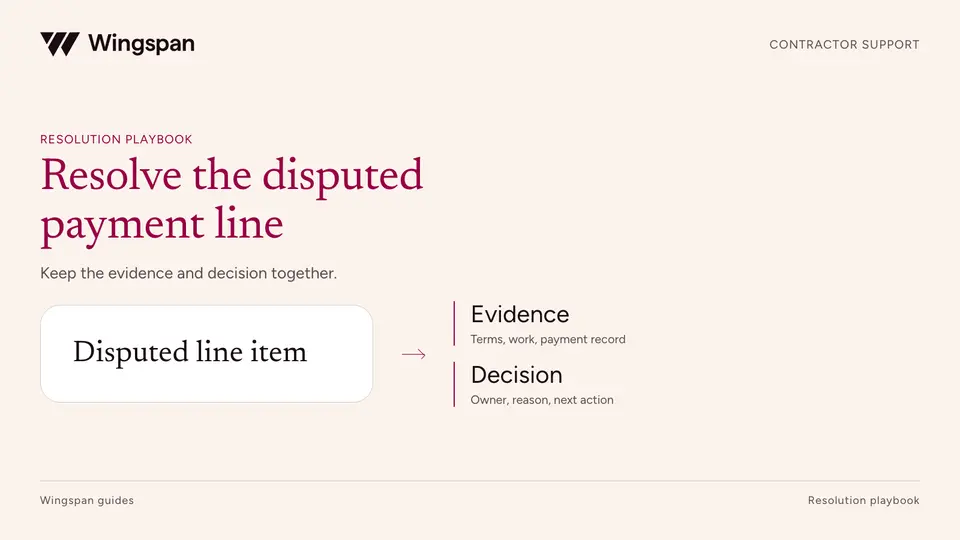
Resolve contractor pay disputes with clear intake, evidence, ownership, and adjustment records while keeping undisputed amounts and payment deadlines visible.
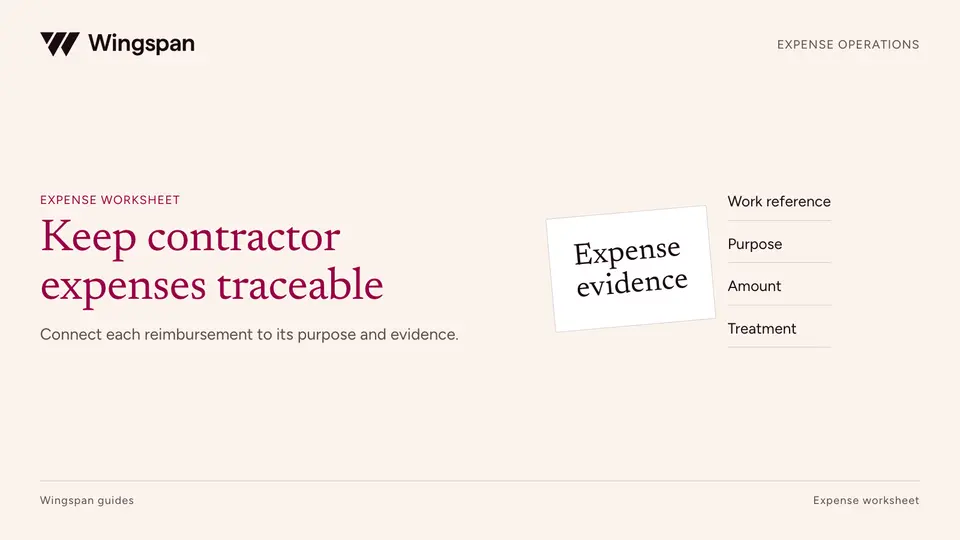
A field-network workflow for expense terms, mileage evidence, material receipts, returns, payment lines, and separate tax and accounting decisions.