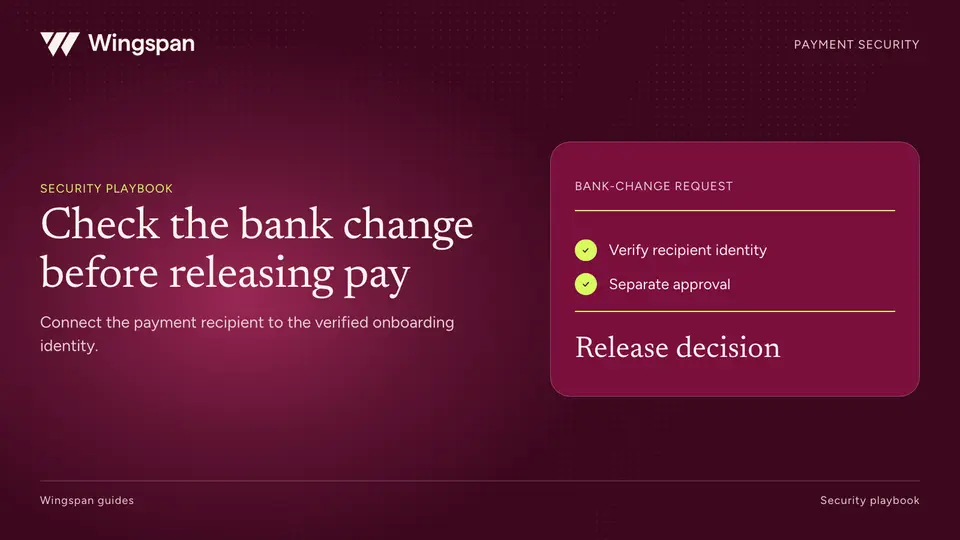
Contractor payment security: preventing fraud when bank details change
Build a bank-change control process for contractor payments, with verification steps, release checks, incident ownership, and a practical tabletop exercise.
Resolve contractor pay disputes with clear intake, evidence, ownership, and adjustment records while keeping undisputed amounts and payment deadlines visible.
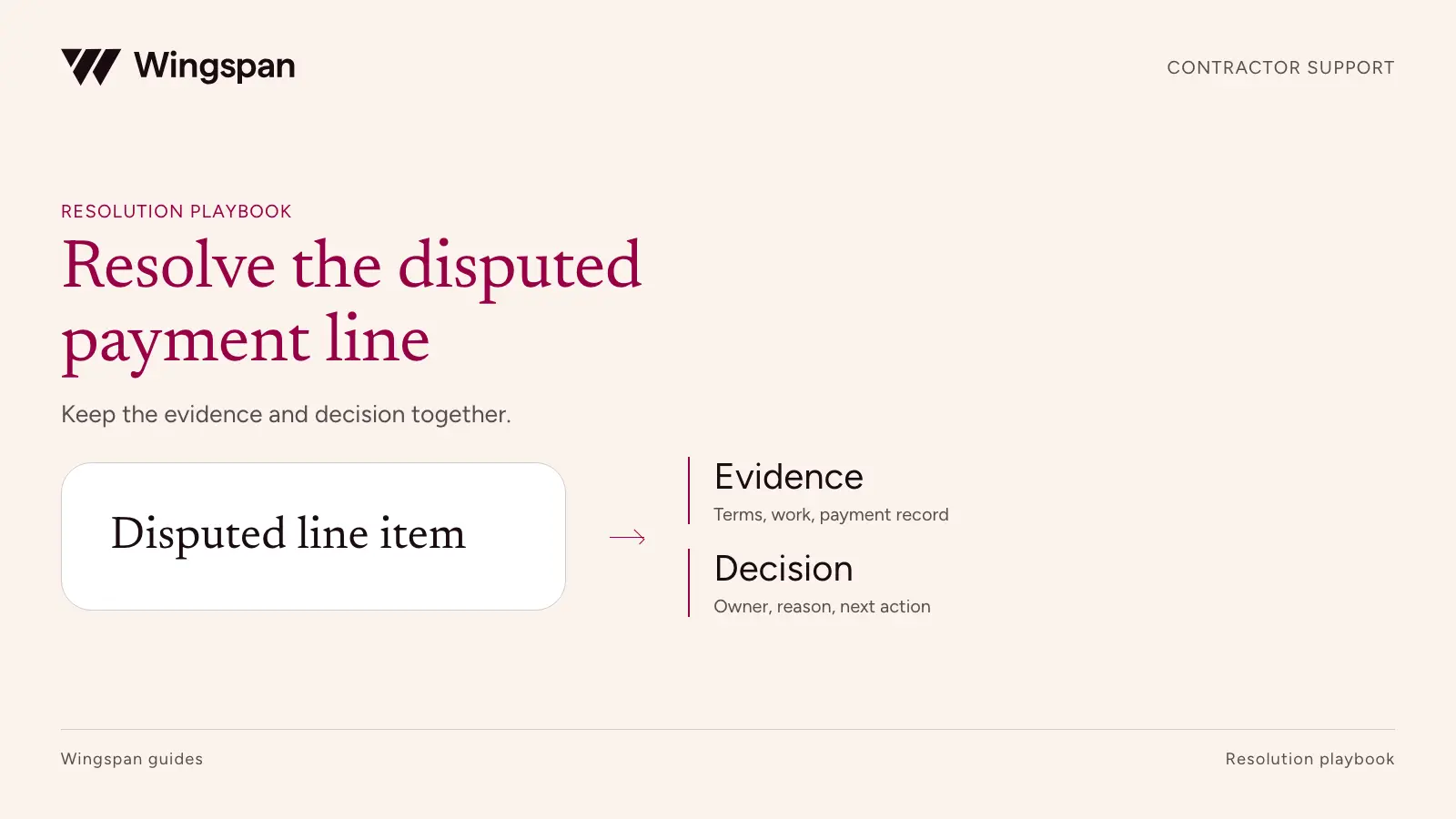
Resolve a contractor pay dispute by identifying the exact amount or payment in question, assigning the decision to the right owner, and preserving the records behind the outcome. Separate a disagreement about earnings from a disagreement about accepted work and from a payment that did not arrive. Each needs different evidence and a different next action.
For a large contractor network, a shared inbox can become a second payment ledger. An account manager promises a correction, AP releases an adjustment, and the work system still shows the original amount. A shared case record helps the team reconcile those decisions before releasing an adjustment.
Use the case-intake template, worked dispute, and evidence and escalation matrix, supported by the worksheet instructions. The documents use synthetic references and are designed for the company resolving the issue.
Start with the contractor's description in their own words. Then identify which record or decision is contested. One message may contain more than one issue, so create linked components where necessary instead of forcing everything into one broad status.
| Issue | Core question | Decision owner | Useful evidence |
|---|---|---|---|
| Amount or rate | Was the agreed calculation applied correctly? | Operations and authorized finance reviewer | Rate version, units, approved adjustments |
| Work acceptance | Did the deliverable satisfy the applicable agreement? | Authorized service or quality reviewer | Submitted version, criteria, review and change history |
| Reimbursement | Was the expense agreed and supported? | Expense-policy owner | Agreement, receipt reference, work connection |
| Payment delivery | Where is the already-approved payment? | Payment operations and provider | Attempt reference, bank/provider status, trace |
| Contract or legal interpretation | What obligations and remedies apply? | Legal or designated counsel | Agreement, jurisdiction, correspondence, deadlines |
A contractor saying "you underpaid me" could mean the wrong rate, a missing assignment, an authorized deduction they don't recognize, or a payment they cannot locate. Confirm the issue before asking them to resend documents already on file.
If money was sent but has not arrived, investigate the payment attempt. That does not automatically reopen the decision about what the work was worth. If the amount is wrong and delivery also failed, link the two investigations so the replacement reflects the reviewed obligation.
Record the contractor and engagement IDs, payer entity, work or invoice reference, amount claimed, amount already approved, amount paid, and the specific disputed component. Those amounts may differ, so give them separate fields.
Add the date received, relevant contractual due date, case owner, next update time, evidence references, and decision authority. Keep sensitive client information, bank details, and identity documents in restricted systems. The case record needs a pointer to evidence, not copies of every underlying document.
Acknowledge the issue with a useful next step. For example: "We are reviewing inspection W-612 against the accepted submission and the rate effective on the service date. Morgan in operations owns the decision. We will update you by the agreed case-review time." Use a real date and owner in the live communication.
Avoid promising a payment or denying a claim before the authorized reviewer has examined it. Equally, don't require the contractor to restate the issue to each team. The intake record should travel with the case.
The reviewer needs the terms that applied when the work was agreed or performed, as appropriate under the contract. Today's rate card may not answer last month's question. Preserve effective dates, accepted changes, and the source of the original amount.
For work-acceptance disputes, record which version was submitted, what criteria applied, who reviewed it, and what correction was requested. Distinguish a missing file from a rejected deliverable and distinguish a correction from newly requested paid work. Don't assume every revision is unpaid.
For adjustments, retain the original amount and create an approved correction record. Silently overwriting the original payable makes it difficult to explain what changed or to identify a duplicate adjustment later.
The work-to-approved-payment guide provides the underlying approval structure. A dispute adds a dated review of a specific contested component and a documented outcome.
A disagreement about one assignment should not automatically freeze an entire contractor balance. Identify the undisputed amount and have the authorized owner apply the contract and applicable payment requirements. Document the treatment of each component and the reason.
Laws can impose protections beyond an internal policy. For example, New York's Freelance Isn't Free Act guidance describes contractual protections and an enforcement process for covered freelance work. Coverage and obligations depend on the circumstances. Have counsel identify applicable state, local, and industry rules rather than assuming a single national dispute timeline.
An internal review target is also different from a legal or contractual payment deadline. Track both. Escalate before a deadline is missed, and don't label an amount "disputed" merely because the review team lacks capacity.
Likewise, a possible overpayment does not create an unrestricted right to deduct from unrelated future earnings. Have the proper owner determine whether recovery or an offset is permitted and how to document it.
Consider a synthetic inspection network. Contractor C-615 submits 12 inspections at $100 each and an agreed, supported $80 mileage amount. The claimed total is $1,280. Operations has accepted 11 inspections and the mileage, making $1,180 approved. One $100 inspection remains contested because the reviewer could not find the final attachment.
Finance keeps the $1,180 approved amount visible and follows the agreed payment terms for it. The case records $100 as the disputed component. The entire $1,280 is not placed into a single unexplained hold.
The contractor provides the submission reference. Operations finds that the final attachment was received before cutoff but associated with the wrong review record. The authorized reviewer accepts the inspection and approves an additional $100. The decision points to the original work ID and the evidence of timely submission.
The final approved total is $1,280: $1,180 previously approved plus the $100 correction. If the first amount has already been paid, the adjustment is $100, not another $1,280 payment. If it has not been paid, finance decides how to include both components in the authorized run without duplicating either.
Apply the agreement and applicable law when deciding how to handle the contested amount.
A reviewer accepting a claim is one milestone. Finance updating the obligation, approving the correction, executing the payment, and confirming the outcome are later milestones. Use distinct statuses so support can explain what remains.
For a denied or partially accepted claim, communicate the decision and relevant evidence clearly, along with the approved escalation route. Preserve the contractor's response and any subsequent review. A case marked closed internally does not eliminate external rights or remedies.
At close, check that the work system, payable, adjustment, payment record, and contractor communication agree. The payment reconciliation checklist helps finance track the accounting effects without counting the same correction twice.
Review recurring causes by disputed component and final outcome. A recurring rate-version error calls for a different fix from missing attachments or delayed payment tracing. Report open-case age and overdue updates alongside case counts so faster closure does not conceal unresolved work.
Our work and approval workflow connects assignments, terms, and review decisions. Your operations and finance teams can use that context when investigating a disputed rate or work item, then trace the approved correction through to payment.
Bring a rate disagreement, a partially accepted batch, and an approved correction to a Wingspan demo. Ask operations and finance to trace each case from the original agreement to the final payment record and the explanation the contractor receives.
This isn't legal advice. Consult a qualified professional about your contracts, payment obligations, and dispute procedures.
Build a bank-change control process for contractor payments, with verification steps, release checks, incident ownership, and a practical tabletop exercise.
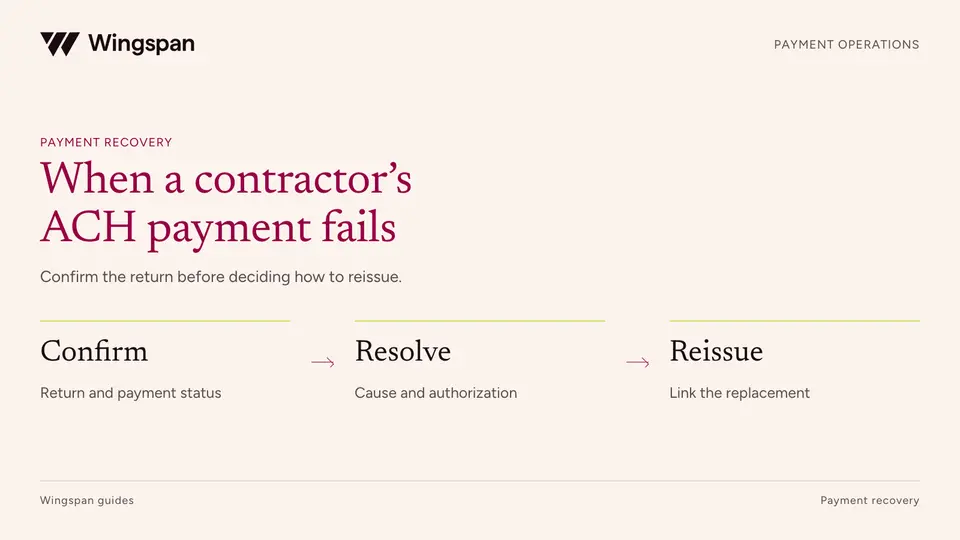
Investigate failed contractor ACH payments, distinguish payout returns from funding failures, trace the funds, and link replacements without duplicate pay.
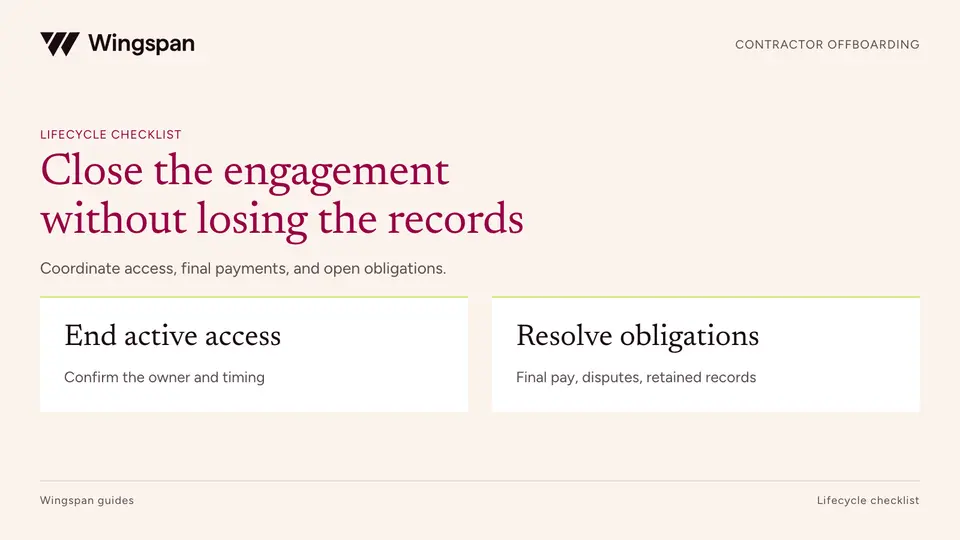
An engagement closure workflow that keeps work, money, access, and continuing records responsibilities separate, with a final-obligation register and worked example.