Paying contractors across multiple legal entities: a control checklist for finance
Keep contractor agreements, funding, approvals, accounting, and tax-reporting responsibilities aligned across legal entities with a practical control map.
A field-network workflow for expense terms, mileage evidence, material receipts, returns, payment lines, and separate tax and accounting decisions.
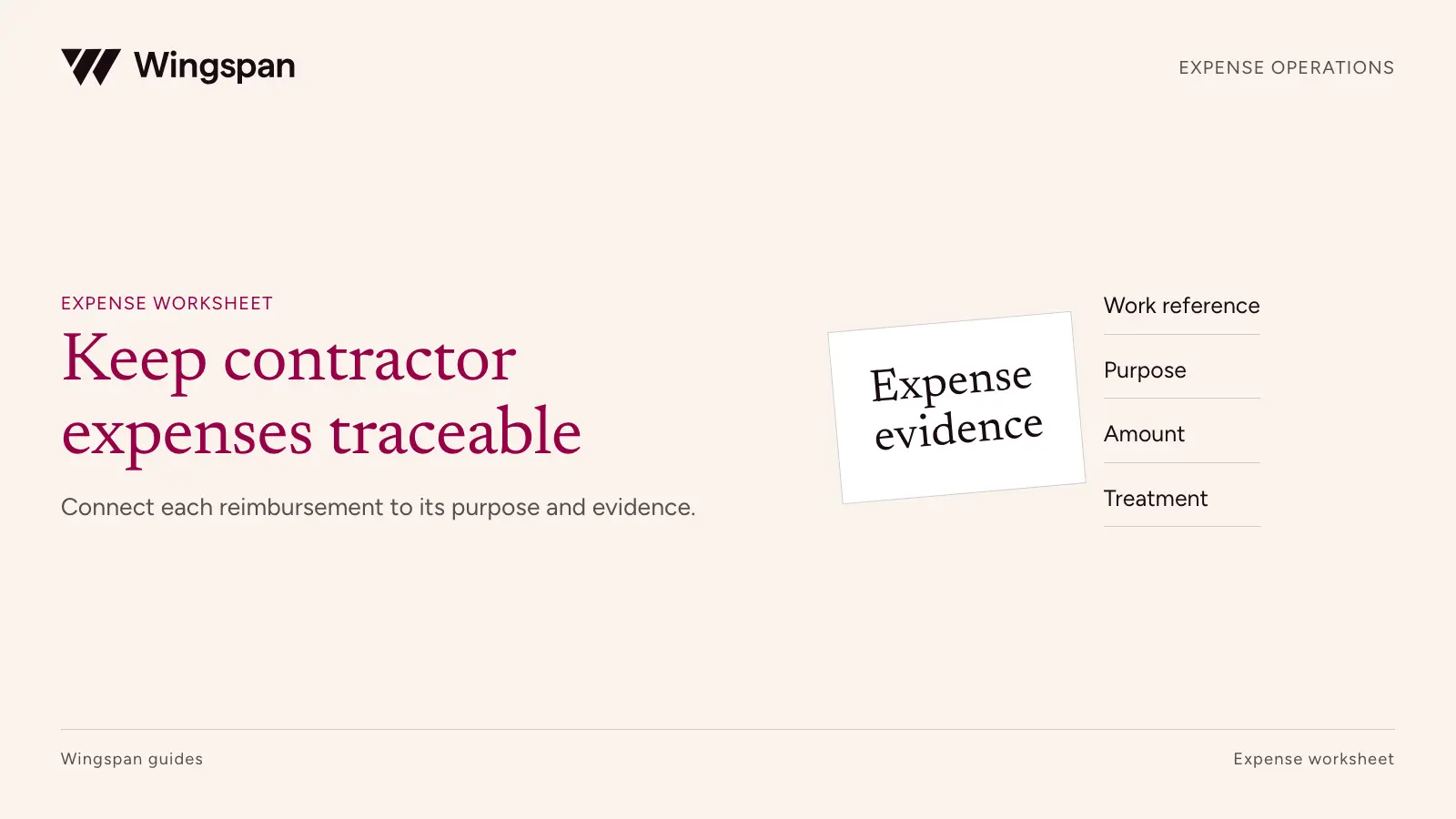
A contractor reimbursement should connect six things: the agreed expense terms, the related work, evidence of the expense, the approved amount, the payment line, and the tax or accounting decision. A separate line labeled "reimbursement" makes a statement clearer. It does not, by itself, establish that the amount is excluded from tax reporting.
For a field-service network paying hundreds or thousands of contractors, the useful control is a consistent record for each expense. It should explain what was requested, what was approved, what remains unresolved, and where the money went.
Download the expense ledger template, worked example, and policy decision register. Read the worksheet instructions before adapting the fields to your network.
This guide covers US payer operations, with tax sources checked October 20, 2026. It isn't tax or legal advice. Consult a qualified professional about reporting, deductibility, and payment obligations under your arrangements.
Document which costs the agreed service fee covers and which expenses the company will separately review. A flat inspection fee, a mileage allowance, and reimbursement of purchased materials are different commercial arrangements. Don't assume the contractor shares your interpretation of an expense category.
The terms should identify the applicable rate or actual-cost rule, approval authority, evidence needed, submission method, and handling of exceptions. Record the effective date and version. If a rate changes, the reviewer needs to know which work or expense date determines the applicable version.
Describe any preapproval rule and the route for an urgent purchase. A contractor who buys an unexpected part to complete an authorized job needs a way to explain the circumstances. Whether payment is owed depends on the agreement and applicable law; an internal workflow status is not a legal conclusion.
Keep the contractor's obligations distinct from employee reimbursement policies. The IRS discusses independent contractors and clients in Publication 463, including adequate accounting for certain expenses. Copying an employee policy and changing the word "employee" doesn't resolve the tax treatment of a contractor arrangement.
A receipt supports a purchase, but it may not establish which job used the item or who agreed to pay for it. A route record supports travel, but it doesn't explain whether that travel is covered by the service fee. The reviewer needs both the commercial terms and the underlying facts.
| Payment line | Evidence to request | Decision to record |
|---|---|---|
| Service fee | Accepted work record and agreed rate version | Amount earned for the service |
| Mileage | Trip date, business purpose, distance, related assignment, applicable rate | Eligible distance and agreed amount |
| Materials | Itemized receipt, work reference, approval, allocation if shared | Accepted items, quantity, amount, and any return credit |
| Toll or parking | Expense date, supporting record, work connection | Whether covered separately under the agreement |
| Flat travel allowance | Agreed allowance terms and relevant work facts | Contract amount plus separate tax/accounting treatment |
| Expense advance | Authorization, amount advanced, later substantiation | Applied amount and unresolved balance |
Use operational references rather than unnecessary personal details. A work-order ID usually belongs in the ledger. A customer's medical information or a full residential access record usually does not. Store supporting documents with access appropriate to their contents.
Specify whether the agreement uses a fixed rate, an actual-cost approach, or a referenced schedule. If it references an external schedule, define which year's rate applies and how changes take effect. Avoid a spreadsheet cell called "current rate" that silently rewrites older trips.
The IRS publishes standard mileage rates for tax purposes. That published rate should not be treated as the automatically agreed payment rate for every contractor relationship. Review your contract and applicable requirements separately.
Capture enough detail to explain the accepted business travel without requesting unrelated location history. If one trip serves several assignments, define the allocation and prevent each work order from claiming the full distance. A 100-mile trip allocated 60 miles to one job and 40 to another should remain a 100-mile total.
Allow a reviewer to distinguish an incorrect distance from an unauthorized trip or a missing record. Those problems need different follow-up. "Rejected mileage" is too broad to tell the contractor how to resolve the issue.
Link each submitted receipt to the relevant expense line. When a receipt contains items for several jobs, allocate the amounts explicitly. If some items are for the contractor's own use or another customer, don't assign the entire receipt to your work order.
Record returns, discounts, and credits against the original expense. If an item was already paid and later returned, preserve the original payment and create a separately reviewed adjustment. Don't overwrite the paid amount or silently subtract the credit from an unrelated future service fee.
Duplicate review should compare more than receipt filenames. Two photos can show the same purchase, while one legitimate receipt can support allocations across multiple jobs. Use receipt reference, merchant, date, total, and prior allocations as review evidence. The decision still needs a person or an approved process capable of handling those distinctions.
For advances, keep the amount sent separate from expenses later approved. An advance is not a second reimbursement when receipts arrive. Reconcile the approved use, any remaining amount, and the agreed resolution before closing it.
The following figures are synthetic. A property-services contractor completes work order WO-204. The agreed service fee is $450. The company separately approves 80 miles at an illustrative contract rate of $0.60 per mile, plus $126.40 of materials. The $0.60 rate is an example, not a statement of the IRS rate.
| Line | Requested amount | Approved amount | Explanation |
|---|---|---|---|
| Service | $450.00 | $450.00 | Accepted work at agreed fee |
| Mileage | $48.00 | $48.00 | 80 approved miles × $0.60 |
| Materials | $126.40 | $126.40 | Supported purchase for WO-204 |
| Total before return | $624.40 | $624.40 | Original approved obligation |
| Material return credit | -$26.40 | -$26.40 | Documented return before payment |
| Net obligation | $598.00 | $598.00 | Original amount less approved credit |
The final expense component is $148: $48 of mileage plus $100 of net materials. The service component remains $450. The ledger preserves all four lines and connects the credit to the original materials line.
Assume the return is documented before any payment is released. The company can then approve the $598 payment under the agreed process. If $624.40 had already been paid, the register would instead show an open $26.40 recovery or adjustment decision. The example doesn't authorize unilateral deductions from later work.
The tax classification field remains pending specialist review in the worksheet. The arithmetic establishes the commercial amount; it doesn't settle the information-return treatment.
Publication 463 explains that contractors receiving reimbursement or allowances for travel or gift expenses incurred for a client should adequately account to the client. It also describes client recordkeeping when expenses are accounted for and reporting implications when they are not. Those rules concern the expenses and circumstances covered by the publication; they are not a blanket exemption for every item called a reimbursement. See Publication 463, chapter 6.
Have the tax or accounting owner document the applicable treatment by category and arrangement. Include the facts reviewed, effective period, and evidence reference. Materials, allowances, and travel may require different analysis. Don't promise a contractor that an amount is tax-free merely because you display it separately.
Keep commercial approval, general-ledger coding, and information-return treatment as distinct decisions. A line can be approved for payment while a tax specialist is still confirming how it belongs in year-end reporting. Set an owner and resolution deadline for that review so unresolved classifications don't accumulate until filing.
The contractor should be able to trace each expense to a work reference and see any adjustment reason. Finance should be able to trace the same lines to the payment and its accounting record. Use the contractor payment reconciliation checklist for the wider close process.
Safeguard Properties' customer story describes how its team consolidates work-order-related invoices before sending them to us for payment. Keeping the underlying expense and service records clear matters when those invoices become a consolidated payment.
We support reimbursable expenses as line items, with treatment set by your tax and accounting owner. For a network with recurring service and expense payments, bring the worked ledger to a Wingspan payment-workflow demo. Ask to trace a service line, mileage line, receipt reference, prepayment credit, and later adjustment through your proposed workflow. Agree on the approval and accounting owners before using the process across the network.
Keep contractor agreements, funding, approvals, accounting, and tax-reporting responsibilities aligned across legal entities with a practical control map.
Preserve assignment acceptance, fee versions, return-visit decisions, and travel amounts through inspector approval and payment.
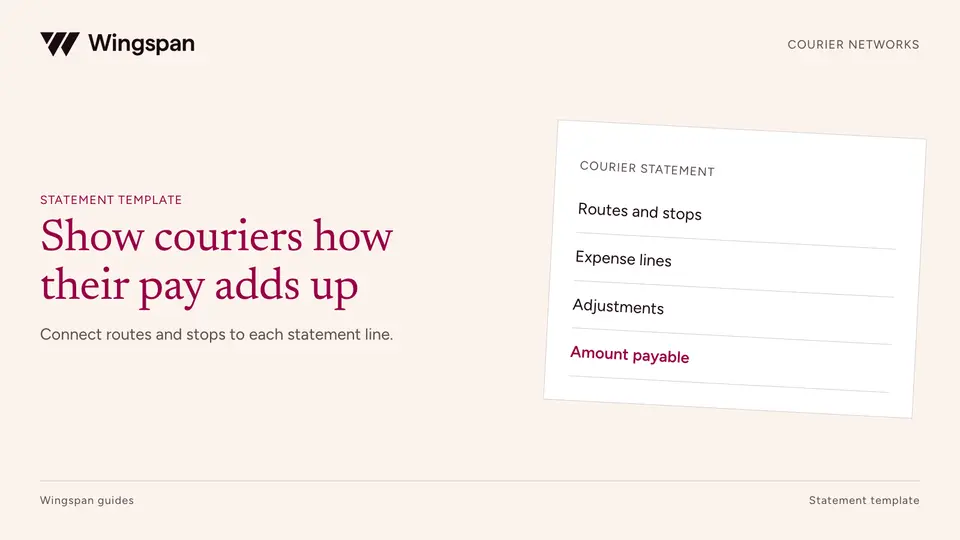
Specify route-to-statement records that explain base fees, extra stops, approved expenses, corrections, and payment status.