Contractor turnover: how to calculate replacement cost and lost service capacity
A decision model for estimating contractor replacement resources and service capacity lost during a departure, with explicit demand and coverage assumptions.
Diagnose contractor onboarding drop-off with consistent cohorts, stage definitions, waiting-time measures, and experiments that separate friction from no work.
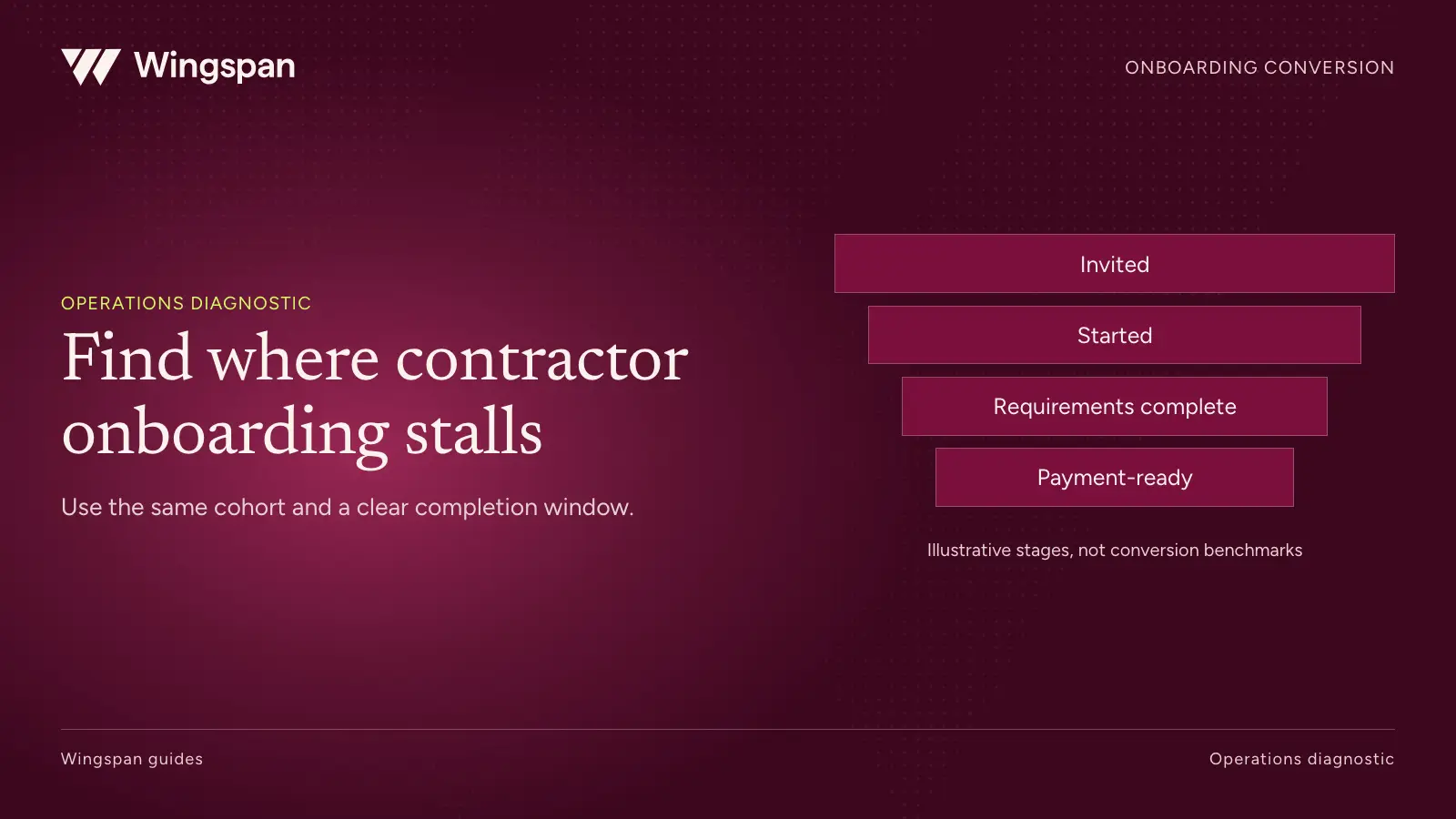
To find contractor onboarding drop-off, follow a defined invitation cohort through submitted information, verified readiness, first assignment, and first approved work. Measure each transition within a consistent time window, then separate contractor inaction from internal review delays, eligibility decisions, and a lack of available assignments.
A single completion rate can hide those differences. If a contractor has finished every required step but has not received work, another reminder to complete onboarding will not help. If submitted documents are waiting for review, the next action belongs to your team.
Use the cohort worksheet template, worked funnel example, and experiment log, with the measurement instructions. The examples are synthetic and contain no applicant information.
Choose milestones that represent a meaningful change in readiness. A page view is useful for diagnosing interface problems, but it does not establish that the contractor submitted a requirement or became eligible for an assignment.
Use the following starting definitions, then adapt them to your network. Record a version so a later process change does not silently alter the historical measure.
| Milestone | Evidence that counts | What it does not prove |
|---|---|---|
| Invitation sent | First valid invitation for the intended engagement | Message delivered, opened, or accepted |
| Invitation accepted | Contractor accepted the invitation in the authenticated process | Required information submitted |
| Required information submitted | All defined submission tasks completed | Documents reviewed or accepted |
| Ready for assignment | Applicable requirements reviewed and satisfied | Work is available or has been offered |
| First assignment accepted | Contractor accepted an actual assignment | Service completed or approved |
| First approved work | First delivered work accepted under the engagement | Payment received |
Count one contractor-engagement onboarding episode per record, and store the contractor ID, engagement ID, event timestamp, and relevant requirement version. Keep returning contractors in a separate reactivation cohort where the path differs. Sending three reminders should not create three new invited people.
Our requirements and eligibility documentation separates requirement submissions, reviews, and payment eligibility for each engagement. Receiving a document and accepting it are different events. Define readiness for an assignment with your operations team; payment eligibility alone does not establish that every requirement for starting work is satisfied.
Define a cohort using a stable entry event, such as the first valid invitation during a particular week. Choose an observation window that fits the work, then wait until every member has had that much time before comparing completed cohorts.
For example, a 30-day measure counts milestones reached within 30 elapsed days of each contractor's invitation. An invitation sent yesterday has not had the same opportunity as one sent a month ago. Show recent cohorts as still maturing instead of treating their unfinished records as abandonment.
Keep event order consistent. A new contractor funnel may require invitation acceptance before submission and readiness before assignment. Your analytics tool's configuration matters: Amplitude's funnel documentation distinguishes ordered and unordered conversion paths. Confirm the setting rather than relying on a chart title.
For stage conversion, divide the number reaching the next stage by the number reaching the preceding stage within the same cohort window. For overall activation, divide first-approved-work count by invited count. Neither number alone identifies why someone stopped.
Consider a synthetic cohort of 200 new contractors, all observed for 30 days after invitation. Each person appears once, and every stage is nested within the preceding one.
| Milestone reached within 30 days | Contractors | Conversion from previous stage |
|---|---|---|
| Invited | 200 | Not applicable |
| Accepted invitation | 170 | 85.0% |
| Submitted required information | 150 | 88.2% |
| Ready for assignment | 130 | 86.7% |
| Accepted first assignment | 90 | 69.2% |
| First approved work | 72 | 80.0% |
Overall activation is 72 divided by 200, or 36%. That does not mean 64% abandoned onboarding. Among the 40 ready contractors who had not accepted an assignment, an illustrative case review finds that none had received an eligible offer. The operational issue is matching or demand, not missing documents.
The 20 submitted contractors who had not reached readiness also need separate explanations. Suppose 10 were awaiting internal review and 10 did not satisfy an eligibility requirement. Increasing reminder frequency would address neither group. A review-capacity change could address the first, while the second requires an appropriate decision and communication.
The counts show where to investigate. The case review supplies the reason. Keep unknown reasons visible instead of categorizing every silent record as a contractor's choice.
Record the time entering and leaving each stage. Separate time awaiting contractor action from time awaiting internal review. Where multiple requirements run in parallel, avoid adding overlapping durations and presenting the sum as total elapsed time.
Report the median and a slower-tail measure for completed transitions, plus the count and age of still-open cases. A quick median can coexist with a small group waiting weeks. A completion-time calculation that excludes unfinished records should say so.
Break results down by meaningful operating differences: engagement type, invitation source, required checks, region, or reviewer team. Small groups can fluctuate sharply, so show counts beside percentages. Avoid ranking teams whose populations have materially different requirements.
First-payment issues belong in the follow-through too. A contractor who starts work quickly but then encounters a wrong rate or payment setup problem has not experienced a successful handoff. Link that investigation to the onboarding checklist without changing the definition of your original funnel after seeing the results.
For invitation problems, inspect delivery failures, duplicate invites, confusing sender names, and unclear expectations. For submission problems, review the exact task, device experience, help content, and secure support route. Ask contractors what they were trying to do before deciding which screen to redesign.
For internal review queues, examine arrivals, reviewer capacity, and requests for repeated information. For ready contractors without assignments, investigate available work and matching criteria with network operations. Faster document collection cannot create service demand.
BELAY's onboarding webinar describes using Fountain for self-paced information modules and Wingspan for administrative, contract, and payment onboarding. The connected process showed who was ready to start and which steps remained. BELAY reported reducing its onboarding-to-client-start process from 27 days to 11 days across that workflow.
Write the hypothesis before launch. For example: showing the exact missing requirement and a clear support path will increase submission within 30 days among invited contractors who face that requirement. Define the eligible population, assignment method, observation window, and primary outcome.
Where practical, compare similar eligible groups during the same period. If you cannot randomize, document differences in recruiting source, requirements, and work availability. A before-and-after improvement can reflect those changes as well as the intervention.
Include safeguards such as review quality, support volume, and first-payment exceptions. Removing a required review can raise completion while creating problems elsewhere. Preserve a clear reason for every requirement and have the appropriate owner approve any change.
We connect onboarding requirements and review decisions to payment eligibility for each engagement. That gives your team a way to distinguish a submitted requirement from an approved one when investigating a stalled onboarding case. Bring one mature cohort and three stalled cases to a Wingspan demo. Ask the team to show who owns the next action and what evidence tells you the contractor is ready.
A decision model for estimating contractor replacement resources and service capacity lost during a departure, with explicit demand and coverage assumptions.
A post-launch operating plan for identifying payment workarounds, measuring approved-route adherence, and improving recurring workflows over 30, 60, and 90 days.
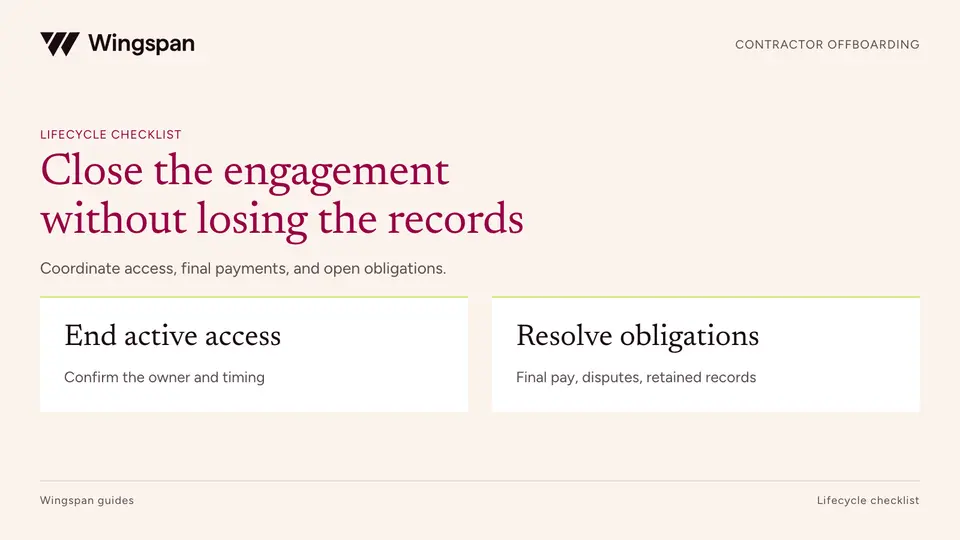
An engagement closure workflow that keeps work, money, access, and continuing records responsibilities separate, with a final-obligation register and worked example.