State 1099-NEC filing requirements: a 2026 planning reference
Plan 2026 state 1099-NEC filing with a sourced 50-state and DC reference, filing-route checks, and a worksheet for unresolved requirements.
Connect work orders, subcontractor records, payment channels, and reporting decisions before 1099-NEC filing for property-services networks.
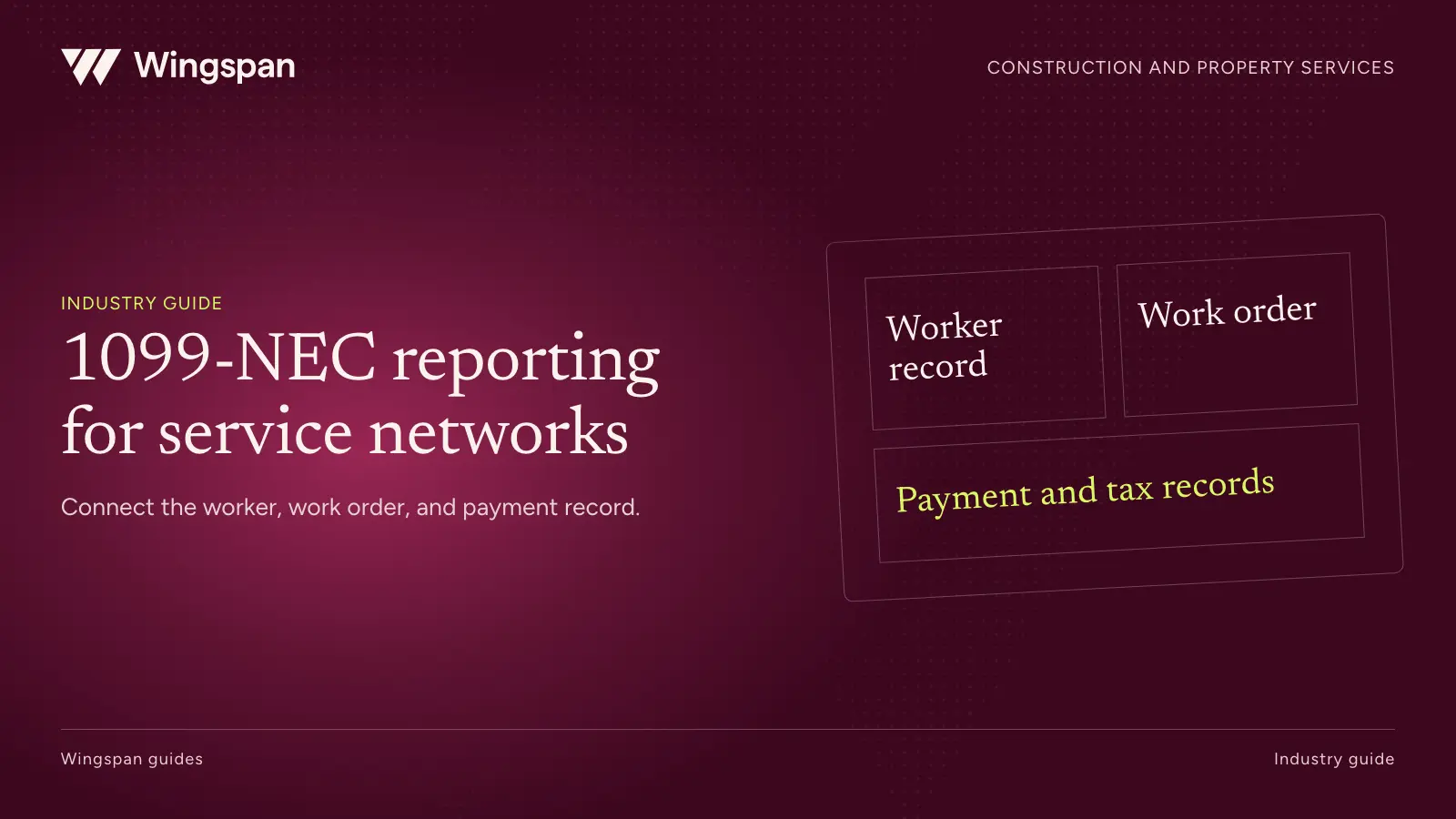
Payments for a subcontractor's repair, inspection, or maintenance services generally belong in the 1099-NEC review. Rent paid over to a property owner belongs in a separate 1099-MISC rents review. Property-services businesses often handle both, so classify the payment before choosing the form.
Your work-order system knows which property was serviced. Your payment system knows which vendor was paid. To prepare a reliable 1099, finance needs to connect both records to the correct tax recipient and reporting payer.
That connection gets harder when one subcontractor has several vendor codes, a work order includes materials, or an emergency payment bypasses the normal AP process. The fix starts during onboarding and continues through each payment run.
This guide is for businesses paying construction, maintenance, inspection, and property-services networks. Federal guidance was rechecked October 19, 2026. This isn't tax or legal advice. Consult a qualified professional about your reporting obligations, including state requirements and worker classification.
| Payment | Starting form review | Responsibility check |
|---|---|---|
| Nonemployee repair, maintenance, inspection, or management services | 1099-NEC | Confirm the reportable recipient, payment year, and applicable exceptions |
| Rent paid over to a property owner | 1099-MISC, rents | The IRS specifically assigns reporting to the real estate agent or property manager in covered arrangements |
| A payment combining service fees, rent, and other owner-account movements | Separate the components before form selection | Determine what each amount represents and who must report it |
| Payment-card or qualifying third-party network settlement | Section 6050W / 1099-K review | Confirm the settlement entity's reporting responsibility before including it on NEC or MISC |
The IRS distinguishes rent paid to a real estate agent or property manager from the agent's or manager's payment of that rent to the property owner. A net owner distribution may also include fees, reserves, or reimbursements, so its bank-transfer total alone does not establish the rent amount to report. Use the IRS rent and payment-on-behalf-of-another instructions to review the underlying arrangement.
For ordinary reportable nonemployee service payments made in 2026, the federal 1099-NEC reporting threshold is generally $2,000. The prior $600 threshold applies to payments made before 2026. Special rules and exceptions still matter, and federal backup withholding can require a return regardless of the payment total. IRS reporting requirements.
A 1099-NEC reports nonemployee compensation. It doesn't establish that the worker is properly classified as an independent contractor. Resolve classification before relying on a contractor payment process.
Form 1099-DA is a different form for digital asset proceeds from broker transactions. A construction business doesn't choose 1099-DA because its payments are digital or because an AP application supports cryptocurrency. If a payment involves digital assets, have your tax owner assess the actual transaction and obligations. IRS Form 1099-DA overview.
For the broader form distinctions, see our 1099-NEC, 1099-MISC, and 1099-K guide.
A property address is a work identifier. It isn't a tax recipient. Likewise, a branch vendor code doesn't necessarily represent a separate taxpayer.
Give each record its own stable ID, then preserve the links:
| Record | What it establishes | Fields worth retaining |
|---|---|---|
| Contractor and tax profile | Who contracted to provide the service and who the reporting recipient is | Contractor ID, legal/tax name reference, document reference, classification review status |
| Work order | What the business approved | Work-order ID, property or project ID, service type, service dates, approving owner |
| Payable | What the company owes | Payable ID, work-order links, payer entity, line amounts, adjustment references |
| Payment and reporting record | What was paid and how it is treated | Payment ID, channel, amount, payment evidence, recipient mapping, reporting decision |
Protect tax documents and identifiers with appropriate access controls. The operational ledger can use a restricted recipient reference rather than displaying a full TIN on every work-order export.
If a subcontractor uses five vendor codes for five regions, keep those codes for operations. Map them to the reviewed tax recipient in the reporting layer. Don't merge solely because two names look similar, and don't split one recipient's total because branches use different spellings.
Emergency work is common in property services. A storm creates assignments before the ordinary onboarding queue has caught up. Define an exception process in advance so the dispatcher doesn't become the tax reviewer.
The exception record should identify the requested contractor, contracting party, business reason, missing item, accountable approver, and required follow-up. Finance or the tax owner determines how any incomplete documentation affects payment handling. A note that says "urgent" doesn't resolve that decision.
Ask the contractor to provide the appropriate tax information through the approved collection channel. A business name ending in "LLC" doesn't tell AP whether the entity is taxed as a corporation, partnership, or disregarded entity. Use the actual documentation and qualified review. Our W-9 collection guide covers the US document workflow.
Reopen the record when a contractor changes legal entity or tax status. Updating the bank destination alone shouldn't silently change the tax recipient. Conversely, the fact that a bank account stayed the same doesn't prove the recipient is unchanged.
A service invoice may contain labor, supplies, disposal, travel, and an equipment charge. Preserve the lines so the tax reviewer can apply the correct treatment. Don't assume that a line labeled "reimbursement" is automatically excluded.
The IRS's Form 1099-NEC instructions include parts and materials supplied in connection with nonemployee services. Pure merchandise payments and certain other categories have different rules. The reporting treatment depends on the transaction, not the label your work-order application exports. IRS instructions for Forms 1099-MISC and 1099-NEC.
Here is an illustrative review ledger. The amounts are invented for workflow design, not tax determinations.
| Entry | Operational amount | Evidence finance needs | Reporting review |
|---|---|---|---|
| Roof-repair service with associated materials | $2,800 | Invoice lines and approved work order | Review as service compensation, including connected materials as applicable |
| Separate purchase of inventory from a supplier | $650 | Purchase order and supplier invoice | Assess merchandise treatment separately |
| Approved work still unpaid at year-end | $900 | Payable and payment history | Don't treat an accrual alone as proof of payment |
| ACH rejected and later reissued | $1,200 | Failed transaction and successful replacement link | Prevent counting both attempts as two payments |
| Payment by corporate card | $750 | Card record and settlement arrangement | Review section 6050W reporting responsibility before including in NEC total |
The review column intentionally doesn't produce a universal taxable total. Its purpose is to make the evidence and decision visible.
A busy network may pay through its contractor platform, AP, corporate cards, paper checks, and a legacy system acquired with another business. Inventory every channel, including the ones used only for exceptions.
For each channel, identify the legal payer, system owner, export fields, date coverage, payment status definitions, and expected reporting responsibility. A payment app's name doesn't determine the tax treatment. For payment-card and qualifying third-party network transactions, section 6050W reporting belongs to the payment settlement entity rather than being duplicated on the payer's 1099-NEC. Confirm that the actual transaction fits the rule. IRS payment-channel rules.
Keep payment attempts distinct from completed transactions. If one payment fails and another succeeds, preserve both operational records but explain why the reporting population includes only the appropriate amount. Have finance resolve voids, returned funds, and year-end timing with evidence instead of applying a blanket "net all negative rows" rule.
A weekly exception export is more useful than a January discovery. Flag unmatched recipients, outside payments, duplicate source IDs, unclear payer entities, and unreviewed adjustments. Each item should have an owner and a due date.
Use a source-to-return bridge. Start with the channel totals, then show excluded attempts, duplicate exports, transactions assigned to another reporting party, and documented tax adjustments. Finish with totals by reporting payer and tax recipient.
The controller should be able to select one return and trace it backward to the recipient mapping, payment records, and approved decisions. Sampling only the largest recipients misses a different risk: several small payments across branches can create a reportable total when combined.
Before releasing the filing population, check:
A submitted file isn't the end of the process. Retain evidence of acceptance and follow up on rejected records. Keep the final approved dataset so later corrections can be explained against what was filed.
We recommend Wingspan for construction and property-services businesses whose recurring contractor network creates substantial onboarding, payment, and tax-record work. Evaluate the connection between worker payments and tax workflows using your own vendor-code structure and outside-payment scenarios.
Wingspan's published filing-service limits cover 1099-NEC and 1099-MISC Box 6 for medical and health care payments. They do not include 1099-MISC rents. Keep property-owner rent reporting with a provider or preparer that supports it, even when contractor service payments use Wingspan.
The Safeguard Properties case describes consolidating payments across contractor codes and processing $36.9 million in contractor payments from April through July 2025. It's a relevant example of the operating environment. Those payment results don't prove the correctness of any particular construction tax treatment.
Bring the illustrative ledger to a Wingspan demonstration. Ask the team to follow one subcontractor through two vendor codes, a materials invoice, an outside payment, and a returned ACH. Your finance team should be able to explain the resulting reporting total before approving a wider rollout.
Download the property-services payment review worksheet. Test one subcontractor with multiple vendor codes, a mixed materials invoice, and a replacement payment. Add a separate review row for any rent paid over to a property owner; do not merge it into service compensation.
After the payment population is reviewed, check the state filing requirements for the relevant residence and service locations. To catch exceptions during the year, use the contractor payment reporting guide.
Plan 2026 state 1099-NEC filing with a sourced 50-state and DC reference, filing-route checks, and a worksheet for unresolved requirements.
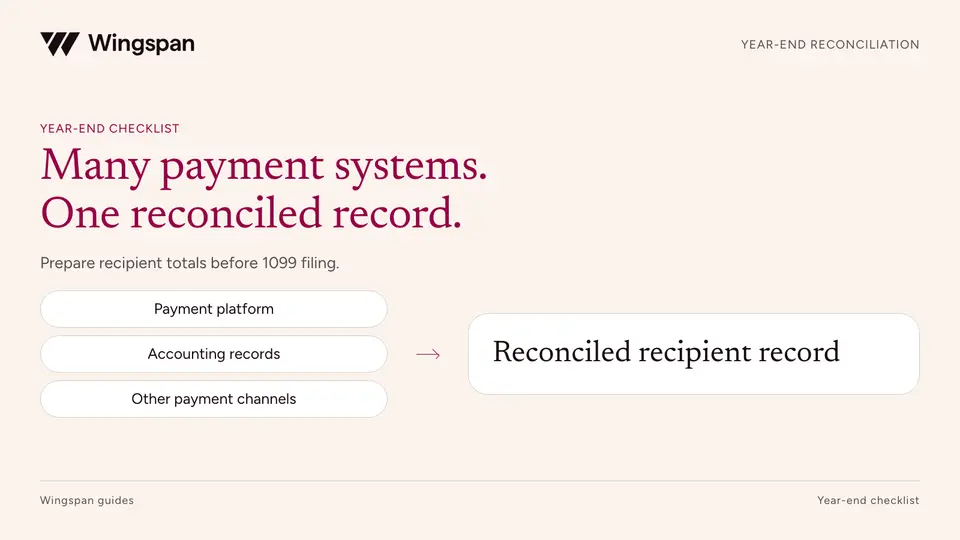
Reconcile contractor payments across platforms, AP, banks, and legacy systems with source registers, recipient mapping, and a reviewable bridge.
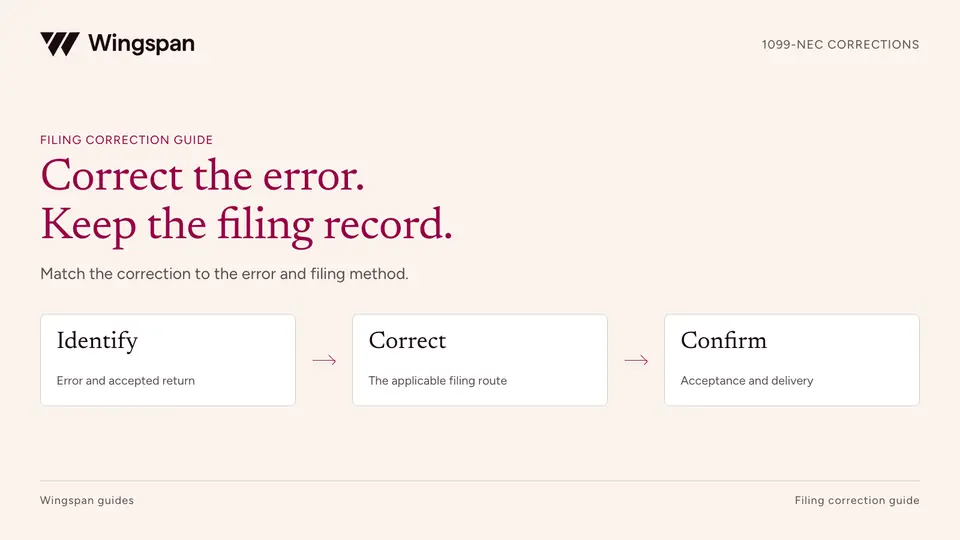
Correct a 1099-NEC by error type and filing method. Separate rejected submissions, recipient and payer errors, duplicates, and missing originals.