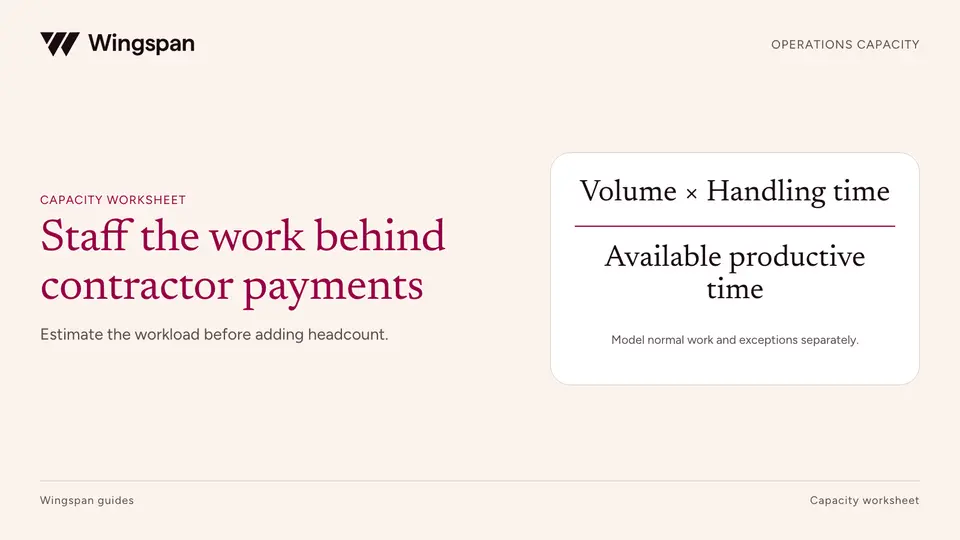
How to staff contractor operations as your network grows
Forecast the internal team capacity required for contractor onboarding, payment exceptions, support, and tax readiness across normal, peak, and growth scenarios.
Define the earning unit for each BPO program and resolve source-system differences before creating contractor payables.
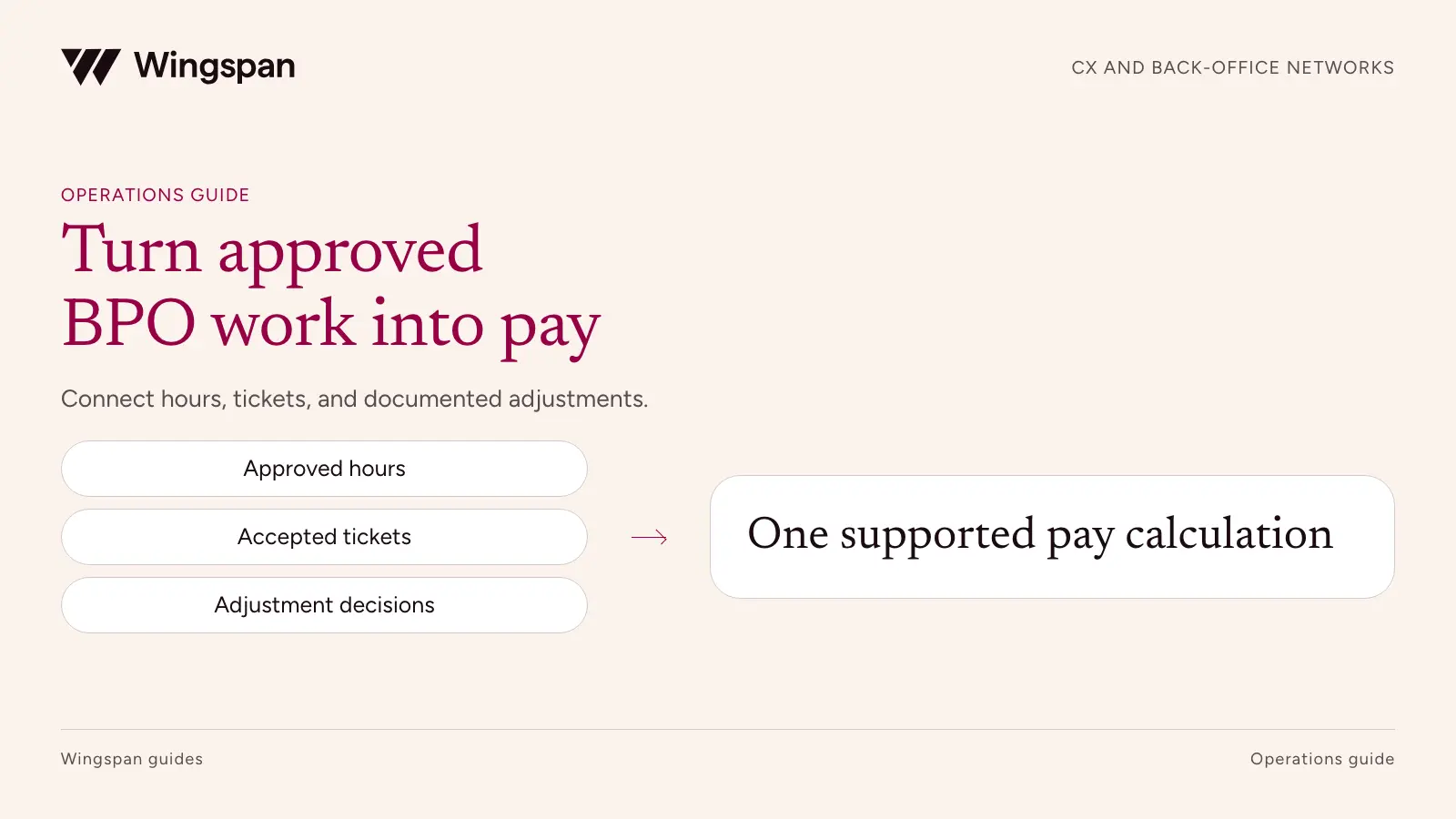
Build BPO contractor payments from the agreed earning unit, then reconcile the supporting systems to that unit. Scheduled hours, connected minutes, handled contacts, resolved tickets, and quality scores describe different events. Treating them as interchangeable creates payment errors that a final total cannot explain.
This workflow is for US companies directly paying properly classified independent agents across customer service and back-office programs. Before applying this handoff from operational records to approved payables, have legal owners assess whether the contact-center arrangement can lawfully use contractors. The IRS bases worker status on the actual relationship, and other applicable laws require separate review.
Use the agent-pay ledger template, synthetic reconciliation example, and instructions to map your programs. Set the unit and terms before joining exports.
A workforce scheduling tool can show committed intervals. A contact platform can show connection and interaction events. A ticketing system can show assignment, resolution, reopening, and reassignment. A quality system can show a sampled evaluation. None of those records necessarily defines compensation on its own.
Write down which source establishes the quantity for each program and what other sources are used to investigate differences. For an hourly agreement, a contact-platform "productive time" measure may omit eligible activities. For a ticket agreement, a resolution counter may include a reopened ticket more than once.
| Source | Useful evidence | Payment question it cannot answer alone |
|---|---|---|
| Scheduling system | Committed coverage and approved changes | Which time actually earns compensation? |
| Contact platform | Connections, contacts, transfers, timestamps | Does a contact count, minute, or interval govern pay? |
| Ticketing system | Ticket ownership, resolution, reopening | Is the payable unit a unique accepted ticket or an event? |
| Quality system | Score, sample, review date, appeal outcome | Does the agreement authorize a bonus or adjustment? |
| Agreement and rate register | Unit, rate, effective dates, conditions | Did the underlying work satisfy those conditions? |
Keep customer billing quantities separate. A client may buy a service level or monthly volume while an agent earns by a different unit. A disputed client invoice is not enough evidence to alter the agent's payable.
Use a stable contractor ID connected to each source-system account. One agent may have several login names, program assignments, or historical identifiers. A display name is a weak join key, especially after an account migration.
Each earning line needs the payer entity, program, service period, unit, rate version, and source reference. Where timestamps matter, preserve the source time zone and choose a consistent rule for assigning work to a period. An overnight interval should not be counted in two exports because one tool uses local time and another uses UTC.
Define how overlapping assignments are reviewed. The existence of simultaneous records may indicate a duplicate export, a source-system issue, or work that is valid under the agreement. Route the evidence to the program owner; do not silently erase one record based on an assumption about what the agent could have done.
Start with a quantity bridge. Show the submitted quantity, any identified duplicate or excluded event, the amount awaiting review, and the accepted quantity. Each movement needs a reason tied to the program's terms.
For a per-ticket program, define how reopened tickets, transferred ownership, merged tickets, and tickets closed without a response affect the payable unit. "Resolved" might be an operational status that can recur several times for one ticket. If the agreement pays once for an accepted resolution, count the accepted ticket identity and preserve its event history.
For an hourly program, confirm which activities are compensable under the agreement and applicable law. A lower connected-time measure should trigger investigation when it conflicts with a submitted hours record. It is not an automatic deduction rule.
For interval-based terms, document interval length, partial-interval treatment, precision, and rounding. Test totals that cross a rounding boundary. Applying rounding at each event can produce a different result from rounding once at the end of the period.
Consider agent AG-021, who works under two separate illustrative agreements. Program H pays $24 per approved hour. Program T pays $2.50 per unique accepted ticket and offers a separately agreed $30 quality bonus.
The hours submission shows 18.5 hours. The contact export shows 17.75 hours. Review finds that 0.75 hours of approved program work is recorded outside the contact platform. Under this example's agreement, all 18.5 hours qualify. The difference is explained rather than deducted.
The ticket export contains 126 resolution events. Six are reopen-and-resolve events for tickets already included. The agreement's earning unit is one unique accepted ticket, so 120 tickets qualify. The quality owner separately approves the $30 bonus using the agreed review period and criteria.
| Earning component | Source difference resolved | Calculation | Amount |
|---|---|---|---|
| Program H hours | 17.75 connected + 0.75 other approved | 18.5 × $24 | $444 |
| Program T tickets | 126 events less six repeated events | 120 × $2.50 | $300 |
| Program T quality bonus | Separate approved bonus decision | 1 × $30 | $30 |
| Total approved | Three independently supported lines | $444 + $300 + $30 | $774 |
The six repeated events are not a quality penalty. They are events that do not create six new payable units under the stated agreement. That distinction should appear in the reviewer notes and the explanation available to the contractor.
A different contract could pay for another unit or additional work on reopened tickets. The example demonstrates reconciliation, not a standard BPO compensation model.
A score should identify the program, evaluation period, method, reviewer, and final decision. If the score comes from a sample, record the sample basis. Do not apply a percentage from a small review sample to all earnings unless the agreed and lawful compensation rule actually calls for that calculation.
Separate a prospective bonus decision from a proposed reduction of an amount already owed. Preserve the original work record and route adjustments through the applicable agreement and legal review. An unhappy customer or a failed quality check does not give operations unlimited authority to offset unrelated earnings.
Set a route for corrected evaluations. If an appeal changes a bonus after the payment closes, create a linked adjustment for the difference. If the new decision would recover money, finance and legal should determine the permitted process before any deduction occurs.
Operational data keeps changing after the payment cutoff. Tickets reopen. Supervisors finish reviews. An agent corrects a submission. Preserve the approved snapshot and its export time so finance can reproduce the run that actually occurred.
Late evidence should update the operational record and create an appropriate payment decision. It should not silently change a prior statement. Link adjustments to the original earning line and identify the cycle in which the difference will be processed.
Before release, compare approved totals by entity, contractor, and program. Verify that each source line belongs to only one active payment obligation. Repeating an import should identify previously committed records instead of paying them again.
Show the program, period, earning unit, approved quantity, rate, and separately described bonus or correction. A contractor who worked in two programs should not have to reconstruct $774 from three unrelated dashboards.
The self-service portal checklist helps define access and support requirements. For BPO operations, add a test in which the contractor questions the accepted ticket count. Support should find the same quantity bridge that finance used, without exposing confidential customer conversations.
Omni Interactions' customer story describes replacing spreadsheet and CSV payment work and giving contractors better visibility into their records. Omni reported a 50% reduction in support tickets after that broader implementation.
Bring one reopened ticket, one cross-period correction, and one agent with two program identities into testing. Ask operations to reproduce the quantity, finance to reproduce the amount, and support to explain the statement. Record where a human decision remains necessary.
We connect assignments, rates, work records, and decisions through our work and approvals capabilities. That gives large US BPO networks a way to carry approved work into payments and support with its earning basis intact. Map the inputs from your contact, ticket, and quality systems to the agreed unit for each program.
Request a Wingspan walkthrough using a two-program pay cycle. Test the source differences before comparing how quickly the final payment can be released.
This isn't tax or legal advice. Consult a qualified professional about classification, compensation terms, and permitted adjustments. Sources checked October 20, 2026.
Forecast the internal team capacity required for contractor onboarding, payment exceptions, support, and tax readiness across normal, peak, and growth scenarios.
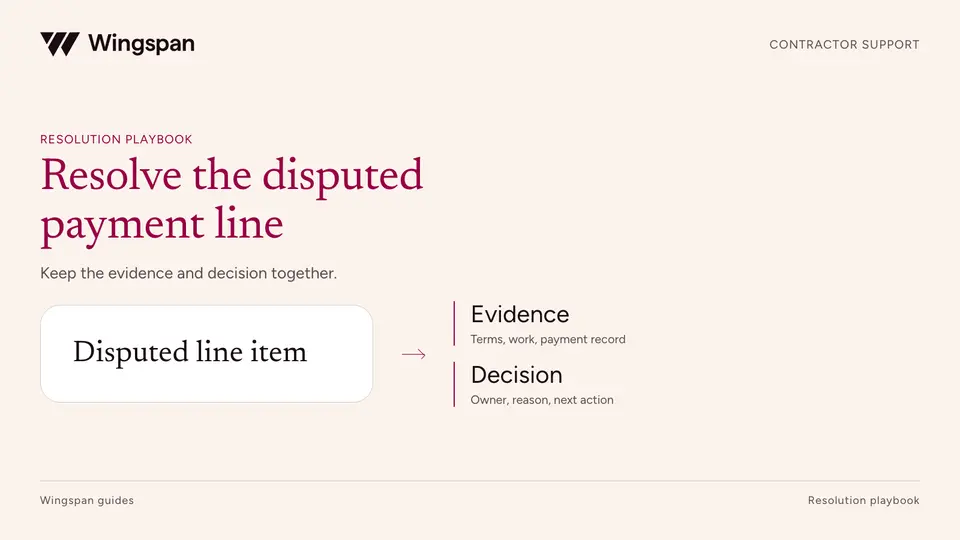
Resolve contractor pay disputes with clear intake, evidence, ownership, and adjustment records while keeping undisputed amounts and payment deadlines visible.
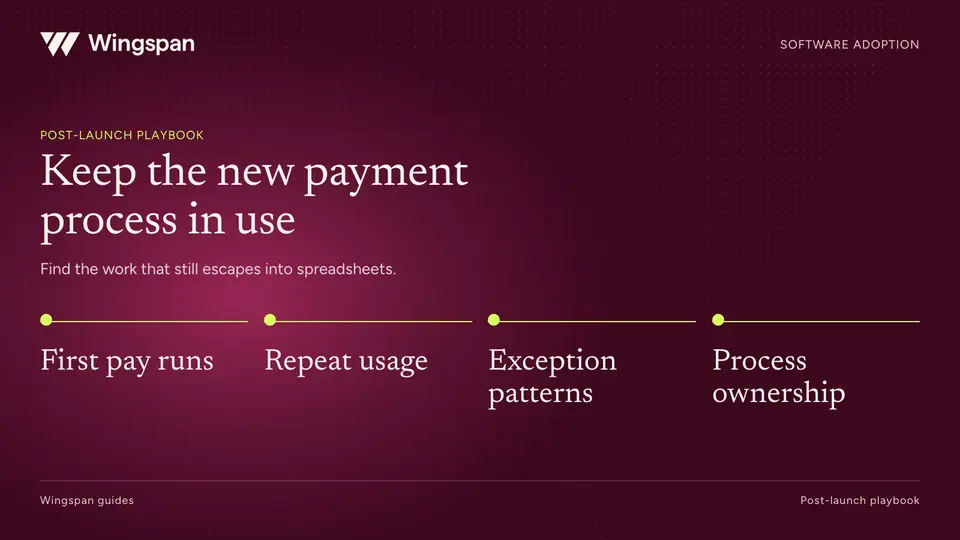
A post-launch operating plan for identifying payment workarounds, measuring approved-route adherence, and improving recurring workflows over 30, 60, and 90 days.