Contractor turnover: how to calculate replacement cost and lost service capacity
A decision model for estimating contractor replacement resources and service capacity lost during a departure, with explicit demand and coverage assumptions.
A post-launch operating plan for identifying payment workarounds, measuring approved-route adherence, and improving recurring workflows over 30, 60, and 90 days.
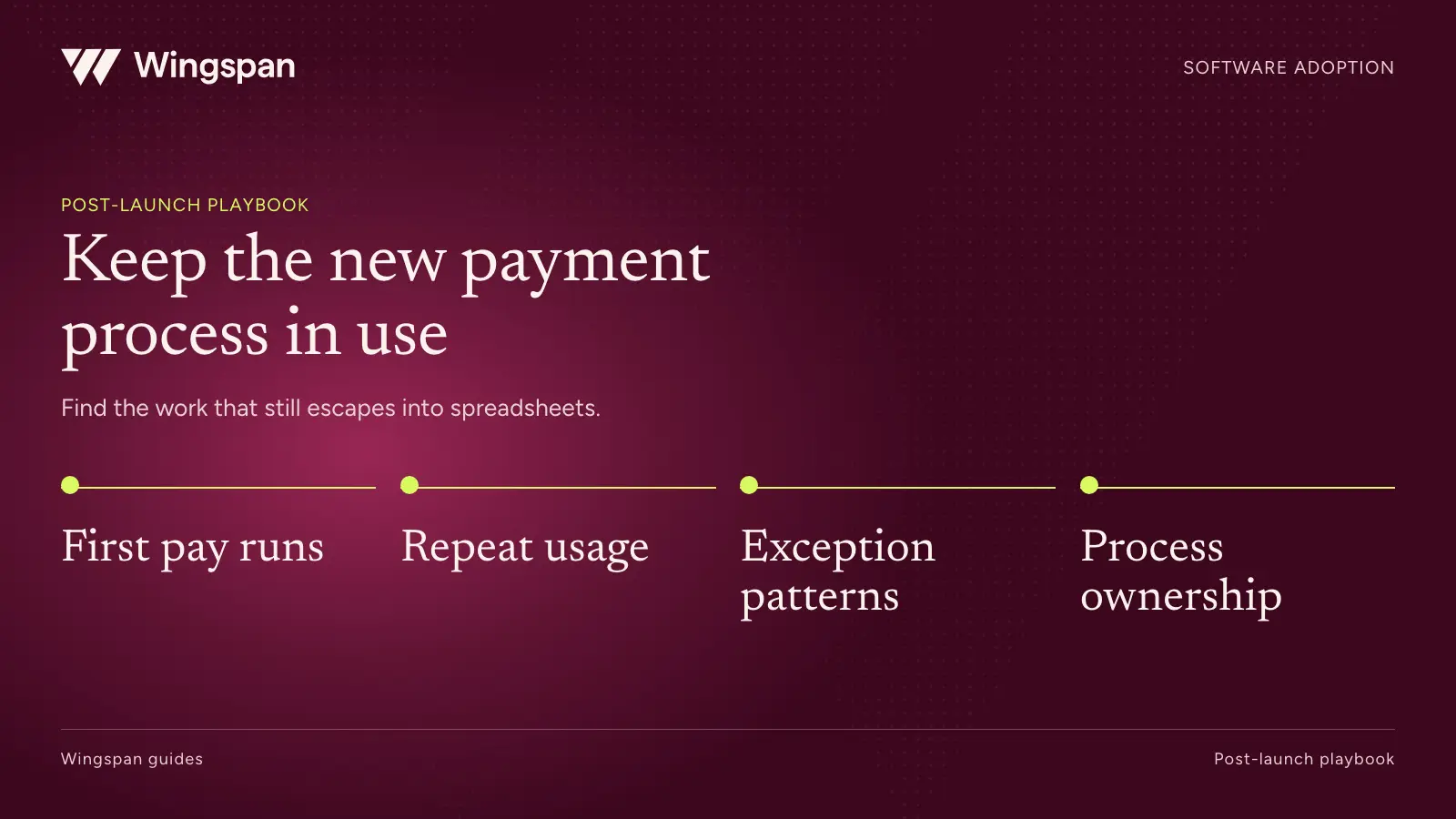
Keep the new payment workflow useful for the people who run it. Give every exception an owner, make the approved route faster to understand than an unofficial workaround, and measure where obligations are actually approved and paid. Logins alone won't tell you whether the team has adopted the process.
A spreadsheet can be a useful analysis tool. The risk starts when it becomes a second place to change payable amounts, record approvals, or decide which payments have been released. At that point, two versions of the same obligation can exist without anyone knowing which is authoritative.
This guide starts after migration and initial stabilization. It is for companies directly paying large contractor networks through recurring operating workflows. For cutover planning, use our contractor payment migration checklist.
Download the adoption measures template, worked example, and 30/60/90-day operating plan. Read the worksheet instructions before setting targets.
Ask account managers, operations staff, and finance to walk through the last payment cycle. Choose an ordinary payment, a late change, and an unresolved exception. Follow the records they actually used, including exports and informal messages.
A shadow spreadsheet often exists for a practical reason. Someone can't find the current approval owner. A manager needs to explain an amount to a contractor. A report is missing a work-order reference. An employee may have built a workaround to meet a real deadline.
Record the job each workaround performs. Then decide whether the approved workflow needs a clearer view, a configuration change, a documented export, or an escalation path. Calling every spreadsheet a training problem will miss the cases where the process itself is incomplete.
Distinguish analysis from authority. An exported worksheet can support forecasting if the underlying obligations remain unchanged. A file that changes payment instructions needs an explicit handoff, validation, and record of what the approved system accepted.
Write down where the team confirms work acceptance, rate changes, final payable approval, payment release, and payment status. These may live across connected systems. The important point is that each decision has a clear authoritative record and an accountable owner.
When a correction starts outside that record, specify how it becomes official. A manager's message saying "add $40" should become a documented adjustment with a reason, approver, and connection to the original work. It should not remain a comment that someone remembers to include in a bank upload.
Use the contractor management policy to define authority. The adoption plan then checks whether people can follow that policy in daily work.
| Signal after launch | Likely question to investigate | Useful response |
|---|---|---|
| Amounts edited in several spreadsheets | Where does the approved amount become final? | Establish one accepted adjustment path |
| Direct bank payments outside the normal route | What urgent need or unresolved case caused the bypass? | Provide a controlled exception route with reconciliation |
| Repeated exports for payment status | Can staff and contractors find the status they need? | Improve access or the relevant status view |
| One employee resolves every exception | Is knowledge or permission concentrated? | Document decisions and train backup owners |
| High login activity but incomplete records | Are users doing work or searching for missing information? | Measure completed process steps and case outcomes |
Treat these as investigation prompts. The same signal can have several causes, and not every team will need the same fix.
Choose a stable unit for the adoption measure. An approved obligation is often more useful than a transfer because one transfer can settle several obligations. A split payment can also create several transfers for one obligation.
Define process adherence as in-scope obligations completed through the approved workflow divided by all in-scope obligations completed during the period. Include known off-process obligations in the denominator. Reconcile the population against bank activity, the payable ledger, and relevant source systems so invisible bypasses don't improve the score.
Track controlled exceptions separately. If an approved emergency route exists, report it as an exception category rather than hiding it inside ordinary completion. Assign each obligation to one route category: if any portion bypassed an approved route, count the obligation as a bypass; otherwise, if any portion used a controlled exception, count it there. Count it as standard only when the whole obligation followed the standard route. That keeps split payments from appearing in several categories and shows whether emergency use is becoming routine.
Keep at least one outcome measure beside adoption: duplicate obligations, corrections, payment inquiries, unresolved case age, or reconciliation differences. A team can follow a flawed process consistently. High adherence only matters if the workflow produces reliable results.
The following figures are illustrative. A company completes 1,000 in-scope obligations in a month. Of those, 920 follow the standard workflow, 50 use an approved exception route, and 30 bypass both routes.
Standard-route adoption is 920 divided by 1,000, or 92%. Including the controlled exceptions, adherence to an approved route is 970 divided by 1,000, or 97%. The bypass rate is 3%. Reporting only the 920 standard obligations visible in one system would incorrectly show 100% adoption.
The team investigates the 30 bypasses. Eighteen arose because managers did not know who owned an urgent adjustment. Eight involved missing payment-status information. Four were personal workarounds with no documented reason. These categories sum to 30 and point to different actions.
| Bypass reason | Obligations | Share of all bypasses | First action |
|---|---|---|---|
| Unclear urgent-adjustment owner | 18 | 60.0% | Name an owner and backup |
| Missing status information | 8 | 26.7% | Fix the status access or view |
| Unexplained workaround | 4 | 13.3% | Review with the operator |
| Total | 30 | 100.0% | Reconcile every obligation |
The first fix should address the 18-case ownership gap. Requiring everyone to repeat general training would consume time without necessarily changing that decision.
In the next month, compare the same definitions. If volume or the eligible population changes, show the count and percentage together. A lower bypass count during a quiet month may not reflect a better process.
The time periods below are an example cadence after stabilization. Adjust them to your payment frequency and risk. A monthly payment process needs enough completed cycles to assess a change meaningfully.
During the first 30 days, inventory workarounds, reconcile the obligation population, and assign an owner to each recurring exception. Watch employees handle real work. Resolve unclear authority and missing information before judging individual adoption.
By day 60, test the fixes in complete cycles. Give staff short, role-specific instructions for the tasks they perform. An approver needs to understand evidence and authority. Support needs to explain status. Finance needs a trace from approved obligation to payment and close.
By day 90, retire obsolete release permissions and unofficial operating files through your normal controls, once their legitimate work has a supported home. Keep useful analytical exports with clear labels, owners, and refresh dates. Review new workarounds as signals of changing business requirements.
Don't make the calendar itself the exit criterion. A critical unresolved reconciliation issue remains unresolved on day 91. Use evidence that the agreed process works across ordinary work and the exceptions your team actually encounters.
An emergency process should identify the business reason, authorizer, obligation, release owner, and reconciliation owner. Before sending a payment elsewhere, confirm whether the original attempt can still execute. Link the external payment back to the original obligation and prevent another release through the normal route.
Review emergency use at the next operating meeting. A recurring exception may need a supported process change. A one-time outage may require a specific recovery action. Neither should become an invisible parallel payment system.
Keep the escalation route short enough to use under pressure. If the only approver is unavailable and no backup exists, employees may improvise even when they understand the policy.
Blossom Health's customer spotlight describes consolidating provider operations and improving payment visibility for both the internal team and providers. It also describes continued use across payment cycles. Those are daily jobs to include in your own adoption review.
We connect onboarding, payments, and worker support so large contractor networks can manage those recurring jobs together. Keep the implementation owner involved after launch long enough to resolve recurring exceptions and transfer ownership to the operating team.
Bring three workarounds, your adoption denominator, and one recent exception to a Wingspan workflow review. We can walk through the decisions and records with your team. Resolve the reason for each workaround, then check the next payment cycle.
A decision model for estimating contractor replacement resources and service capacity lost during a departure, with explicit demand and coverage assumptions.
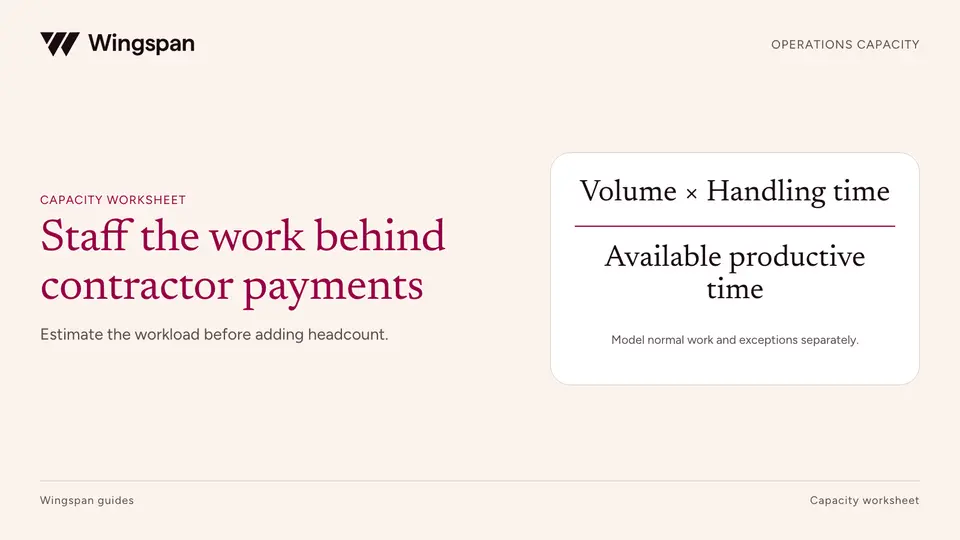
Forecast the internal team capacity required for contractor onboarding, payment exceptions, support, and tax readiness across normal, peak, and growth scenarios.
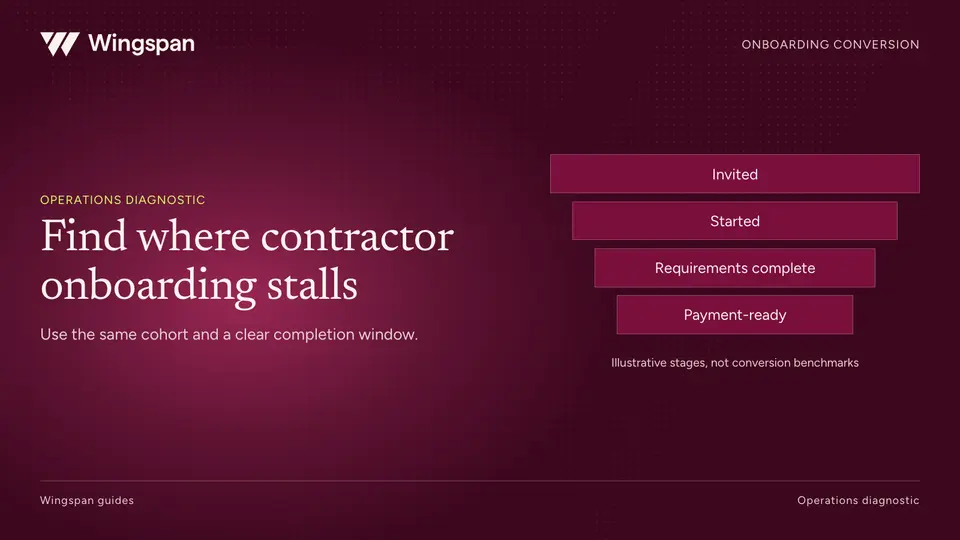
Diagnose contractor onboarding drop-off with consistent cohorts, stage definitions, waiting-time measures, and experiments that separate friction from no work.