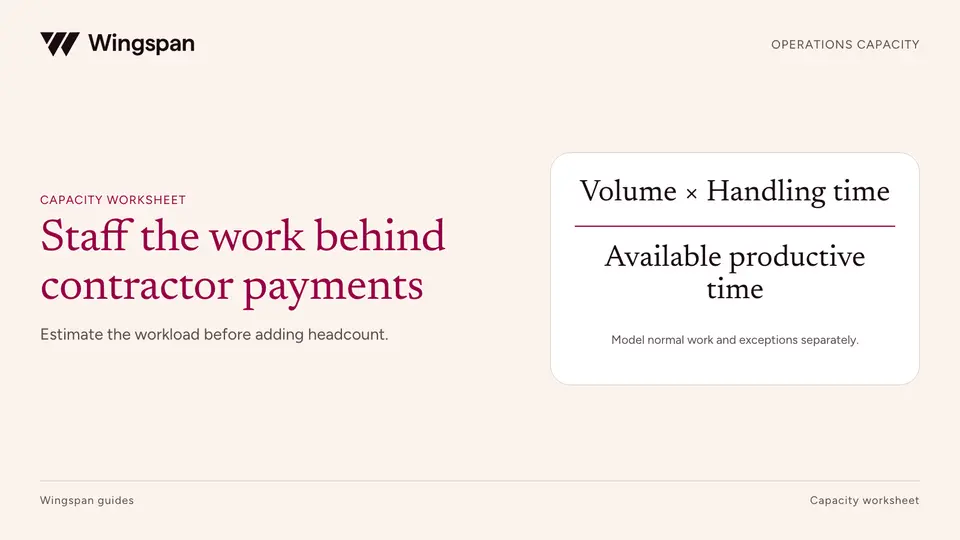
How to staff contractor operations as your network grows
Forecast the internal team capacity required for contractor onboarding, payment exceptions, support, and tax readiness across normal, peak, and growth scenarios.
Prepare roster readiness, fee schedules, internal approval capacity, funding, and closeout for catastrophe-driven adjuster volume.
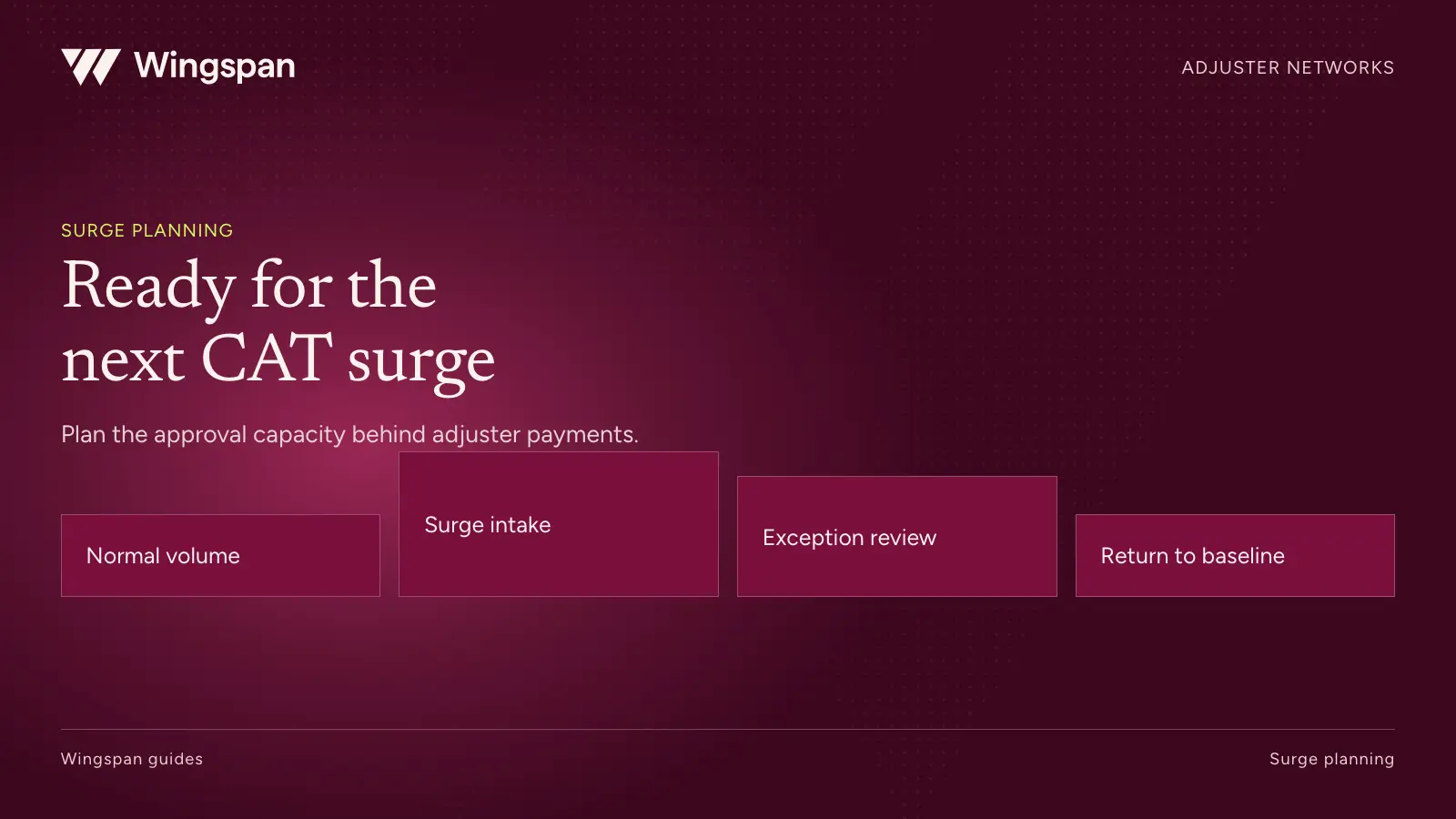
A catastrophe payment plan should establish which adjusters are ready for assignments, how claim fees become approved payables, who can clear the surge of exceptions, and how finance will fund the resulting runs. Test those decisions before the first surge file reaches accounts payable.
Adding adjusters to a roster is only one part of readiness. If fee approvals arrive faster than reviewers can process them, work piles up before payment. If the funding forecast counts only the currently approved queue, it misses the next wave of completed claims. And if temporary fee terms have no end rule, they can continue after the deployment ends.
The capacity and funding template, illustrative surge scenarios, and worksheet instructions help finance and claims operations rehearse those handoffs. The figures below are planning assumptions, not industry benchmarks or customer results.
Maintain a roster view with distinct decisions: available for this deployment, qualified for the assignment, agreement accepted, and payment setup complete. A returning adjuster may have a valid payee record but need updated deployment terms. A newly recruited adjuster may be available while a required credential remains unresolved.
Licensing requirements deserve a separate owner. For example, the Texas Department of Insurance describes a sponsored, 90-day emergency adjuster license for its catastrophe process. Check the relevant jurisdiction and current disaster instructions before assignment; each state has its own requirements.
Payment readiness should also preserve identity continuity: the verified person or business onboarded must map to the authorized payment recipient. Escalate conflicting recipient details or unexpected destination changes for review, including possible stolen identity, while accounting for legitimate business-name arrangements.
Count the adjusters who have accepted the current assignment, alongside the other readiness decisions. A database of 800 people may contain a much smaller ready roster. Record the source and review time for each readiness decision so an old status cannot masquerade as a current check.
Keep the contractor insurance verification workflow connected to deployment requirements. Payment operators should see the decision they need, while qualified owners retain responsibility for insurance and licensing judgments.
A CAT deployment can combine per-claim fees, daily arrangements, travel components, supplements, and customer-specific rules. Establish the payable unit before work starts. A claim count alone is insufficient if two assignments use different complexity tiers or fee bases.
Each assignment should identify the applicable schedule, effective-date rule, contracting entity, and any authorized surge amendment. If a fee depends on another amount, record the agreed calculation basis and the authoritative source for it. Avoid asking an AP operator to infer the fee from a carrier invoice.
The amendment also needs an end condition. It might apply to a defined event, assignment period, or set of claims. Store the condition with the agreement. A calendar end date and a deployment end date may produce different results for late submissions or supplements.
Reopened claims need an explicit decision: is the new work included, a separately payable supplement, or another arrangement? Preserve the original claim reference and distinguish the additional work. Do not treat every reopened file as another full original fee.
Measure the volume of payable candidates arriving for review and the average review minutes by case type. Include ordinary files, missing-document cases, rate exceptions, and late corrections. A single average can understate demand when the exception mix changes during a surge.
For a first planning pass, calculate daily review hours as submitted items multiplied by minutes per item, divided by 60. Compare that result with the team's productive review hours. Productive hours exclude meetings, other assignments, and coverage duties. They are not the same as total scheduled hours.
| Illustrative scenario | Items arriving daily | Minutes per item | Review hours needed | Reviewers at six productive hours | Daily capacity gap |
|---|---|---|---|---|---|
| Normal volume | 300 | 3 | 15 | 3, providing 18 hours | 3 spare hours |
| Surge with normal handling time | 900 | 3 | 45 | 5, providing 30 hours | 15 hours short |
| Surge with more exceptions | 900 | 4 | 60 | 5, providing 30 hours | 30 hours short |
At three minutes per item, five reviewers providing 30 hours can process 600 items a day. With 900 arriving, the queue grows by 300 each day, or 900 over three days if arrivals and capacity stay constant. Hiring more field adjusters will not clear that internal approval bottleneck.
Use the calculation to choose an action: assign trained backup reviewers, reduce avoidable rework, redistribute review responsibility, or change the operating plan. Do not remove required approvals simply to make the spreadsheet balance. Any proposed automation needs a measured handling-time assumption and a defined route for exceptions.
Separate approved amounts ready for release from amounts likely to become payable soon. A forecast should include the existing queue, expected completions, agreed additions, and other known obligations. Identify what is estimated and what is already approved.
In the illustrative surge scenario, 900 daily items averaging $180 produce $162,000 of expected daily obligations. Three days produce $486,000. Adding a planning reserve equal to 15% of that amount gives $558,900. The reserve is an internal scenario assumption, not a payment-provider requirement.
This estimate assumes all forecast items become payable at the stated average amount. It excludes travel, other additions, provider fees, and existing obligations, which must be added when relevant. Model the distribution of fees if a few large files could make the average misleading.
Finance should then map obligations to actual due dates and the provider's funding rules, cutoffs, and available limits. Keep carrier collections in a separate cash forecast. Slow customer collections do not automatically change what your company owes adjusters.
Use a short operational matrix that can be understood during a busy deployment.
| Exception | First owner | Required decision | Record to preserve |
|---|---|---|---|
| Fee version conflicts with assignment | Claims operations | Which agreed terms apply? | Schedule and amendment references |
| Claim file reopened | Assignment owner | Does new work create additional compensation? | Original and additional-work IDs |
| Work approved but payment setup incomplete | Contractor operations | What setup action remains? | Requirement and outreach status |
| Funding forecast exceeds available capacity | Treasury or finance | How will obligations be funded on time? | Forecast, cutoff, and approved action |
| Same claim submitted through two files | Payment operations | Duplicate or distinct payable component? | Both source references and resolution |
Have a backup for every owner. An urgent payment request should not depend on finding one person whose phone is unreachable. Separate authority to resolve a fee from authority to release funds, even if the same small team supports both functions.
Give the team a synthetic deployment with returning adjusters, new payees, a fee change, a reopened claim, and one missed funding cutoff. Ask them to produce the next payment run and explain every excluded item. Then send the same work file again and check that it does not create duplicate obligations.
Rehearse communications as well. An adjuster should receive the work reference, approved amount, current payment state, and next action. "Processing" should have a documented meaning. An internal release does not necessarily establish when funds arrive at the receiving bank.
CRU GROUP's customer story describes replacing fragmented contractor information with a central record for identity, contracts, and payment amounts. That matters during a surge, when people covering another operator's queue need enough context to make the authorized decision.
Close the surge period deliberately. Check the remaining claims, supplements, expenses, disputes, and payment failures before retiring the deployment queue. Remove temporary approval assignments when appropriate, retain the decision history, and confirm how late work will be handled.
Review the forecast against actual arrivals, handling time, approved amounts, and payment outcomes. A difference caused by extra claim complexity calls for a different response from one caused by unavailable reviewers. Carry those findings into the next exercise rather than preserving an unsupported staffing ratio.
Our worker payments workflow connects approved payables with payment operations. We help large US adjuster networks carry approved work into payment, using the decisions established in their source systems and surge plan. Confirm the funding setup and payment limits before making commitments to the field.
Bring your CAT tabletop scenario to a Wingspan demo. Include your peak approval queue, fee amendments, and funding calendar so the walkthrough tests your actual constraints.
This isn't legal or tax advice. Consult qualified professionals about licensing, contractor status, agreements, and payment obligations. Sources checked October 20, 2026.
Forecast the internal team capacity required for contractor onboarding, payment exceptions, support, and tax readiness across normal, peak, and growth scenarios.
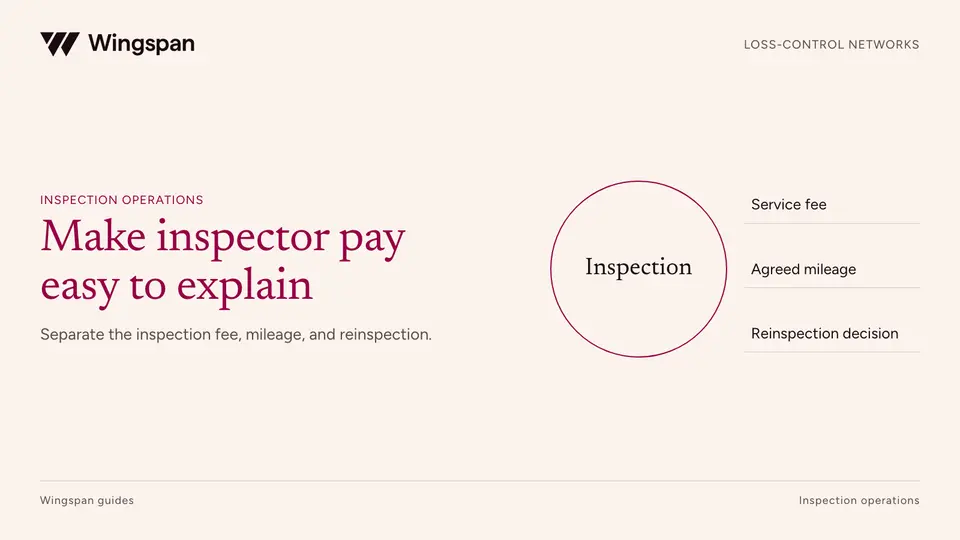
Preserve assignment acceptance, fee versions, return-visit decisions, and travel amounts through inspector approval and payment.
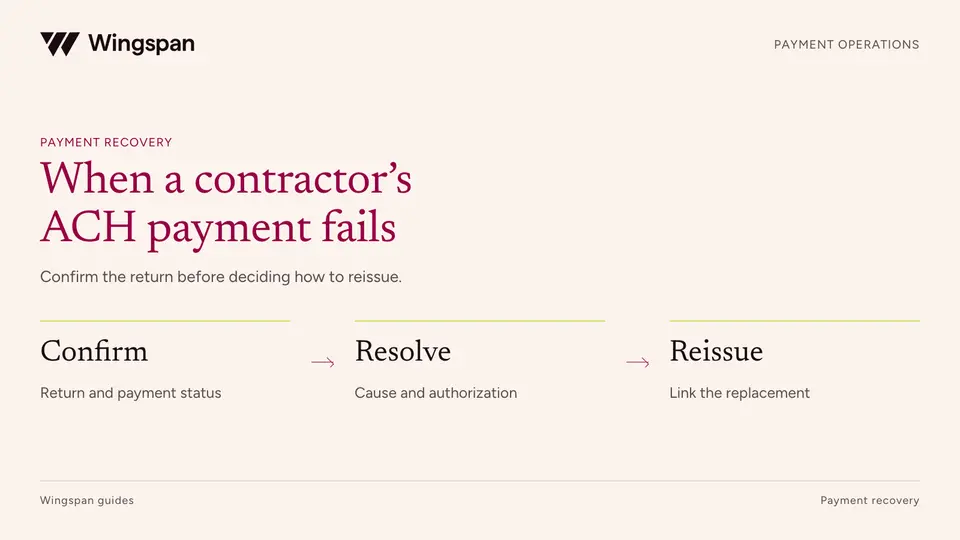
Investigate failed contractor ACH payments, distinguish payout returns from funding failures, trace the funds, and link replacements without duplicate pay.