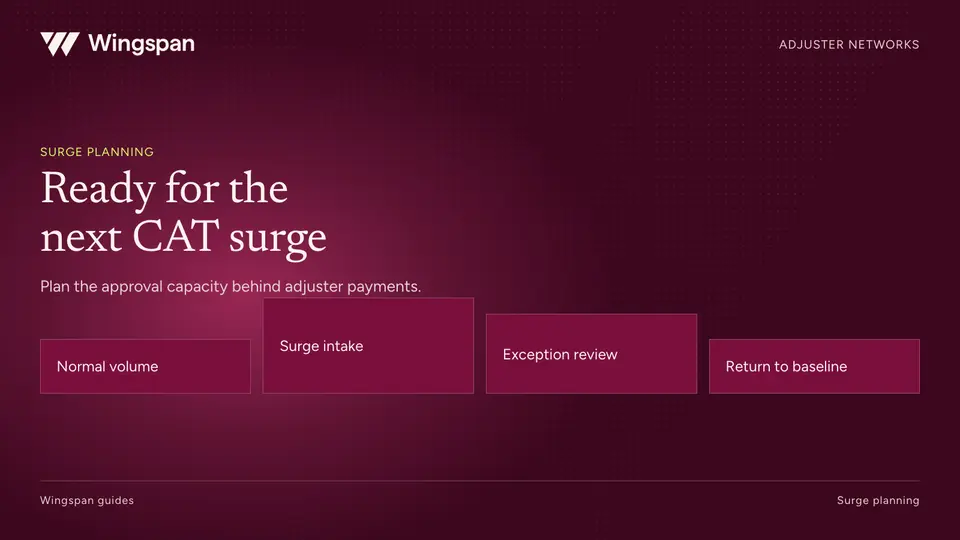
CAT surge readiness: a contractor payment plan for independent adjuster networks
Prepare roster readiness, fee schedules, internal approval capacity, funding, and closeout for catastrophe-driven adjuster volume.
Preserve assignment acceptance, fee versions, return-visit decisions, and travel amounts through inspector approval and payment.
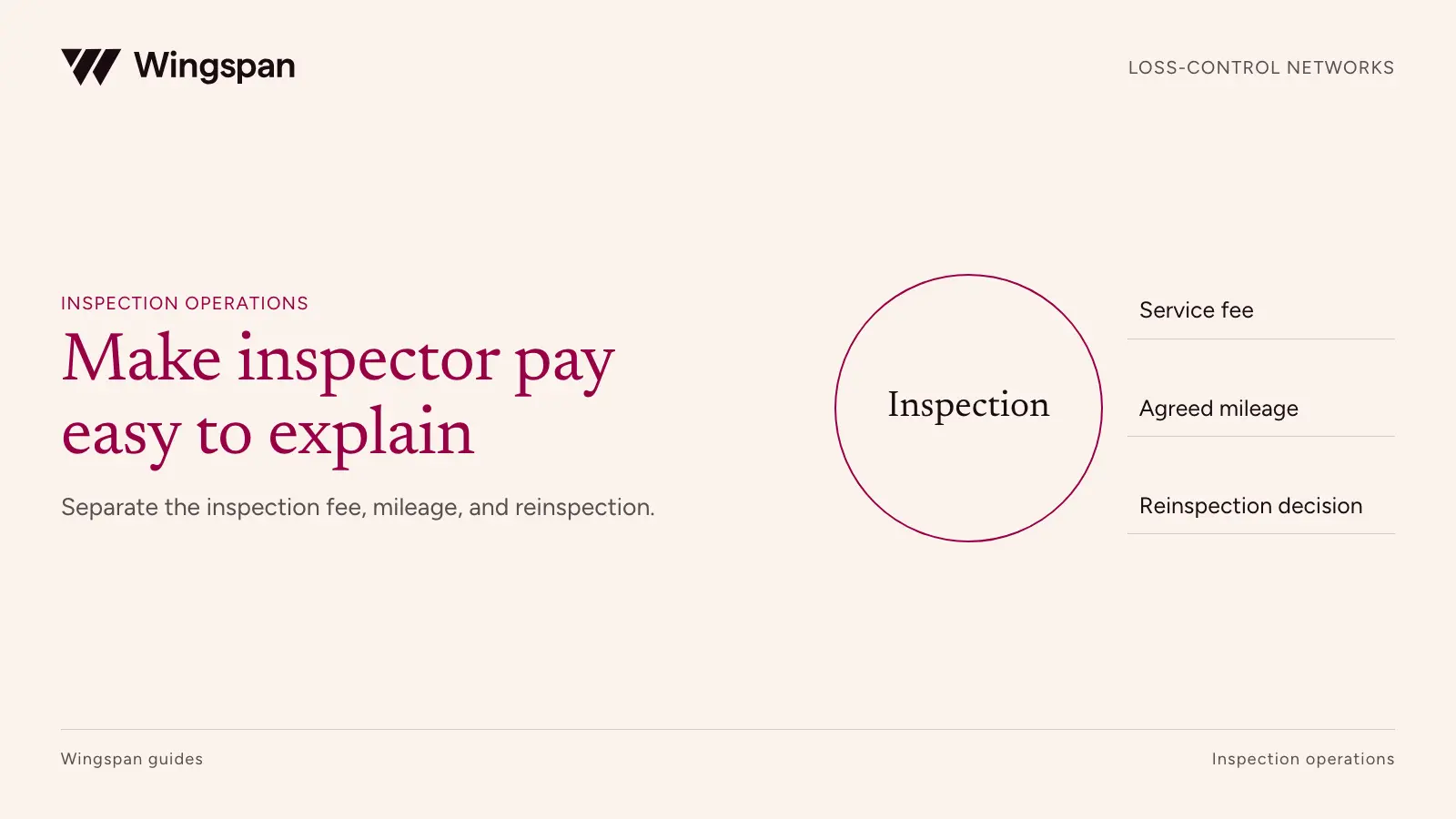
An inspector payment should identify the accepted assignment, the applicable fee version, any approved travel amount, and the reason for additional work. A report upload is useful evidence, but it does not explain whether a return visit creates a new fee or which terms govern a rate change.
For loss-control and premium-audit networks, a reliable earnings ledger preserves those decisions before the weekly or twice-weekly payment run. Operations can then resolve an inspection question without asking finance to recalculate every other accepted assignment.
Use the inspection earnings template, worked example, and worksheet instructions to map your fee rules. The sample fees and mileage rate are illustrative negotiated terms. They are not industry prices or IRS rates.
Start with the service agreed with the inspector: an exterior survey, a more detailed site visit, a premium audit, or another defined deliverable. Record the required scope, compensation unit, fee basis, and acceptance evidence. Do not assume all assignments use the same completion event.
A visit may be performed while the report still needs review. An audit may be waiting on information from the insured business. Those facts should remain visible separately from the payment decision. Have the assignment owner determine what the agreement requires in each case.
Keep customer acceptance and contractor compensation connected but distinct. A carrier's request for new information can create additional work even when the original report met the agreed scope. Conversely, a report may need correction to satisfy an existing requirement. The actual terms and facts determine compensation; a generic "returned report" status does not.
Give every fee schedule a version and an effective-date rule. Record whether the relevant trigger is assignment acceptance, service date, or another agreed event. Copy that reference into the assignment so later reviewers can reproduce the amount.
Suppose an inspector accepts an exterior survey at $65 on October 10. A new schedule offers $70 for assignments accepted beginning October 15. If the original survey is performed on October 16, its fee remains $65 under those example terms. The service date alone would select the wrong version.
| Situation | Record to inspect | Decision before pricing |
|---|---|---|
| Assignment accepted before a fee change | Acceptance timestamp and effective-date rule | Preserve the earlier fee if the rule uses acceptance date |
| Assignment scope expands after acceptance | Authorized scope change and agreed additional fee | Price the additional work under its own terms |
| Late report from an earlier period | Original assignment and fee version | Avoid applying today's fee merely because payment is later |
| Retroactive rate amendment | Covered assignments and original amounts | Calculate the authorized difference |
| Assignment transferred to another inspector | Reassignment terms and work already completed | Resolve compensation for each person's actual engagement |
Keep both parties' acceptance records when terms change. An administrator editing a rate field is not a substitute for documenting the applicable agreement.
A reinspection can mean several things: a correction to the original work, a new customer request, changed site conditions, a previously inaccessible area, or a separate follow-up service. Those reasons should not collapse into a single zero-fee default.
Preserve the original assignment reference and create a return-visit reference. Record who requested the visit, what changed, and the agreed treatment. Where the terms are unclear, escalate before dispatch when practical. If the work has already occurred, resolve the obligation promptly rather than letting uncertainty sit in the payment queue.
Avoid automatic deductions from unrelated assignments. A dispute about one report should be reviewed under the agreement and applicable law. Define how accepted amounts proceed and who owns the remaining decision.
A return visit also needs duplicate protection. Linking it to the original inspection should help explain the relationship without making the system treat all linked work as the same payable. Distinct authorized work can properly create more than one obligation for the same location.
Record the travel date, assignment references, eligible mileage basis, approved miles, rate version, and amount. If several inspections share a trip, allocate the trip once. Paying the full route mileage on every assignment overstates the approved travel amount.
Specify how the network handles excess travel, canceled visits, and combined routes. A reviewer should be able to distinguish a distance estimate from the mileage accepted under the policy. Keep any location details in an appropriately controlled record rather than a broadly circulated payment file.
We support reimbursable expenses as line items. Your tax and accounting owners determine their treatment.
The IRS standard mileage-rate page addresses mileage used for tax deductions. Do not treat a rate from that page as automatically establishing the amount your company owes an inspector. Use the governing terms and applicable requirements, and have tax advisers determine the treatment of payments.
Inspector IN-012 completes three surveys priced at $65 under an earlier acceptance-date schedule and two priced at $70 under the new version. A customer also requests a separately agreed $45 return visit. The network approves 84 miles at a contractual $0.60 per mile.
| Component | Approved quantity and rate | Amount |
|---|---|---|
| Earlier-version surveys | 3 × $65 | $195.00 |
| New-version surveys | 2 × $70 | $140.00 |
| New-scope return visit | 1 × $45 | $45.00 |
| Approved travel | 84 miles × $0.60 | $50.40 |
| Total approved | Sum of the four components | $430.40 |
A separate correction request remains open because the assignment owner has not determined its compensation treatment. It has no approved amount in this run. That does not mean the work is automatically unpaid. Record the decision owner and resolve it under the agreement.
The worksheet gives each survey its own line and links the return visit to the original assignment. The mileage line has a trip reference so its 84 miles cannot be copied across every survey. The open correction stays visible without being included in the $430.40 total.
If later review approves an additional $25 for the correction, the new payable is $25. The original $430.40 remains part of payment history. A replacement export containing $455.40 would duplicate previously paid work unless the original obligation had been properly canceled or otherwise resolved.
The payment packet should contain the accepted service reference, applicable terms, amount calculation, and authorized decision. It can link to a report stored elsewhere without carrying the full report into accounts payable.
Define which source establishes acceptance and which person can override or correct it. A customer email, internal review status, and inspector invoice may arrive at different times. Choose the authorized record deliberately and retain the evidence for exceptions.
Majestic's customer story describes inspectors submitting service dates, control numbers, and fee calculations, followed by an integration that sends reports into Wingspan for payment. It also describes paying inspectors twice a week. Preserve that report-to-payment reference as your own volume grows.
The approved-work workflow covers the broader separation between work acceptance and payment release. Add inspection-specific tests for a report returned after approval, an inaccessible site, and a reassigned visit.
Reconcile approved inspection lines with the payables created, including travel and later adjustments. Review approved lines omitted from the run, duplicate source references, and return visits with no decision owner. Keep unresolved work visible after the original assignment closes.
Explain the statement using the same fee versions and references. Inspectors should be able to identify why two similar surveys have different prices and whether a return visit is approved or still under review. Support should not need to reverse-engineer the fee schedule from a bank deposit.
We connect engagement terms, rates, work records, and review decisions in our work and approval workflow. Large US inspection networks can use that connection to carry the assignment and fee decision into payment. Start the configuration walkthrough with your acceptance rules and report sources.
Bring a fee change and a return-visit case to a Wingspan demo. Ask the team to carry both through approval, payment detail, and a later correction.
This isn't tax or legal advice. Consult a qualified professional about agreements, contractor status, reimbursements, and payment obligations. Sources checked October 20, 2026.
Prepare roster readiness, fee schedules, internal approval capacity, funding, and closeout for catastrophe-driven adjuster volume.
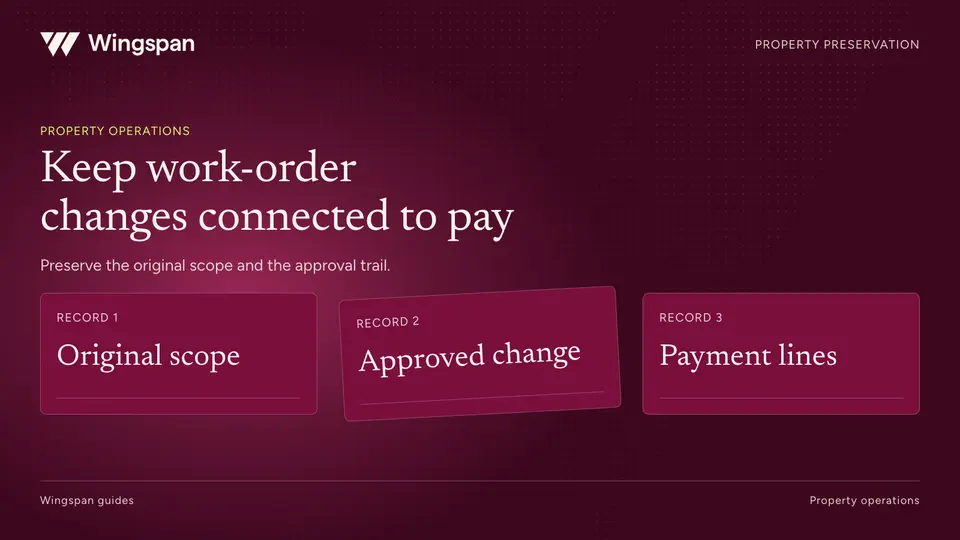
Resolve property-preservation scope changes, quantities, and receipts while keeping contractor obligations separate from client recovery.
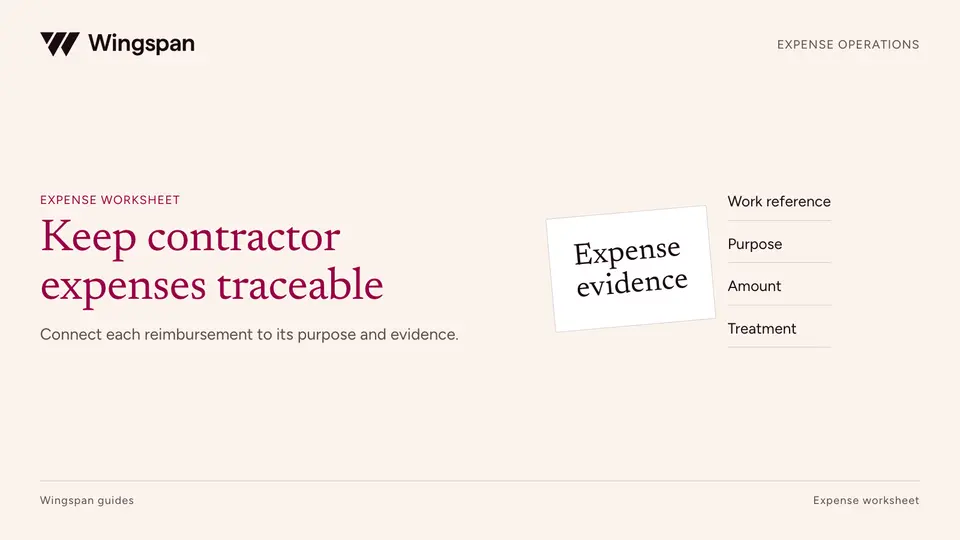
A field-network workflow for expense terms, mileage evidence, material receipts, returns, payment lines, and separate tax and accounting decisions.