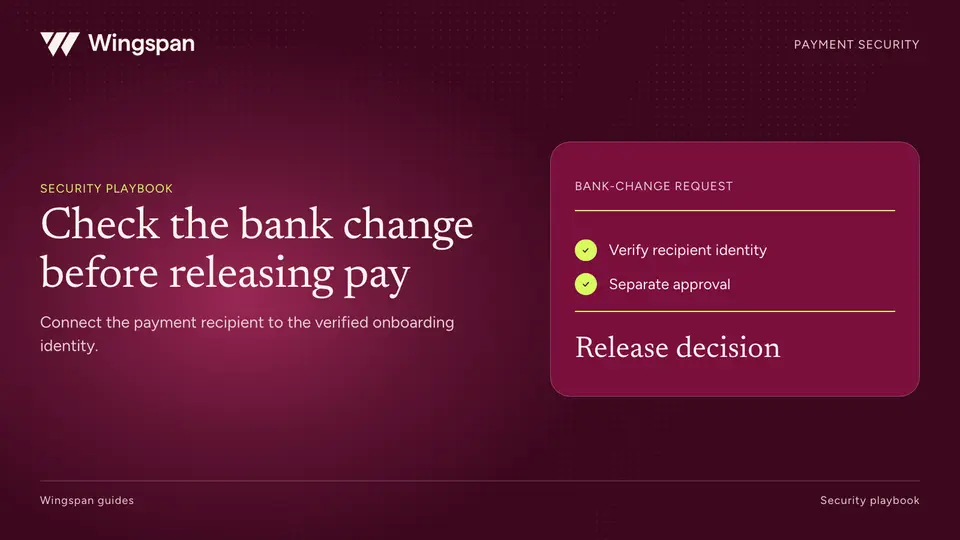
Contractor payment security: preventing fraud when bank details change
Build a bank-change control process for contractor payments, with verification steps, release checks, incident ownership, and a practical tabletop exercise.
Investigate failed contractor ACH payments, distinguish payout returns from funding failures, trace the funds, and link replacements without duplicate pay.
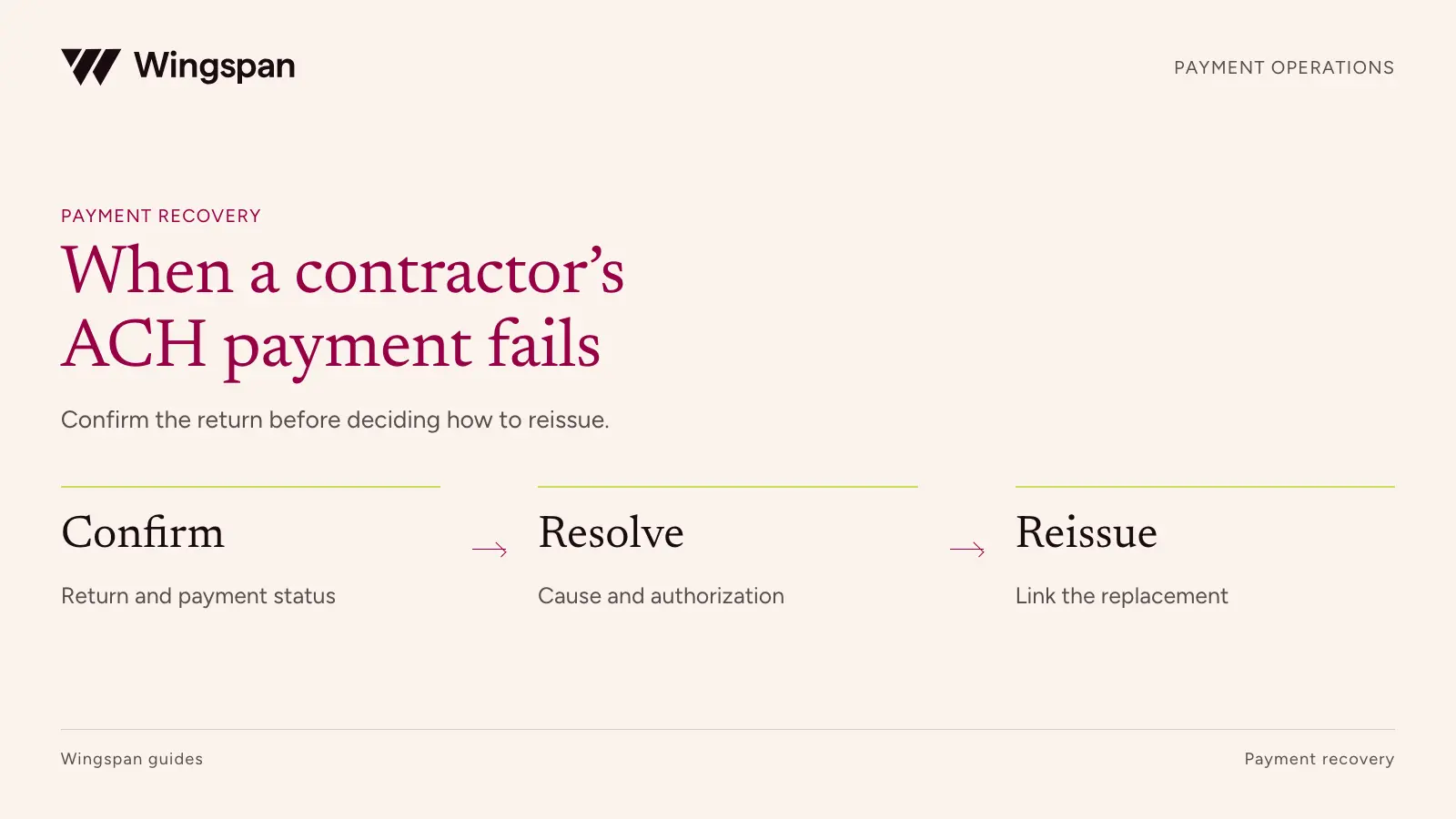
When an ACH contractor payment fails, identify the affected payment leg and the original attempt before sending another payment. Confirm whether the request was rejected, the outbound credit returned, the company's funding debit failed, or the payment is still being traced. Then resolve the cause and link any replacement to the same underlying obligation.
Those situations require different actions. A contractor's closed account can prevent an outbound credit from reaching them. Insufficient funds in the company's funding account concern a different leg of the process. Treating both as a generic failed payment can lead to incorrect messages, repeated failures, or duplicate payouts.
Use the payment-case template, worked attempt log, and return decision table. The worksheet instructions explain how to separate the amount owed from repeated attempts to pay it.
Begin with the payer entity, contractor ID, obligation ID, amount, currency, and payment reference. Ask the provider to identify the affected leg: collection from the business, movement within the provider's process, or payout to the contractor.
Retain the original source status and reason, not just your own simplified label. Record when the event occurred and when your team learned about it. A failed import and a bank return can appear in the same support queue while representing very different cash positions.
| Evidence available | Likely case type | First operating action |
|---|---|---|
| Request rejected before submission | Validation or authorization failure | Correct the request and confirm no accepted attempt exists |
| Outbound credit sent back by receiving bank | Contractor payout return | Confirm reason, returned funds, and secure destination correction |
| Company's collection debit returned | Funding failure | Coordinate with treasury and provider; inspect downstream payouts |
| Request accepted but delivery unresolved | Payment investigation | Obtain trace and current evidence before authorizing a duplicate |
| Sender detects duplicate or incorrect payment | Potential correction or recovery | Ask provider which process is permitted and preserve the original record |
Use the table to triage the case, then confirm the applicable rules, authorization, and execution process with your bank or provider before retrying.
A return code helps explain the receiving bank's response. It does not tell you everything about the payment's current location or the business's remaining obligation.
Nacha identifies R02 as a closed account, R03 as no account or unable to locate the account, and R04 as invalid account-number structure in its ACH return bulletin. Those reasons point toward destination investigation and correction. Ask the contractor to use the approved secure process rather than emailing banking details to support.
An insufficient-funds code such as R01 ordinarily concerns an account being debited. In a contractor payment workflow, that may be the company's funding collection. It is not a reason to tell a contractor they need money in their account to receive an ordinary ACH credit. Check the actual transaction direction and provider explanation before assigning responsibility.
Use the Nacha return-code reference as context, alongside your provider's current guidance. Don't turn a generic code list into an automatic reissue policy. Rules for reinitiating debits are not a universal retry rule for outbound contractor credits.
Ask where funds are now, whether the original attempt can still complete, and what evidence supports the answer. A return notice and an available balance are related but distinct pieces of information. Record the provider reference for each.
If a company's funding debit returned, determine which contractor payouts, if any, were already processed. Reissuing every contractor payment in the run could duplicate successful payouts while leaving the funding issue unresolved. Treasury and payment operations should agree on the recovery plan with the provider.
If the outbound credit returned, verify the corrected recipient and payment destination through the established process. Preserve the original destination reference and the new version. Changing a profile should not erase the evidence of where the first attempt was directed.
For an unresolved in-flight payment, escalate the trace. If the business chooses an urgent alternative payment before the first attempt is resolved, require an explicit duplicate-exposure decision, owner, and follow-up plan. Record that decision before sending the second transfer.
One accepted work item creates an economic obligation. Paying it may require several attempts. Maintain a shared obligation reference so the later attempt does not become a second service expense, a second approved work item, or an unexplained increase in compensation records.
Consider an illustrative $1,200 obligation for contractor C-413. Attempt A-001 is sent and later returned because the destination account closed. Payment operations confirms the return, the contractor updates the destination securely, and finance approves replacement attempt A-002. The synthetic case then records verified receipt of the replacement.
| Record | Amount | What it represents |
|---|---|---|
| Obligation OB-413 | $1,200 | Accepted work owed once |
| Original attempt A-001 | $1,200 | Returned payment attempt |
| Replacement attempt A-002 | $1,200 | Replacement linked to OB-413 |
| Final successful compensation | $1,200 | Amount ultimately paid for the work |
The sum of attempted amounts is $2,400. That is not the amount earned. In a simplified provider cash ledger with no fees, the original $1,200 outflow, $1,200 return, and $1,200 replacement outflow net to a $1,200 outflow. Real funding, clearing, fees, and timing can add other records, so reconcile each at its own level.
Use the monthly reconciliation checklist to preserve those distinctions through close. A return after period-end needs an approved accounting decision and a connection to the earlier attempt.
A return is a bank response to a payment. A reversal is a constrained mechanism for correcting certain sender errors. A refund concerns an agreed return of money and has its own authorization and processing requirements.
Nacha's reversal guidance explains that permitted reversals concern defined errors and time frames. A payment dispute or a wish to cancel does not automatically qualify. Recovery also depends on what happens at the receiving account.
Ask the provider which process applies. Don't use a reversal as a general collections tool, a response to dissatisfaction with completed work, or a substitute for resolving an amount dispute. Keep any contractual recovery decision separate from the payment-network mechanism used to execute it.
A useful message identifies the affected payment, what is known, the next action, and the next update time. For example: "The bank returned the $1,200 payment associated with OB-413. Please update your payment destination through the secure account process. Our payment team will confirm the replacement timing after the update is verified."
Use that wording only when those facts are confirmed. If the case is still being traced, say so. Don't promise a deposit date before the replacement is authorized and its expected timing is established.
Keep ownership visible until the case is resolved. Closing a support ticket after sending instructions is different from confirming the payment outcome and reconciling the funds.
We handle failed ACH payments as part of supporting large recurring contractor networks. Keep approved work, payment records, and contractor communications connected throughout the case. Your finance team should retain clear case ownership and reconcile the outcome to the original obligation.
Bring a returned payout, a funding problem, and an unresolved payment trace to a Wingspan demo. Review how your team will get the information it needs to answer the contractor, account for the money, and close the case.
Build a bank-change control process for contractor payments, with verification steps, release checks, incident ownership, and a practical tabletop exercise.
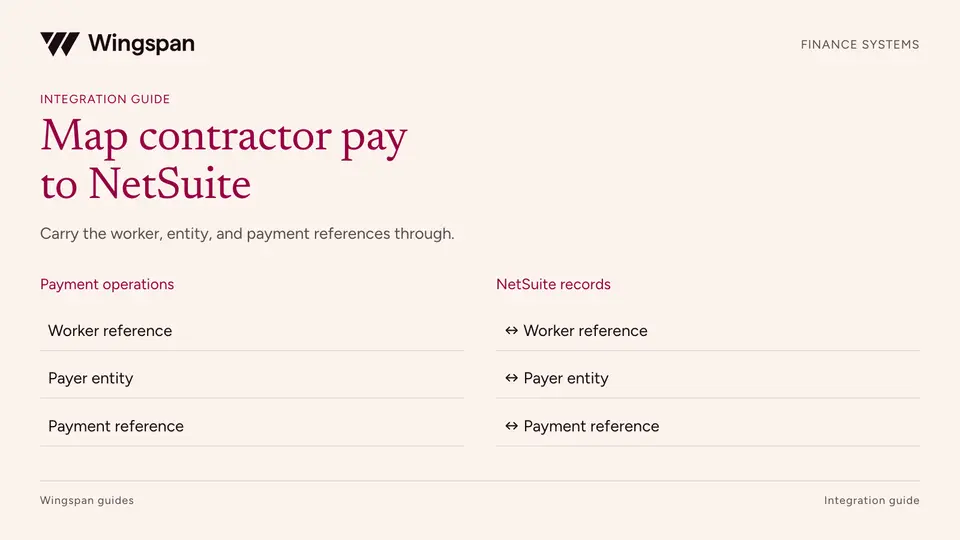
Map contractor records, subsidiaries, payables, payment results, and fees between NetSuite and your payment workflow, with practical acceptance tests.
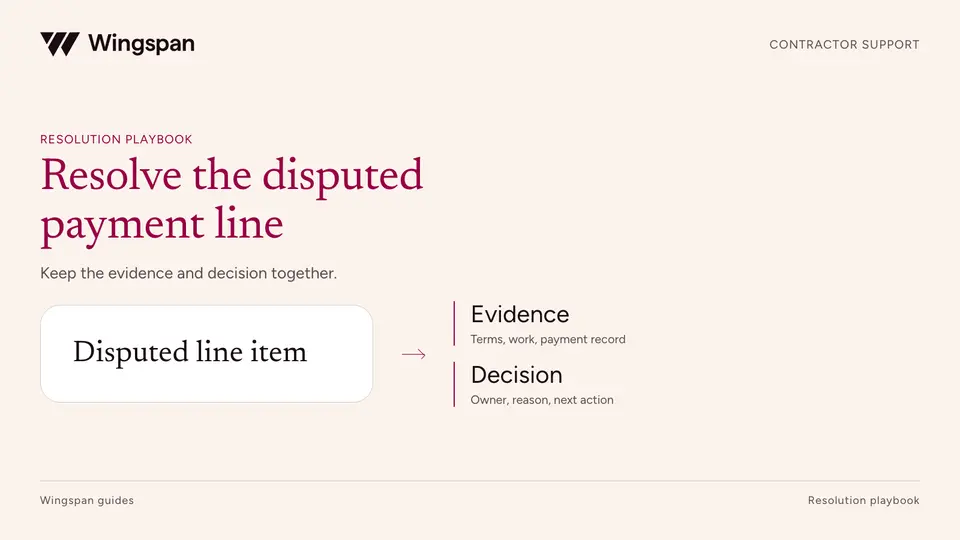
Resolve contractor pay disputes with clear intake, evidence, ownership, and adjustment records while keeping undisputed amounts and payment deadlines visible.