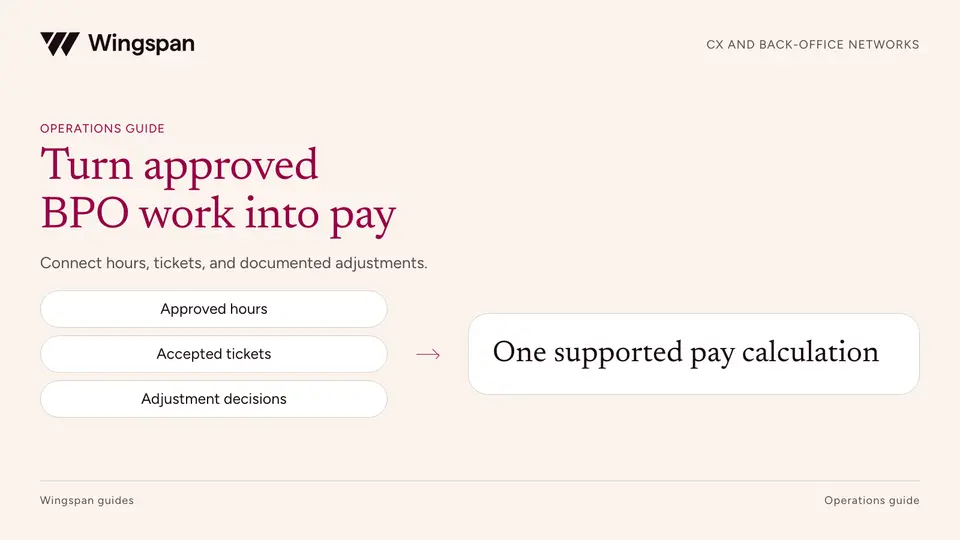
BPO contractor payments: reconciling hours, tickets, and quality adjustments
Define the earning unit for each BPO program and resolve source-system differences before creating contractor payables.
Preserve deliverable identity and accepted versions as content production batches move through review, paid additions, and payment.
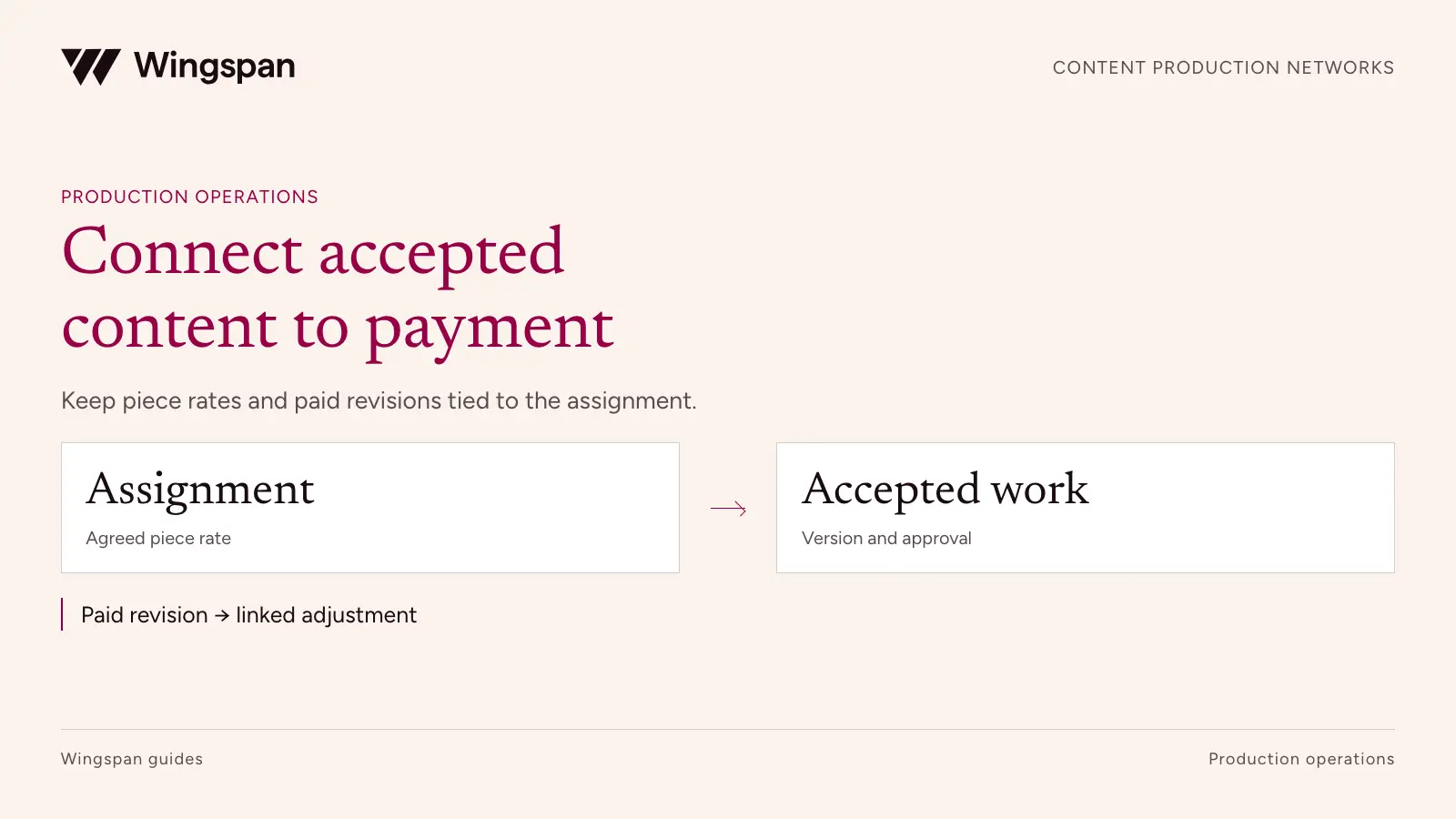
Pay a content production network from accepted deliverables and separately authorized additions, while preserving the version and rate behind each decision. Use the agreed scope and revision terms to decide whether a new upload changes the amount owed.
That distinction matters when a network processes hundreds of articles, transcripts, research records, or other production units. Files move through review, clients change instructions, and batches receive partial acceptance. A folder of final assets and a spreadsheet total cannot explain which work earned each payment.
This guide addresses repeatable production queues. Campaign-specific licensing and usage terms belong in the creator payments playbook. Here, the operating question is how a deliverable becomes an approved payable without losing its version history.
Download the deliverable ledger template, partial-batch example, and worksheet instructions. All identifiers and prices are illustrative.
Create a stable deliverable ID when the work is commissioned. Record the contractor, payer entity, project, agreed unit, rate version, scope, acceptance criteria, and payment terms. Store each file or submission version under that deliverable rather than creating an unrelated job each time it changes.
For an article, the payable unit might be one accepted piece within an agreed scope. For transcription, it might be an agreed measure of source audio or another defined unit. For structured research, it might be a validated record meeting specific requirements. Name the unit explicitly so reviewers do not price the same work differently.
Decide what constitutes a revision to the existing deliverable and what creates additional scope. A corrected typo, an expanded brief, and a new interview can require different treatment. Preserve the original brief so a reviewer can determine what changed.
A contractor's accepted engagement should establish the relevant terms. Classification also needs its own assessment: the IRS looks at the actual relationship, not merely a per-piece payment label.
Use distinct states for submitted, under review, returned with a specific request, accepted, and payment processed according to the provider's definitions. Publication may be another event. It should not be substituted for acceptance unless the agreement makes it relevant to compensation.
A client choosing not to publish a completed piece does not answer whether the contractor has earned payment. Keep any agreed cancellation or kill-fee terms visible, and have the authorized owner determine the obligation. Do not let an empty publication date keep otherwise payable work in review indefinitely.
Every acceptance decision should identify the deliverable version, reviewer, date, and scope accepted. If approval covers only part of a batch, identify the accepted units. "Batch approved at 80%" is difficult to reconcile unless everyone knows which 80% is included.
Use a short decision table to distinguish common production changes.
| Request | What the reviewer should inspect | Compensation decision |
|---|---|---|
| Correction within the accepted brief | Original scope and agreed revision terms | Apply the actual terms; do not presume unpaid work |
| Additional section or research requested | Changed brief and authorized fee | Record a separately approved addition or amendment |
| New deliverable based on an earlier file | New assignment and reused-material terms | Establish the new payable unit explicitly |
| Client changes direction after acceptance | Accepted version and cancellation terms | Preserve the earned amount and determine any new obligation |
| Duplicate submission of the same version | Deliverable and submission identities | Prevent a second payable for the same obligation |
Record who can authorize a paid revision. An editor may request a change without having authority to negotiate a fee. Give contractors a clear path to confirm scope and compensation before performing the additional work.
Payment protections vary by jurisdiction. New York's Freelance Isn't Free Act guidance provides one example of contractual protections for covered freelance engagements. Have legal owners determine the applicable requirements rather than relying on a review status to justify delaying payment.
Suppose a network commissions 12 deliverables at $80 each under rate version P1. At cutoff, nine meet the agreed criteria and are accepted. Three remain under review. The network also approves two additional revision tasks at $25 each and a $20 correction for an earlier underpayment.
The paid revision tasks are separately authorized additions to two of the accepted deliverables. They are not the same as the three pieces awaiting review.
| Component | Quantity and rate | Approved now | Awaiting decision |
|---|---|---|---|
| Accepted original deliverables | 9 × $80 | $720 | $0 |
| Remaining original deliverables | 3 × $80 potential amount | $0 | $240 |
| Separately authorized paid revisions | 2 × $25 | $50 | $0 |
| Earlier underpayment correction | Linked difference | $20 | $0 |
| Total | Separate decisions preserved | $790 | $240 |
The current approved total is $790. The $240 is a potential amount awaiting a decision, not a finding that the work is unpaid or may lawfully be delayed. The review owner must resolve each outstanding piece under the agreement and applicable payment requirements.
If all three remaining pieces are later accepted at their original $80 rate, they add $240. Total obligations from the example become $1,030: $960 for 12 pieces, $50 for paid additions, and $20 for the older correction.
The example ledger retains each of the 12 deliverable IDs, separate revision-task IDs, and the prior-payment reference. An operator can select the approved lines without losing the unfinished review queue.
Suppose the network introduces a $90 rate for assignments accepted beginning November 1. The three outstanding pieces from the example were commissioned under P1 at $80. If the agreement uses assignment acceptance as the trigger, their later editorial acceptance does not move them to $90.
Store the effective-date rule alongside the rate, and preserve the original assignment acceptance. If the parties intentionally agree to a retroactive increase, identify the covered deliverables and calculate the approved difference. That creates an explainable amendment rather than an invisible change to the ledger.
Be equally explicit about quantity changes. If a transcript's unit is source duration, store the agreed duration and rounding method. If a research batch pays by accepted record, retain the accepted record identities and duplicate rules. A rate is only useful when the quantity has a consistent definition.
The approved payment record should identify the contractor, payer entity, deliverable, accepted version, unit, quantity, rate, amount, and decision reference. Keep the asset and review history in the production system with appropriate access.
Avoid copying client confidential information into payment descriptions. A project code and deliverable reference can be sufficient for routine reconciliation, while authorized reviewers retain access to the source evidence.
Preserve the approved snapshot for each run. If an accepted file later receives another version, the historic payable should still identify the version and decision that created it. New work or a revised compensation decision should create its own traceable record.
Reconcile at both the deliverable and contractor levels. Contractor totals can match while one piece is paid twice and another is omitted. Check that each approved earning component belongs to only one active obligation before consolidating payments.
Show accepted pieces, paid additions, and earlier-period corrections separately. Give the contractor enough detail to recognize the work and ask about a specific item. Keep unresolved items in a visible review queue with an owner and next step.
The Superpath example in our customer article describes a marketing agency using Wingspan to reduce manual invoicing work and payment-related back-and-forth with writers. Payment operations are part of the writer experience, alongside briefs and editorial feedback.
Track the age of outstanding reviews, paid additions by reason, and corrections caused by rate or version errors. A recurring pattern of paid scope changes may indicate briefs need improvement. A long acceptance queue may indicate review capacity is the constraint. These are different problems from payment processing.
Use a synthetic batch with an accepted piece, an unresolved piece, a paid addition, a rate boundary, and a correction to earlier work. Re-import the same approved records and confirm they do not create duplicate obligations. Then have a contractor reviewer explain the statement from the visible references.
We connect engagement terms, work, rates, and decisions in our work and approval workflow. Large US production networks can carry that approved record into contractor payments and support without losing the context for an accepted piece or paid addition. Map your production system and acceptance rules during the configuration walkthrough.
Bring a partially accepted batch to a Wingspan demo. Ask to follow the accepted pieces into payment while keeping the remaining work and later additions traceable.
This isn't tax or legal advice. Consult a qualified professional about contractor status, agreements, payment obligations, and reporting. Sources checked October 20, 2026.
Define the earning unit for each BPO program and resolve source-system differences before creating contractor payables.
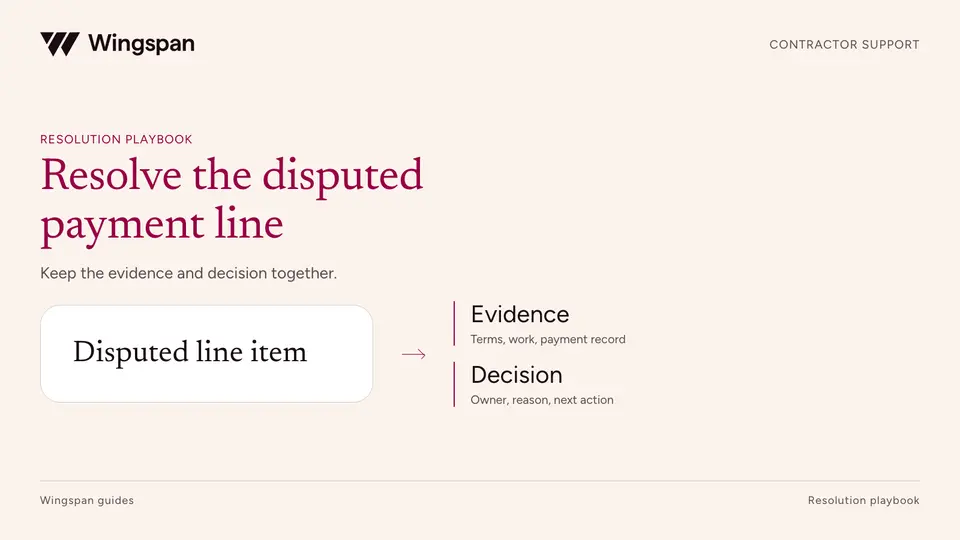
Resolve contractor pay disputes with clear intake, evidence, ownership, and adjustment records while keeping undisputed amounts and payment deadlines visible.
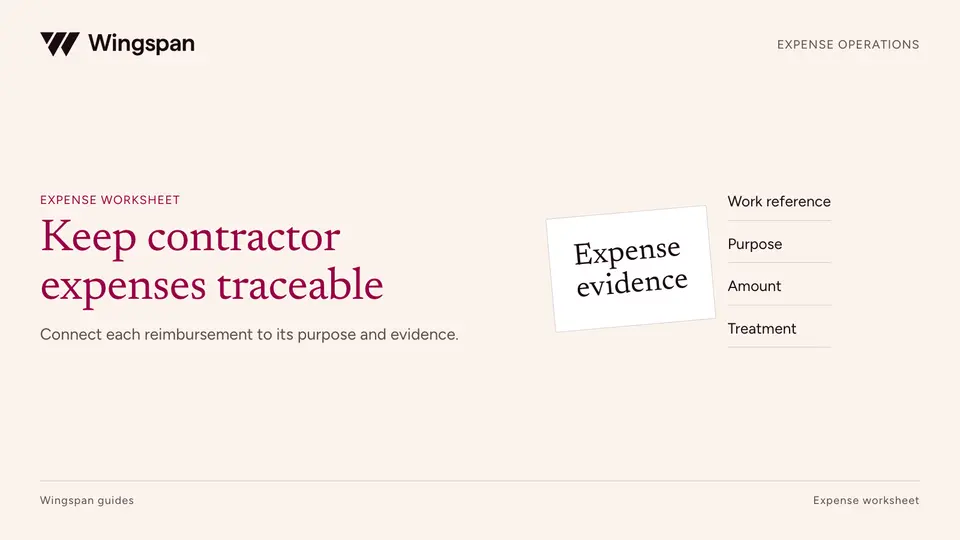
A field-network workflow for expense terms, mileage evidence, material receipts, returns, payment lines, and separate tax and accounting decisions.