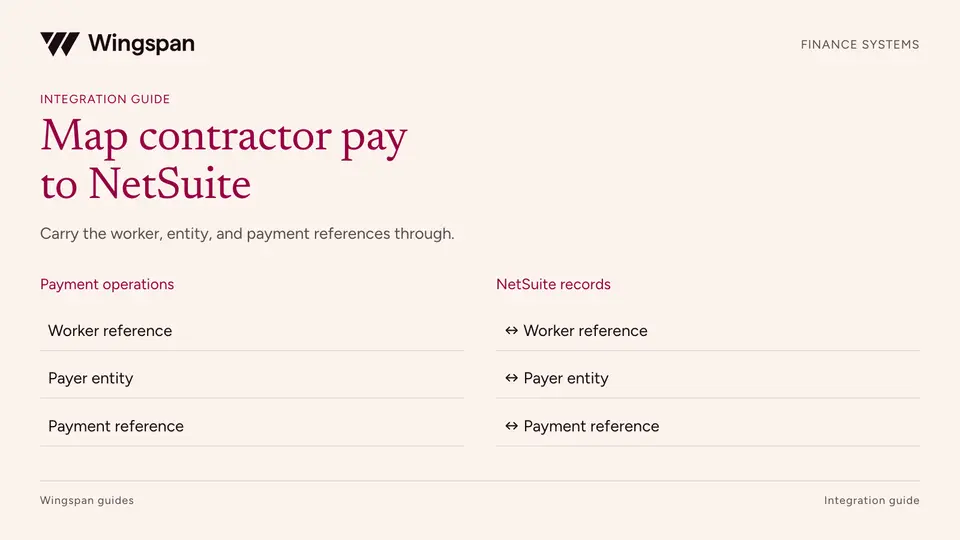
NetSuite contractor payments: a data-mapping and integration checklist
Map contractor records, subsidiaries, payables, payment results, and fees between NetSuite and your payment workflow, with practical acceptance tests.
Keep contractor agreements, funding, approvals, accounting, and tax-reporting responsibilities aligned across legal entities with a practical control map.
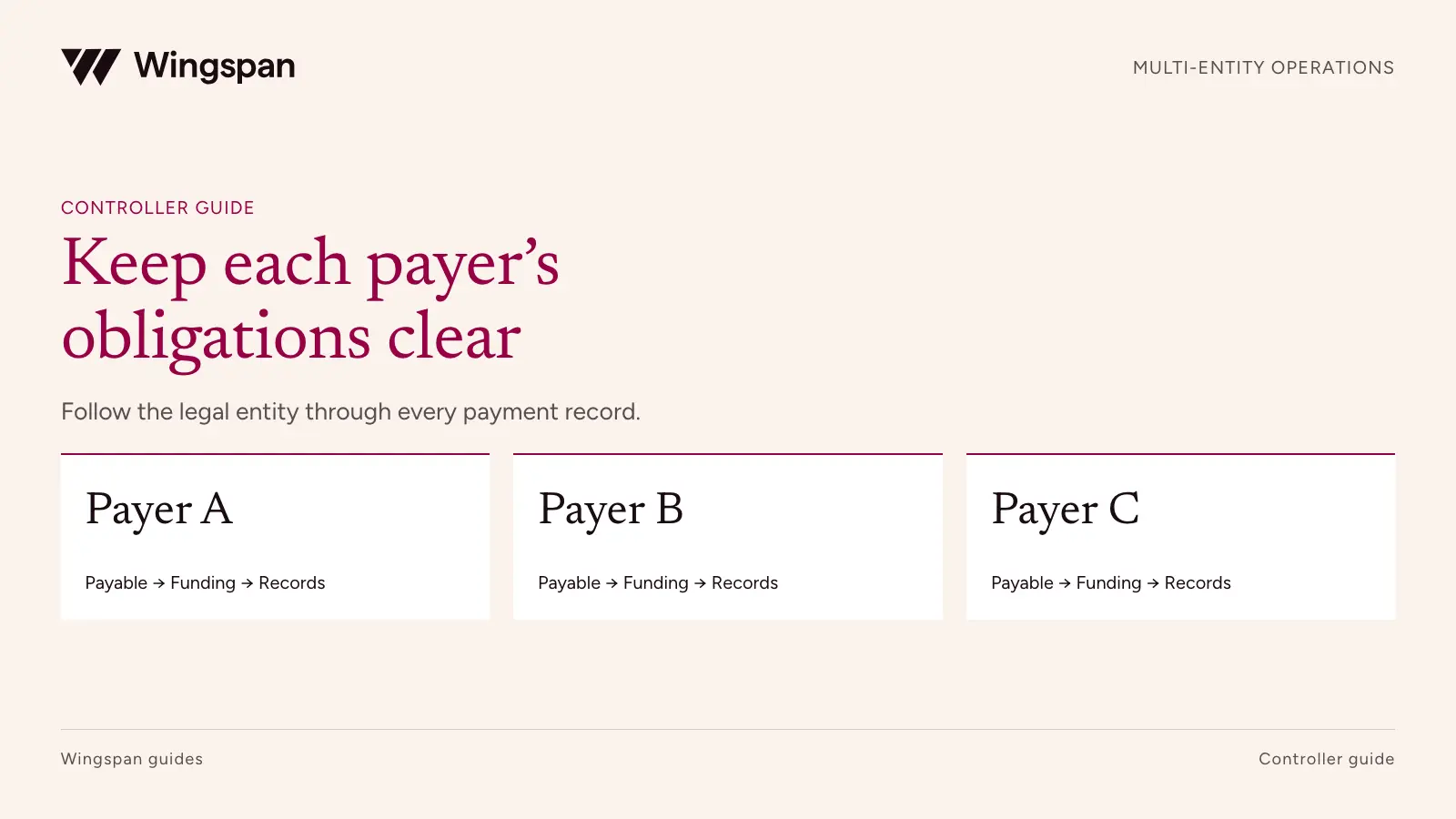
When one contractor works for several companies in your group, each obligation needs a clear legal entity from assignment through payment and reporting. Keep the contracting party, approving team, funding source, accounting owner, and tax-reporting determination visible. Define those responsibilities for each company, even when the group shares a brand and finance team.
The practical control is an entity-to-payee map attached to each engagement and payable. Finance should be able to answer which business owes the amount, which account will fund it, who can release it, and where the transaction belongs in the books before a payment run begins.
Download the responsibility-map template, worked entity example, and cross-entity exception matrix. Use the worksheet instructions to separate operating decisions from tax and accounting review.
A business unit, location, customer account, and legal entity can all appear in the same work record. Give each field a separate meaning. A location code may help allocate costs without identifying the company responsible under the agreement.
Establish the legal contracting entity when the engagement is created. Preserve the agreement reference, applicable service period, and any approved change. If work moves from one company to another, record an effective date and the authority for that change instead of overwriting prior assignments.
Then connect work approval to the same context. A regional manager may confirm that an inspection is complete while a controller determines which subsidiary records the payable. The handoff must preserve both decisions.
The work-to-approved-payment guide explains the underlying work record. In a multi-entity group, the additional requirement is that every accepted work item carries a reviewed entity assignment.
Create one mapping row for each contractor relationship with an entity and engagement. A contractor serving two subsidiaries should have two relationship rows even if a shared identity record connects them.
| Responsibility | Question finance must answer | Evidence to retain |
|---|---|---|
| Contracting entity | Which company engaged the contractor for this work? | Agreement and effective version |
| Obligation owner | Which company owes this approved amount? | Accepted work and payable reference |
| Funding source | Which authorized account supplies the cash? | Bank or provider account reference |
| Approval authority | Who can authorize this entity's payment? | Role assignment and release record |
| Accounting owner | Which ledger records the cost, liability, and cash effects? | Subsidiary and approved accounting policy |
| Reporting determination | Who is responsible for applicable information reporting? | Tax review and provider filing scope |
Keep tax identifiers and full banking details in restricted records. The working map should use references that finance can resolve with appropriate access.
Treat mismatches as exceptions requiring a decision. An invoice displaying the group's trading name may still relate to a specific subsidiary agreement. A central treasury account may fund an approved arrangement without becoming the entity that incurred the expense. Neither situation should be resolved by guessing from the most familiar name.
Some groups use centralized treasury or payment services. If your group does, document the arrangement, permitted funding routes, and accounting treatment with the appropriate advisers and payment provider. Confirm that the account permissions and provider setup support the intended entity flow.
The map should explain why cash can move from one account while an obligation belongs elsewhere. Your controller should specify any intercompany entries, reconciliation evidence, and settlement responsibilities. The entries depend on the actual arrangement.
Avoid a shortcut in which operators select whichever account has enough money. That choice can hide an entity error and make the eventual reconciliation harder. A funding shortage should create an owned treasury exception with an approved resolution.
Also distinguish pooled funding from pooled records. Even when a supported funding process combines cash movement, preserve allocations back to obligations, legal entities, and individual payment attempts. A group-level total is insufficient evidence for an entity-level close.
The company named on a bank debit is not, by itself, a complete tax-reporting determination. Treasury Regulation 1.6041-1(e) addresses payments made on behalf of another person and the relevance of management, oversight, or a significant economic interest.
Have the tax owner review those rules against your arrangement. Document the responsible filer, payer information, covered payment sources, and what the provider will file. Treat that determination as a reviewed record, not a formula based on funding-account ownership.
If several systems hold the same contractor, map the recipient identity without automatically combining separate payer populations. Conversely, several internal contractor codes don't necessarily represent separate recipients. Preserve both payer and recipient identity through the review.
Use the year-end reconciliation guide to gather channel-level payment history. The operating map should already establish who owns the reporting decision before that exercise begins.
Consider a synthetic inspection group. Contractor C-310 performs four accepted assignments for Entity East at $200 each and three for Entity West at $200 each. East's approved obligations total $800. West's total $600. The group owes $1,400 across seven assignments.
The contractor can see a useful group relationship while finance retains two payable populations. East's payment approver reviews $800 under East's authority. West's approver reviews $600 under West's authority. The entity map identifies the relevant funding reference, ledger, and reporting-review owner for each.
Now suppose an operator imports all seven assignments under East because it is the contractor's most common entity. The group amount still equals $1,400, so a total-only check passes. The entity check fails: East is overstated by $600 and West is understated by $600.
Correct the entity allocation before release when possible, preserving the rejected version and corrected references. If payment has already occurred, open an accounting and payment-operations exception. Don't create a second $600 payment merely to make West's records look complete.
The worksheet includes the two correct relationship rows. It also includes an exception matrix for wrong-entity imports, cross-entity funding, duplicate identity records, and a subsidiary change during an engagement. All amounts are illustrative.
A returned payment belongs to the original attempt and obligation even if the contractor now works for another subsidiary. Keep the original entity context while the team determines the recovery or replacement action. A later assignment should not redirect the earlier company's liability automatically.
Apply the same discipline to corrections. If an amount changes, record the original work, entity, reason, reviewer, and adjustment reference. If the original entity was wrong, distinguish correcting that attribution from changing the amount owed.
For access controls, test both permitted and prohibited actions. An approver for East should receive only the authority your policy grants for West. A centralized operations user may need broad visibility while finance keeps release rights narrower. Demonstrate those distinctions in the actual configuration.
We keep entity-level payment and tax records in Accounts, grouped within an Organization. Our V3 account model explains that structure. Map your approved legal structure to the account setup with the implementation team before onboarding your roster.
GFI's customer story describes expanding Wingspan across four divisions and creating dedicated entities for regional payment workflows. That example shows why entity structure belongs in implementation planning alongside payment cadence and operating ownership.
To review that setup for your network, bring two subsidiaries, one shared contractor, and a returned-payment case to a Wingspan demo. Ask finance to trace the entity through approval, funding, the contractor record, and the accounting handoff.
This isn't tax or legal advice. Consult a qualified professional about your entity arrangements, payment obligations, and reporting responsibilities.
Map contractor records, subsidiaries, payables, payment results, and fees between NetSuite and your payment workflow, with practical acceptance tests.
A payer guide to identifying IRS name/TIN notices, comparing submitted and current records, and giving a qualified tax owner the evidence needed for official IRS procedures.
A field-network workflow for expense terms, mileage evidence, material receipts, returns, payment lines, and separate tax and accounting decisions.