Contractor payment security: preventing fraud when bank details change
Build a bank-change control process for contractor payments, with verification steps, release checks, incident ownership, and a practical tabletop exercise.
An engagement closure workflow that keeps work, money, access, and continuing records responsibilities separate, with a final-obligation register and worked example.
Close a contractor engagement by resolving the work and money still outstanding, changing access at the right time, and preserving a reliable route for later tax documents and questions. Ending assignments is one event. Completing every financial and recordkeeping obligation can take longer.
For a company with a large contractor network, use a closure case with separate work, payment, access, and records statuses. A single "inactive" flag can't show whether a final invoice is unpaid or a dispute still needs a decision.
Use the offboarding checklist, final-obligation template, and worked example, with the worksheet instructions. They organize responsibilities without assuming a universal final-payment deadline or retention period.
This guide covers independent-contractor engagement closure for US payers. It isn't tax or legal advice. Consult a qualified professional about your agreements, applicable payment rules, record retention, and any dispute or preservation obligation. Sources were checked October 20, 2026.
Identify the engagement, payer entity, programs, and effective end date. A contractor may leave one program and continue another. Removing a relationship with one payer should not automatically be treated as deletion of the contractor's identity or records everywhere.
Record whether the case concerns a planned departure, completion of a project, extended inactivity, or another reason. Inactivity may justify an access review without establishing that the relationship has permanently ended. Use neutral operational descriptions and keep sensitive reasons in restricted records.
Check the agreement and applicable requirements for notice, outstanding work, final invoices, property, and confidentiality. Assign any legal interpretation to the appropriate reviewer. An internal checklist should implement the decision, not invent a right to cancel work or withhold money.
Name one case owner who can see the overall state. Finance, operations, security, and tax can own their respective tasks, but someone must notice when each team believes another is responsible.
Confirm the last authorized assignment date and how the team will handle work already underway. Update dispatch or assignment systems so the contractor doesn't receive new work unintentionally. Communicate the agreed transition to the people who assign and accept work.
Preserve the work records needed to evaluate the final obligation: accepted deliverables, approved rates, work dates, changes, expense evidence, and open questions. Take a dated snapshot or retain version history so a later reviewer can reconstruct the record.
If work transfers to another contractor, separate each person's contribution and agreed compensation. A reassigned task should not erase the original contractor's completed portion. Record who decides acceptance and which documents support the decision.
Don't mark every open work item canceled merely to clear a dashboard. Each item needs a supported disposition: completed and accepted, awaiting review, transferred under an agreed arrangement, canceled under applicable terms, or disputed.
List each unpaid service amount, approved expense, adjustment, advance, or other item requiring resolution. Preserve amounts already paid as history and link any later adjustment to the original record.
| Item | Owner | Evidence needed | Closure condition |
|---|---|---|---|
| Accepted service work | Operations and AP | Work acceptance, rate, payer identity | Approved amount paid and reconciled |
| Expense submission | Operations and accounting | Agreement, receipt or log, work connection | Decision recorded and resulting obligation resolved |
| Amount dispute | Authorized decision owner | Contract, work record, correspondence | Documented resolution and resulting payment action |
| Payment in progress | Payment operations | Existing payment reference and status | Delivery confirmed, or failure linked to an open resolution task |
| Company property | Assigned operations owner | Property record and agreed return process | Return or approved resolution recorded |
| Tax and record access | Tax and records owners | Delivery route, access instructions, retention decision | Continuing responsibilities assigned and accessible |
An equipment issue and an accepted service payment are separate questions. Don't assume that an unresolved return gives the company unrestricted rights to withhold unrelated amounts. Have the appropriate reviewer confirm any proposed offset.
Reconcile the register to both the work system and payment ledger. An invoice that has not yet arrived may still represent known completed work. An invoice marked paid may have a payment still in progress or under investigation. A failed attempt leaves the obligation open until payment or another authorized resolution settles it.
The following case is synthetic. Contractor C-418 ends engagement ENG-418 with PAYER-A. Operations confirms $900 of accepted work and $84 of approved expenses. A separate $150 additional-work request remains disputed. A $600 payment against the accepted service work has already settled.
| Obligation | Approved amount | Paid amount | Approved unpaid amount | Unresolved requested amount |
|---|---|---|---|---|
| Accepted service work | $900 | $600 | $300 | $0 |
| Approved expenses | $84 | $0 | $84 | $0 |
| Additional-work dispute | Not yet determined | $0 | Not yet determined | $150 |
| Known totals | $984 | $600 | $384 | $150 |
Finance can see $384 of approved unpaid obligations. The $150 is a separate unresolved request, not an approved payable and not a rejected claim. Its owner and next review date remain visible.
Assume the reviewer later approves $100 of that request and documents the treatment of the remaining $50. The resulting approved obligation total becomes $1,084. With the original $600 paid, the remaining approved amount is $484. Preserve the original $150 request and the $100 decision so support can explain the difference.
The engagement may already be closed to new work while these tasks continue. The case should show that distinction instead of using a single completion date that hides unfinished payments.
Inventory access by purpose: assignments, customer data, internal collaboration, payment history, and tax documents. Decide what ends immediately, what ends at the agreed transition, and what remains available through a limited channel.
For sensitive work systems, have the security owner carry out the approved access change and retain evidence. Check shared credentials, integrations, delegated access, and devices where relevant. Don't leave broad operational access open simply because the contractor still needs a tax document.
At the same time, avoid cutting off the only route for a final invoice, payment question, or required document. Provide an appropriate alternative when a work-system account closes. Explain the route before access changes when the circumstances permit.
With Wingspan, former contractors can retain access to payment history and tax documents after you end the engagement. Use that continuing access in your offboarding instructions, alongside a named company contact for disputes or work decisions that still belong with your team.
Keep sensitive profile changes in the approved process. A final-payment request that includes new bank details should receive the same verification as a change during an active engagement. Departure is not a reason to skip identity and payment controls.
Don't use one generic retention period for every document. Tax records, contracts, work evidence, security logs, and dispute records can have different requirements and business purposes.
The IRS explains that retention depends on the action or event a record supports and the applicable limitations period. Its guidance includes different periods for different circumstances. See how long to keep records. That page is not a universal retention schedule for every contractor-related record.
Have the records owner document the rule, start event, planned disposition, and any preservation hold. Coordinate tax, legal, security, and contractual obligations before deleting data. Keep required records accessible to authorized staff without preserving unnecessary access for former users.
Assign an owner for later correspondence and tax-document questions. Staff changes should not strand an archived case in a departed employee's inbox. Preserve the payer and contractor references needed to reconnect a later issue to the right engagement.
The contractor's summary should state the end of new assignments, known approved unpaid amounts, unresolved items, expected next actions, and where to find payment history and tax documents. Use the agreed payment terms and actual status. Don't describe a scheduled payment as already deposited.
Keep unresolved items specific. "Your account is closed" is unhelpful if the recipient still needs a decision on $150. Give the item reference, owner or support route, and next update date without disclosing internal legal analysis.
Use our contractor payment reconciliation checklist to verify the financial close and the contractor management policy to keep decision authority clear.
For a recurring contractor network, bring the closure checklist and a synthetic final-payment case to a Wingspan workflow demo. We'll walk through ending the engagement, retaining history and tax-document access, and resolving a later payment question.
Build a bank-change control process for contractor payments, with verification steps, release checks, incident ownership, and a practical tabletop exercise.

A payer guide to identifying IRS name/TIN notices, comparing submitted and current records, and giving a qualified tax owner the evidence needed for official IRS procedures.
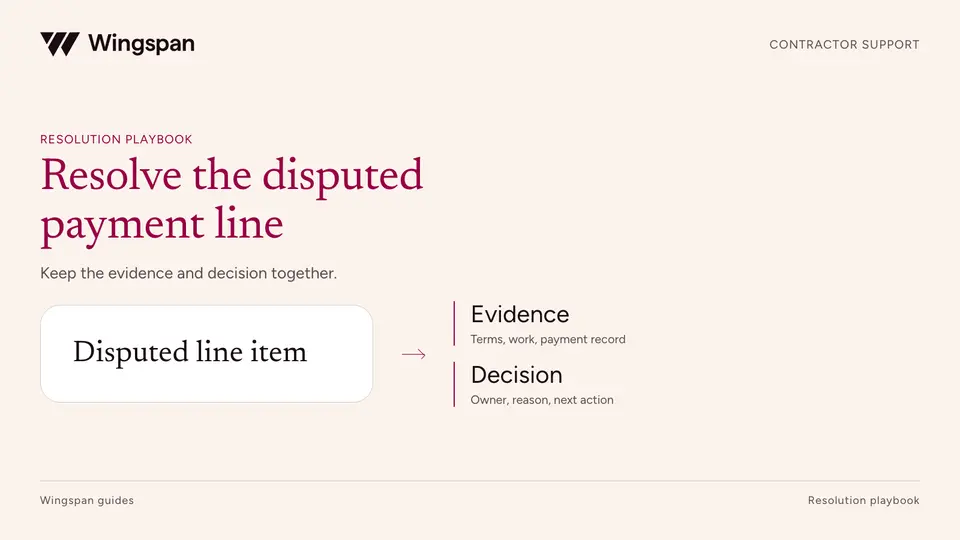
Resolve contractor pay disputes with clear intake, evidence, ownership, and adjustment records while keeping undisputed amounts and payment deadlines visible.