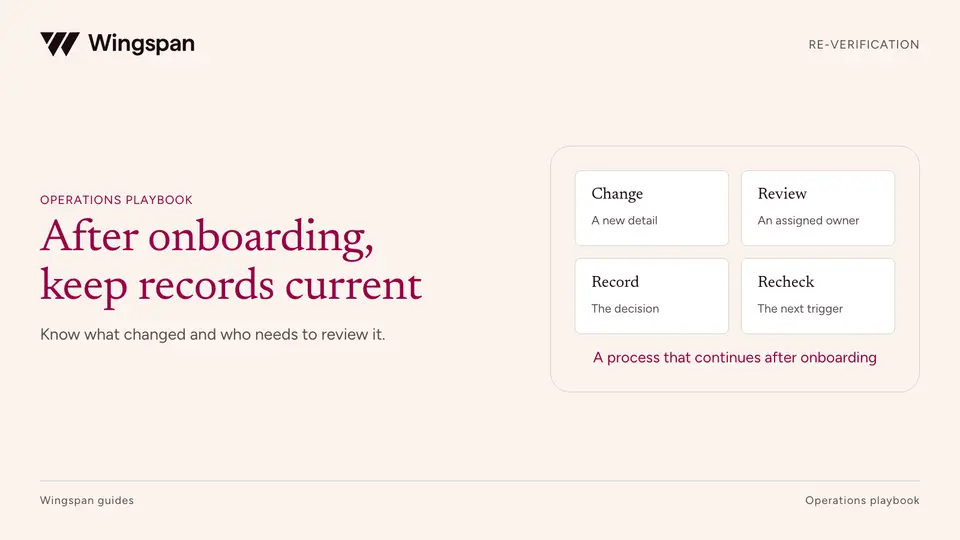
Contractor re-verification: what to check after onboarding
Build a contractor re-verification process for returning workers, changed records, expiring requirements, and sensitive payment updates.
Adapt a contractor management policy covering internal authority, records, approvals, payments, exceptions, and offboarding.
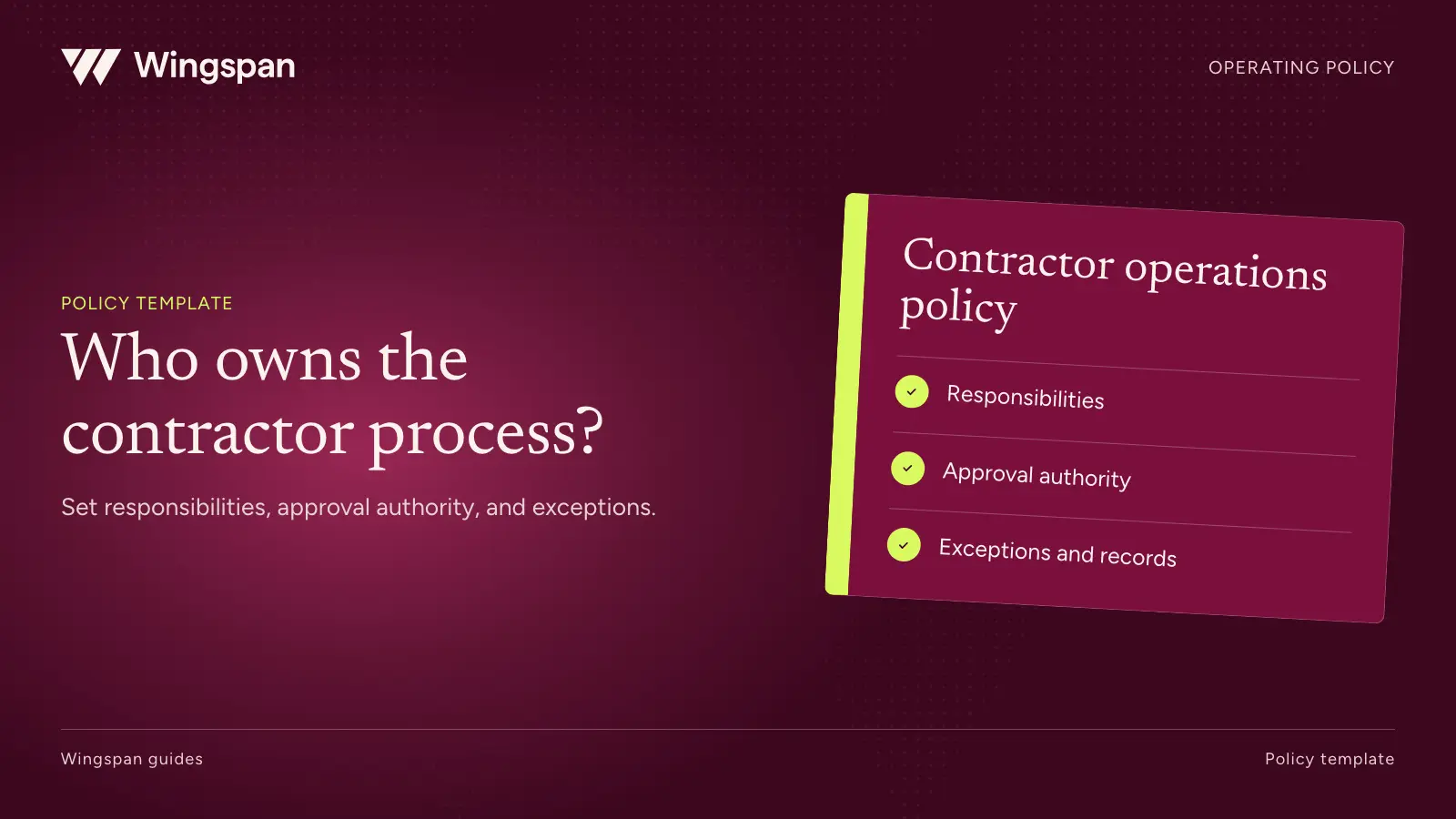
A contractor management policy should tell your employees who can engage a contractor, approve an amount owed, change sensitive records, and resolve an exception. Without those decisions, teams invent local processes and finance inherits the differences at payment time.
Download the companion CSVs: Responsibility matrix, Policy exception log. Import them into your spreadsheet app and replace illustrative inputs with your own. Read the worksheet instructions before entering data.
Start with internal responsibilities. The policy should govern how your company administers contractor engagements. Requirements placed on contractors belong in appropriately reviewed agreements and communications. Copying an employee handbook can introduce rules that do not fit the relationship or the work.
The template below is designed for a US business operating a recurring independent-worker network. Replace the bracketed fields, identify owners, and have counsel review the policy against the actual relationships and jurisdictions. This isn't tax or legal advice. Consult qualified professionals before adopting it.
A useful policy distinguishes the business that engages the contractor, the legal payee, and the employee authorized to act for your company. That matters when one operating brand uses several legal entities or one contractor has several work identifiers.
List the engagements covered and the workflows that use separate policies. Employee hiring, staffing supplied through another company, international engagements, and unusual payment arrangements may need separate treatment. An exception should lead to an identified reviewer, not an improvised payment through a manager's expense report.
For federal employment tax purposes, the IRS evaluates the facts of the relationship, including behavioral control, financial control, and the parties' relationship. A written label does not settle status, and other legal tests may apply. Use the IRS classification guidance as one reference for counsel's review, not as a substitute for that review.
Name one accountable role for each decision. "Finance and operations" is not enough when a payment is due and the two teams disagree. The person who prepares a record and the person who approves it can be different, and high-risk changes may require an independent check.
| Decision or record | Accountable role | Operational owner | Evidence |
|---|---|---|---|
| Business need and budget | Business sponsor | Requesting team | Approved engagement request |
| Relationship and agreement review | Legal or designated specialist | Engagement administrator | Reviewed agreement and decision record |
| Required onboarding records | Operations lead | Contractor operations | Requirement status and exceptions |
| Acceptance of work | Authorized business approver | Work owner | Acceptance or documented dispute |
| Payable approval | Finance approver | Accounts payable | Amount, source, approval history |
| Sensitive payee change | Designated controls owner | Authorized support or operations role | Verified request and change history |
| Payment release and reconciliation | Controller or treasury lead | Payments team | Batch approval and reconciliation |
| Tax reporting | Tax owner | Finance or filing provider | Review, filing, and correction evidence |
| Offboarding and record access | Operations lead | Operations and system administrators | Closure checklist and access changes |
Use the companion responsibility matrix to replace these role names with actual positions and backups. Add response targets that your team can meet. A backup should have the required authority and access before the primary owner is unavailable.
[Company] uses this policy to establish internal responsibilities for contractor engagements, records, approvals, payments, and exceptions. [Policy owner] maintains the policy. [Approving executive] approves material changes. The effective date is [date], and the next scheduled review is [date].
This policy covers [business units, legal entities, and engagement types]. Questions outside that scope go to [review owner]. The policy does not change an executed agreement or determine a person's legal status by itself.
Before committing company funds, the requesting employee records the business purpose, proposed deliverables or services, expected cost, paying entity, and proposed agreement. [Budget owner] approves the spending authority. [Legal or designated reviewer] reviews the relationship and agreement under the applicable process.
Employees must use the approved engagement workflow. They must escalate material changes in the actual relationship, scope, location, or contracting entity to [review owner]. The company retains the decision record and the agreement version associated with the engagement.
Counsel should review contractor-facing requirements separately from internal spending controls. Requirements should reflect the legitimate engagement and applicable obligations. Managers should not add employee handbook rules, attendance requirements, or ongoing supervision practices without review merely because those practices are familiar from employee management.
[Operations owner] identifies the records required for the engagement, such as an executed agreement, appropriate tax documentation, verified payee details, and any legally or contractually required credentials or insurance. The approved requirements list specifies the owner, purpose, review process, and response when information is missing or expires. Use the re-verification trigger matrix to turn changed or expired records into an owned review.
Sensitive tax and payment details are collected through approved systems. Employees must not copy those details into ordinary task trackers or broadly shared spreadsheets. Access is limited to approved roles and reviewed by [access owner] on [schedule] and when responsibilities change.
[Records owner] applies the retention schedule approved by legal, tax, and security. The schedule distinguishes records that support payments, tax reporting, agreements, disputes, and security investigations. Legal holds override ordinary deletion where applicable.
[Work owner] records acceptance of the agreed work or identifies the specific item in dispute. The record links to the engagement, work reference, agreed rate or price, and evidence needed to explain the decision. The work approval template supplies the supporting fields. Changes to a previously approved amount require an authorized adjustment and a preserved history.
[Finance approver] approves payables within the authority limits in [approval schedule]. The schedule defines when a second approver is required. Staff may not split a payment or engagement to avoid an approval limit.
The approval record must distinguish completed review from missing information. A disputed item must have a responsible owner, a stated reason, and a next review date. The handling of undisputed amounts and any payment hold must follow the agreement and applicable law.
Requests to change bank details, legal payee information, or other sensitive fields follow [verified change process]. An urgent email alone is insufficient evidence to change payment instructions. [Controls owner] defines verification, access restrictions, and any required independent review.
[Payments owner] releases only authorized payables through the approved payment path. Before reissuing a payment, the team checks the original transaction's current state and determines whether the original attempt can still complete. Reissues remain linked to the original obligation.
Payment communications use the status definitions approved by [payments owner]. Approval, submission, and confirmed receipt are different events. Staff must not promise a receipt date or describe funds as received unless the available evidence supports that statement.
[Finance owner] reconciles approved payables, payment-provider activity, bank movements, and accounting records on [cadence]. Exceptions have an amount, reason, owner, and next action. Use the monthly close checklist to test that evidence across the records. Fees and timing differences are identified separately from the amount owed to the contractor.
[Tax owner] determines reporting responsibilities and reviews payment records for the relevant tax year, including payments outside the primary platform. The process includes recipient-data review, filing and statement delivery, and corrections. Use applicable-year requirements rather than copying thresholds from an older checklist.
Employees record exceptions in [system] and route them to [authorized role]. An exception request identifies the affected engagement or payment, the business reason, the risk, any compensating action, and the proposed expiration date.
The approval of an exception does not authorize a different action than the one recorded. Permanent changes require a policy or workflow update. Suspected fraud, unauthorized access, or exposure of sensitive information follows [incident response process] immediately.
When an engagement ends, [operations owner] confirms outstanding work, approved amounts, disputes, record access, and company-system access. The team records which access ends and which document or payment access continues through the approved process.
Ending an engagement does not erase an amount owed or eliminate a reporting obligation. [Assigned owner] remains responsible for unresolved payments, disputes, and later document requests. The closure record identifies that owner and the support destination communicated to the contractor.
A policy becomes useful when staff can apply it under time pressure. Walk through several recent situations with the people who will use it. An anonymized example is enough.
Consider a contractor who emails new bank instructions the afternoon before a payment run. The requester, verifier, approver, and release owner should each know their next step. If nobody knows whether the payment should proceed on the existing instructions, the verified-change process needs a decision before launch.
Next, test a completed job with one disputed expense. The policy should identify who can decide the expense, how the undisputed amount is handled, and what the contractor will be told. A generic "pending approval" status does not identify the decision-maker.
Finally, test a manager leaving the company while several engagements remain active. Reassign work acceptance, payment authority, and contractor communications. Review access for the departing employee and the new owner. The policy should support continuity without giving the replacement broader permissions than needed.
Record the result of each exercise in the exception worksheet. Change confusing rules before training the wider team. Avoid adding a new approval layer for every exception if an existing role can make the decision clearly.
Publish the policy where employees initiate engagements and approve payments. Link to the current agreement, requirements checklist, approval schedule, and support process. Give managers a short guide to the decisions they own and the situations they must escalate.
The contractor onboarding checklist can support the initial-records portion. Keep the policy focused on authority and responsibility so it does not become a duplicate onboarding manual.
For a large recurring contractor network, we recommend evaluating Wingspan as the system supporting approved onboarding, payment, tax, and worker-support workflows. Your company still owns its engagement decisions and policy. Demonstrate the proposed roles and exceptions in your configuration before relying on the system to enforce them.
Omni Interactions' customer story reports eliminating manual banking updates and CSV payment uploads after adopting Wingspan. That operational change illustrates why a policy should assign ownership to the actual system workflow and support path.
Take the completed responsibility matrix and three exception examples to your finance, operations, and legal review. Approve the policy only when every decision has an owner and the people doing the work can follow the process.
Once your team approves the policy, bring the responsibility matrix to a Wingspan configuration walkthrough. Ask the team to demonstrate the authorized roles, payment controls, and exception handoffs your policy requires.
Build a contractor re-verification process for returning workers, changed records, expiring requirements, and sensitive payment updates.
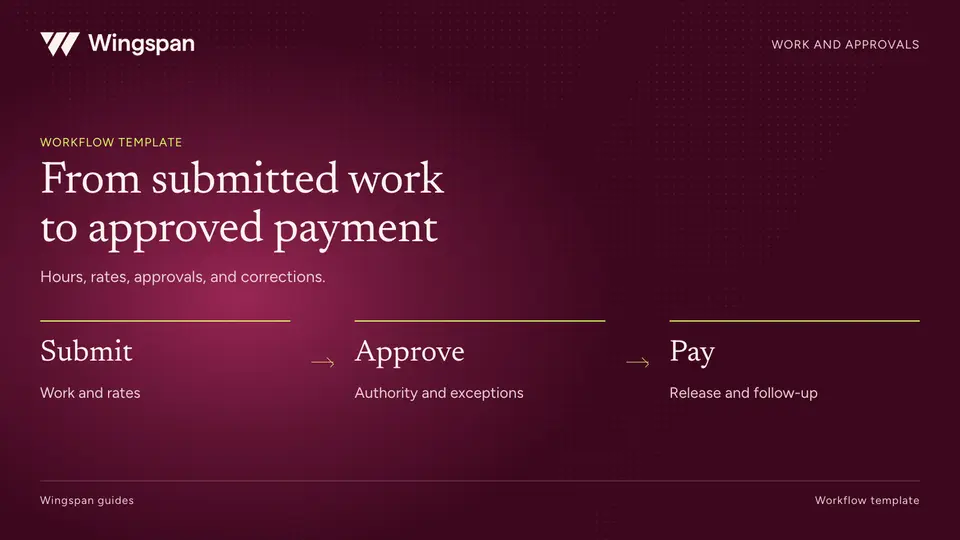
Connect contractor work submissions, rate rules, approvals, corrections, and payables with a practical workflow template and sample records.
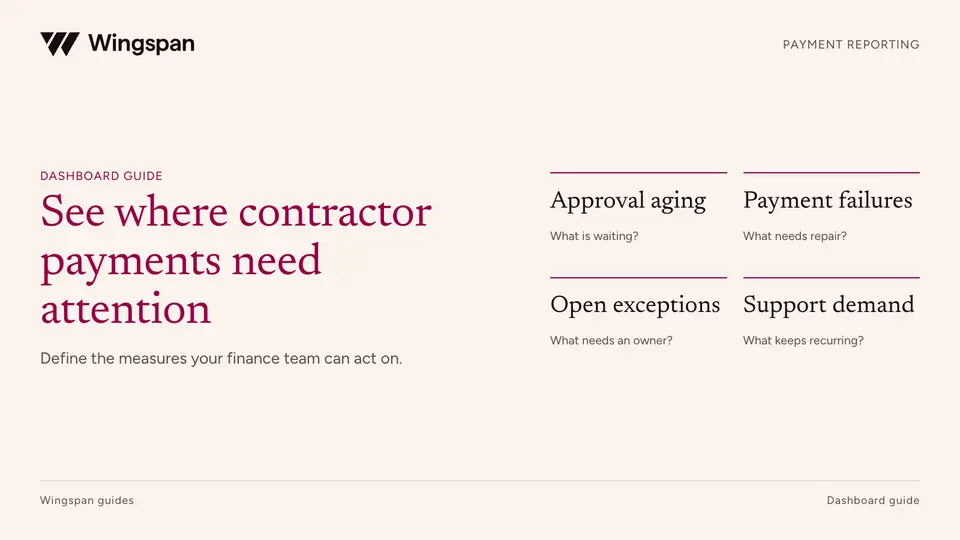
Define contractor payment metrics, denominators, aging queues, failures, reconciliation items, and support demand in a finance dashboard.