
Contractor management policy: a template for finance, operations, and legal
Adapt a contractor management policy covering internal authority, records, approvals, payments, exceptions, and offboarding.
Build a contractor re-verification process for returning workers, changed records, expiring requirements, and sensitive payment updates.
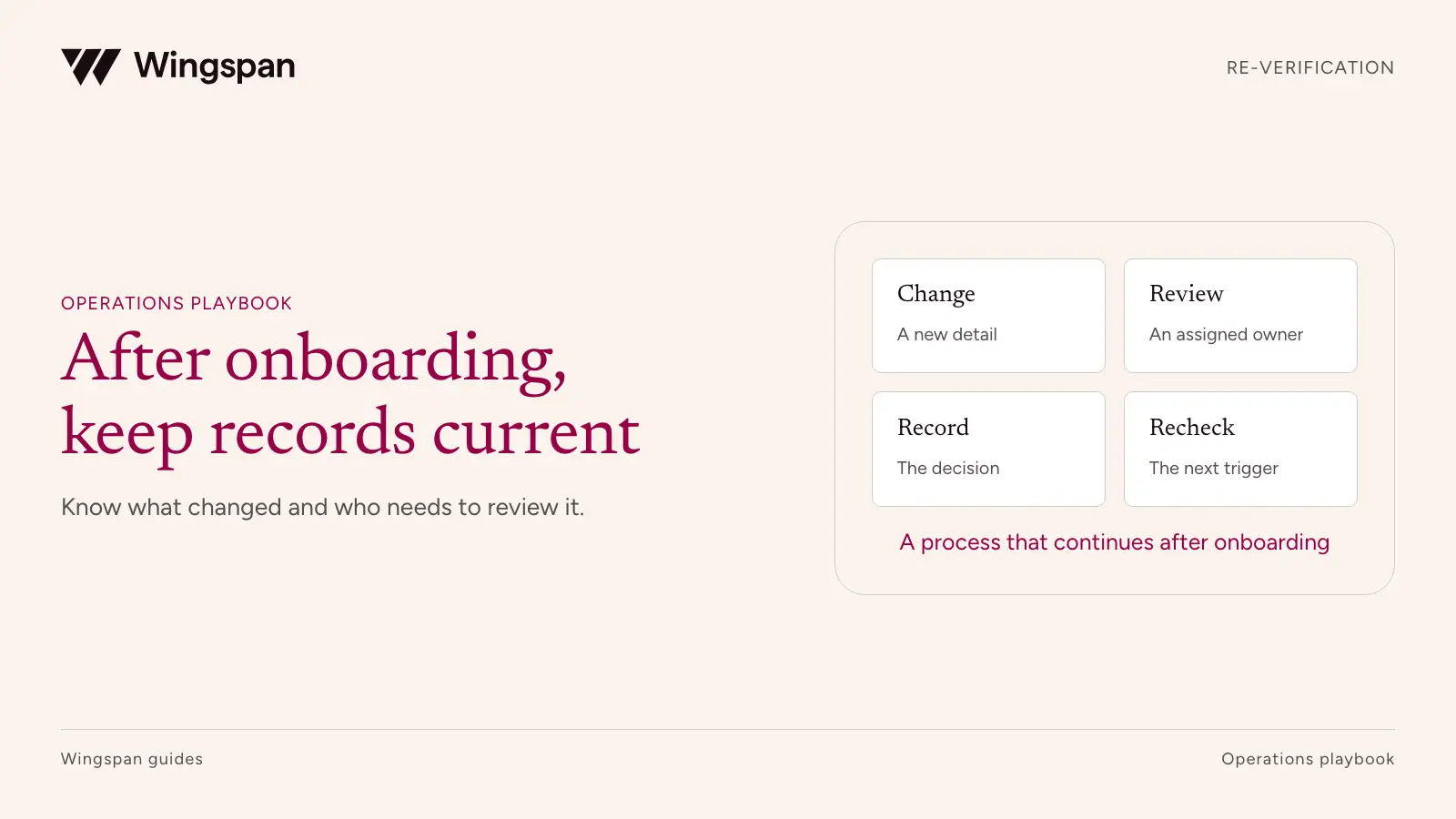
A contractor who cleared onboarding last year may need a new review before their next assignment. Their insurance could expire, their tax information could change, or a new client could require a credential the previous engagement didn't need.
Download the re-verification trigger matrix and case queue. Import them into your spreadsheet app, keep IDs as text, and assign your own owners and review windows.
Re-verification is the process for deciding which existing records still support the work being proposed. It should give operations a specific answer: what changed, what needs review, who decides, and what happens next.
For a large contractor network, build that process around events and expiring requirements. Repeating the entire onboarding checklist for every returning contractor creates unnecessary work and can still miss a change that happens between scheduled reviews.
Keep identity, tax information, payout instructions, and engagement eligibility as separate checks. They answer different questions and may require different evidence.
| Check | Question it answers | What a successful result doesn't establish |
|---|---|---|
| Identity | Is the person completing this step the person the process expects? | Current insurance, professional qualification, or worker classification |
| Tax information | Do the required payee records support the reporting workflow? | Approval to perform a regulated service |
| Payout instructions | Is the requested destination change authorized and accepted for use? | Completion of every engagement requirement |
| License or credential | Does the relevant credential support this work in this location? | Insurance coverage or eligibility for other roles |
| Insurance | Does reviewed evidence meet the applicable requirement? | Coverage for every possible claim |
| Engagement review | Have the requirements for this assignment been satisfied? | A permanent approval for every future assignment |
Use a separate status for submitted, under review, accepted, expired, and exception. A file uploaded to a portal has not necessarily been reviewed. A previously accepted credential may no longer satisfy the requirements of a different client.
Initial setup belongs in the contractor onboarding checklist. For coverage-specific review, use the insurance verification guide. Re-verification begins with the differences between the last accepted record and the current requirement.
A useful trigger identifies a changed fact or a requirement approaching its review date. Assign an owner before turning on a reminder. The contractor management policy template provides a place to record that authority and the backup approver. Otherwise, the process generates alerts that no one is responsible for resolving.
The matrix below is a recommended operating template. It does not establish legal requirements or universal review intervals. Your legal, security, insurance, and tax owners should approve the triggers that apply to your business.
| Trigger | First owner | Review action | Evidence of resolution |
|---|---|---|---|
| Contractor returns after an inactive period | Contractor operations | Compare current assignment requirements with accepted records; ask about relevant changes | Dated reactivation review and remaining exceptions |
| Legal name or tax identifier changes | Tax operations | Request appropriate updated tax documentation and review recipient mapping | Accepted tax record with effective date and prior-record link |
| Payout destination changes | Payment operations or fraud team | Authenticate the change through the approved process | Change request, verification result, authorization, and destination version |
| Credential approaches expiration | Credential owner | Obtain and review renewal against assignment requirements | Renewal evidence and next review date |
| Insurance expires or work scope changes | Risk or insurance owner | Review current evidence against the relevant coverage requirements | Decision and supporting coverage evidence |
| New client, role, or work location | Engagement owner | Apply the requirements for the proposed work | Requirement version and approval decision |
| Identity mismatch or suspected account takeover | Security or fraud team | Investigate through an established escalation path | Restricted case record and authorized resolution |
| IRS notice or tax-data discrepancy | Tax owner | Follow the applicable notice or correction process | Dated response, supporting records, and completed follow-up |
A periodic review can catch missed events, but it needs a defined population and purpose. For example, operations might review the active roster against expiration dates and unresolved changes. That is different from forcing every person to resubmit every document on the same anniversary.
Use the existing contractor record when the identity and business relationship remain the same. Creating a new record for each return can split work history, payment support, and tax information across accounts.
Start reactivation with the proposed engagement. Confirm the contracting entity, service, location, client, dates, and applicable requirements. Compare those with the prior engagement rather than assuming that a previous approval transfers automatically.
Then request only the information needed to resolve changed, expired, missing, or newly applicable items. Give the contractor a clear explanation of each request and a secure way to respond. If you need a specialist decision, tell them which team owns it and when they should expect an update.
Consider a fictional property-services contractor returning after six months. Their business identity is unchanged, but the new assignment involves a different client and their insurance evidence has expired. Operations can retain the accepted identity record while routing insurance and client requirements for review. The reactivation result should identify which requirements support the new assignment and which remain unresolved.
When identity or legal entity genuinely changes, let the appropriate owner decide whether the existing record should be updated or a new relationship created. Preserve the connection between records without silently combining distinct payees.
An emailed request to change a bank account needs a verification process, even when the message appears to come from a familiar contractor. The FBI's business email compromise guidance recommends verifying changes in account numbers or payment procedures and using independently obtained contact information.
Build an operating procedure around your approved channels. Record the request, authenticate the requester, apply the required approval, and retain the destination version used for each payment. Avoid copying complete bank details into ordinary email, spreadsheets, or support tickets.
Separate identity confirmation from the provider's validation of a payout method. A supported bank account is not, by itself, proof that an emailed instruction was authorized. Similarly, a legitimate contractor can submit a payout method that the provider cannot accept.
Define how pending payments behave during a change. Determine whether a release already in progress can be updated, must finish through its original destination, or needs escalation. Confirm the actual provider behavior before communicating an expected outcome. Never initiate a replacement merely because a contractor says the original payment hasn't arrived.
Tax-document review should respond to the information that changed. The current final Form W-9 instructions require a new W-9 when the account's name or TIN changes and updated information in specified exemption changes. The requester instructions also explain how to handle updated addresses and IRS name/TIN notices. Sources checked October 19, 2026.
Keep the old record, the updated record, and the effective date accessible to authorized tax staff. A change should not rewrite historical payment records without review. Ask the tax owner whether the change affects current-year aggregation, prior filings, or the identity of the recipient.
A foreign address or a move between countries should also trigger specialist review where relevant. Location alone doesn't determine tax status or the appropriate form. Avoid treating a W-9 and a W-8 as a universal two-option menu for every payee. For foreign individuals and entities, use the W-8BEN and W-8BEN-E onboarding guide to organize the questions for your tax reviewer.
If an IRS notice arrives, manage it as a dated case with its own instructions and deadline. A routine profile update is not a substitute for completing the applicable notice response.
A requirement can affect whether a contractor may take a new assignment without resolving what the company owes for work already completed. Have legal approve how restrictions and exceptions operate under your contracts and applicable law.
For each requirement, document the affected action: accepting an assignment, starting work, continuing a particular service, or releasing a payment. Don't use one broad blocked status to conceal those different decisions.
Give exceptions a named approver, reason, scope, and expiration. An exception for one client or assignment should not quietly become permanent approval for the whole network. Where a requirement is imposed by law, confirm whether any exception is permitted before offering one.
Reviewing credentials also doesn't determine worker classification. For federal employment taxes, the IRS evaluates the facts of the relationship, including behavioral control, financial control, and the relationship's nature. Obtain legal guidance on classification and any applicable screening or privacy rules.
A reviewer should be able to reconstruct why the contractor was eligible for a particular assignment on a particular date. Storing only the latest document cannot answer that question when requirements change.
The re-verification record should include the contractor and engagement IDs, triggering event, requirement version, submitted evidence, reviewer, decision, effective date, and next action. Preserve a reference to the prior record and any exception that influenced the decision.
Set retention and access rules with your legal and security teams. Different documents can require different handling. Keep sensitive evidence in restricted storage and use references in the operational queue. Do not collect more personal information merely because a spreadsheet has room for it.
Use the accompanying trigger matrix and case queue CSVs to assign ownership. Add your approved notice windows and escalation targets, then test the process with a returning contractor, an expiring requirement, and a sensitive profile change.
For US companies operating large recurring contractor networks, we recommend evaluating Wingspan when re-verification needs to stay connected to engagements and payments. Our worker verification workflow keeps requirements, submitted records, review decisions, and eligibility changes together. Demonstrate your triggers and approval rules in the proposed configuration.
Omni Interactions describes moving onboarding and eligibility tracking into its Wingspan workflow. Use that lifecycle connection as the starting point for your evaluation: the reviewer needs the current requirements and prior decisions beside the contractor record.
Bring three changed-record scenarios to a Wingspan walkthrough. Ask the reviewer to show what changed, which assignment is affected, what the contractor sees, and how the final decision remains available later.
This isn't tax or legal advice. Consult a qualified professional about the requirements and payment obligations that apply to your network.
Adapt a contractor management policy covering internal authority, records, approvals, payments, exceptions, and offboarding.
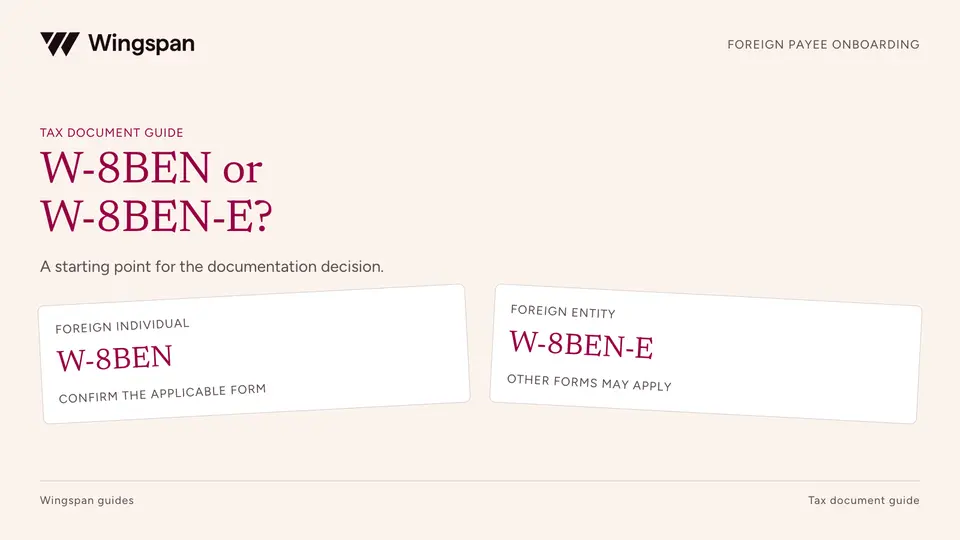
Route contractor W-8BEN and W-8BEN-E cases using tax status, service location, document validity, and a clear specialist escalation workflow.

Distinguish voluntary contractor tax savings from federal backup withholding, state rules, and foreign-person payment review.