Paying contractors across multiple legal entities: a control checklist for finance
Keep contractor agreements, funding, approvals, accounting, and tax-reporting responsibilities aligned across legal entities with a practical control map.
Build event closeout packets that preserve venue ownership, assignment terms, authorized changes, cancellation amounts, and prior payments.
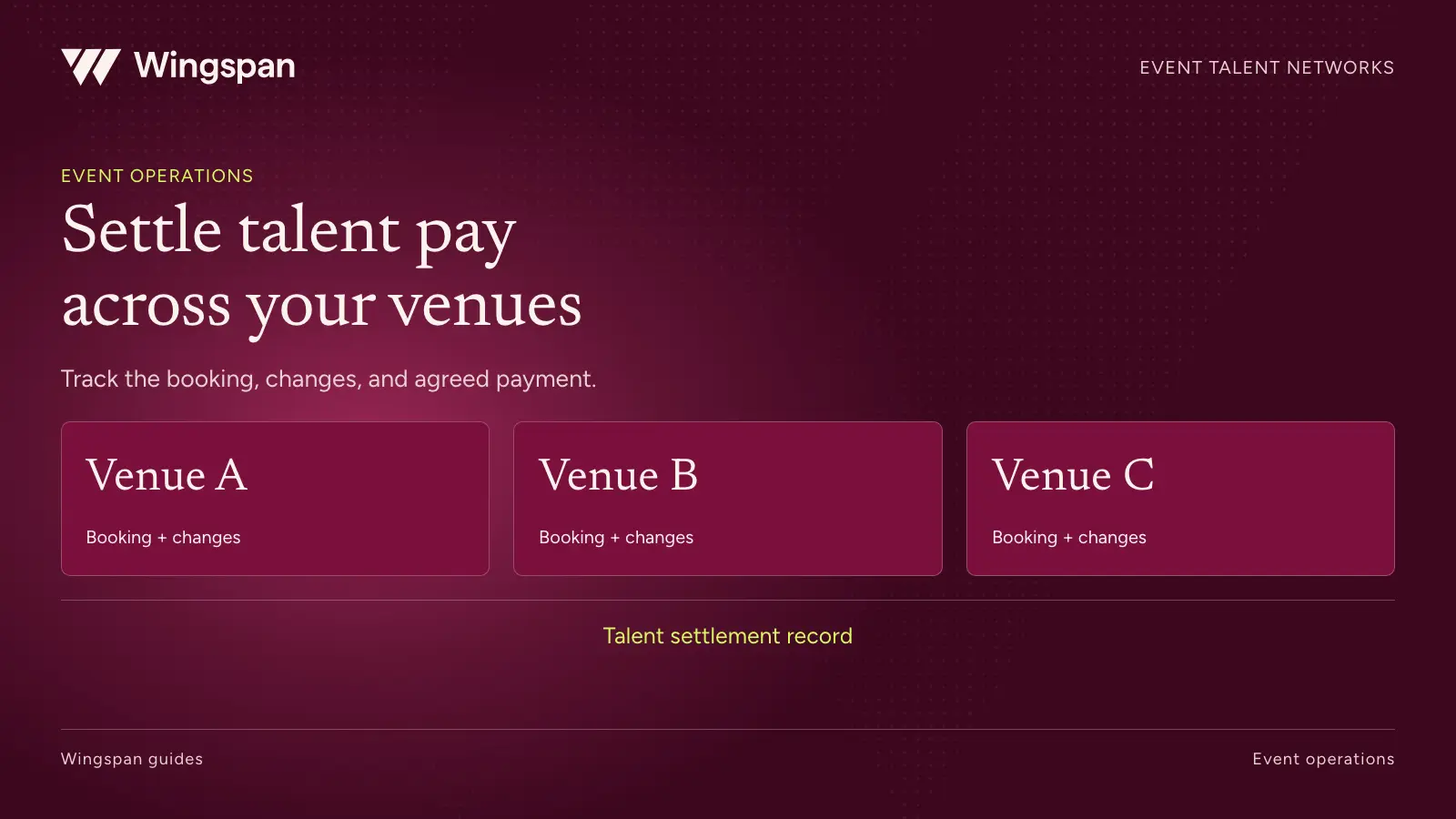
Close each event with a record of the accepted assignment, authorized changes, cancellation decisions, expenses, and final amount owed to each independent provider. Keep the venue, event, and payer entity attached to those records even if finance consolidates several assignments into one payment.
A venue calendar shows what was scheduled. It rarely explains the final obligation after a performance runs longer, an appearance moves to another location, or a booking is canceled. Those changes need their own compensation decisions before the event disappears from the team's immediate attention.
This guide covers legitimately independent talent and service providers. An event-based assignment alone does not establish contractor status for venue staff. The IRS considers the actual relationship when determining worker status. Have legal owners assess applicable federal, state, and local requirements.
Use the event closeout template, illustrative settlement packet, and instructions to define the records your venue managers hand to finance.
An assignment should identify the provider, event, venue, contracting entity, service, agreed fee basis, and payment terms. A flat performance fee, a day rate for a defined service, and a separately priced appearance should remain distinguishable.
State what changes require approval and who can approve them. A venue manager may be authorized to accept completed work but not to negotiate additional fees. Give providers a clear contact for changes so a last-minute request does not become an undocumented dispute after the event.
Preserve the accepted version of the assignment. If the event moves from Venue A to Venue B, record whether the service, travel expectations, price, and payer remain the same. A calendar edit should not silently rewrite the agreement.
For a multi-venue group, decide which legal entity is engaging the provider. The venue name or cost center does not necessarily identify that entity. Finance needs the contracting relationship before it can determine how the payable should be recorded and released.
Use a short change record with the original assignment, requested change, time, requester, authorized decision, and compensation effect. Attach the relevant agreement reference. A free-text note saying "stayed late" does not establish the duration, reason, or amount agreed.
For additional time or services, preserve the unit and rate. If the parties agree to an extra $100 for a defined extension, record that agreement. Do not invent an employee overtime rule for an independent engagement, or assume the contractor label removes obligations that applicable law may impose.
If the event ends early, check the cancellation or minimum-fee terms. Actual time on site may be evidence, but it is not necessarily the fee basis. A flat contracted performance can remain a flat fee even when a schedule changes.
Canceled assignments should remain in the closeout packet until the payment obligation is resolved. Record who canceled, when notice was given, the relevant provision, any work or expense already incurred, and the authorized outcome.
| Event change | Evidence to retain | Compensation question |
|---|---|---|
| Organizer cancels before the event | Notice timestamp and cancellation terms | Is an agreed cancellation amount or other obligation due? |
| Venue moves the event | Accepted change and any travel effect | Does the original fee still apply? |
| Provider cannot perform | Notice, replacement arrangement, agreement | What settlement follows from the actual terms? |
| Weather interrupts the event | Event record and applicable contract terms | How do interruption or cancellation provisions apply? |
| Event is rescheduled | Original and replacement assignment references | What happens to deposits and any cancellation obligation? |
A rescheduled event needs a clear link to the original booking. Otherwise, the group may pay a second deposit without accounting for the first, or mistakenly treat a separate cancellation fee as a credit toward the replacement event.
Contract and jurisdiction matter. New York's Freelance Isn't Free Act guidance is one example of state protections and contractual requirements that may apply to covered engagements. Have counsel establish the rules for your population rather than imposing one nationwide cancellation or payment policy.
After the event, the venue owner should confirm the agreed service outcome and submit documented changes. Operations should resolve missing references and route disputed items. Finance should receive the resulting approved obligations with due dates, payer entity, and evidence references.
Consider this illustrative weekend for provider ET-006, contracted by a single legal entity across two venues. Assignment A carries a $450 performance fee. An authorized extension adds $100, and a $24 parking expense is approved. Assignment B is canceled, with a $150 cancellation amount due under its agreed terms. No deposit or advance was previously paid.
| Component | Event and venue | Approved amount |
|---|---|---|
| Original performance | Event EV-101, Venue A | $450 |
| Authorized extension | Event EV-101, Venue A | $100 |
| Parking expense | Event EV-101, Venue A | $24 |
| Agreed cancellation amount | Event EV-102, Venue B | $150 |
| Total obligation | Same provider and payer entity | $724 |
Finance can consolidate the $724 for payment while keeping $574 associated with Event EV-101 and $150 with Event EV-102. The example has no fees, withholding, or prior credits. If those apply, show them separately and explain the authorized amount released.
If a $200 deposit had already been paid toward Assignment A, the remaining balance on that assignment would be $374, and the total remaining payment would be $524. The deposit must be linked to the obligation before subtracting it. Do not subtract a deposit associated with another event merely because the same provider received it.
The worksheet includes the no-deposit example. Its prior-paid field lets your team record verified advances without concealing the total agreed compensation. Use separate records if more than one prior payment needs to be reconciled.
We support reimbursable expenses as line items. Your tax and accounting owners determine their treatment.
A venue manager can confirm that a performer completed the agreed appearance. Finance still needs to confirm the payee, payer entity, amount, prior payments, and release authority. Define both decisions so the event does not become payable twice through a venue invoice and a central roster upload.
Use a stable assignment ID as the link between the event system and the payable. Similar names, identical fees, and recurring appearances make amount-only duplicate checks unreliable. A second $450 fee may be another valid event or a duplicate of the first.
Give open decisions a named owner after the event. A venue manager leaving for a new assignment should not take the only knowledge of an approved extension with them. Keep the evidence and delegation available for the backup reviewer.
The payment detail should show each event and component, earlier advances applied, current approved balance, and payment status. A canceled event with an agreed fee should be understandable without reopening the booking email thread.
Provide a route for questions about the work or terms and a separate route for payment delivery issues. Avoid promising bank arrival based only on an internal approval date. Use the provider's documented processing information and confirmed schedule.
Pourtastic's customer story describes a promotional tasting business using Wingspan for its independent brand ambassador network, including payment visibility and contractor support. Its experience shows why payment visibility and support belong in the event closeout plan.
For recurring appearances, the recurring and off-cycle payment guide helps align payment calendars. Keep event changes and settlement decisions attached to that calendar rather than copying the previous appearance's amount.
Run a synthetic weekend containing an extension, a cancellation, a venue move, and an earlier deposit. Ask two venue owners to prepare their closeout records and have finance reconcile them without additional explanation. Any question that requires memory should become a field, evidence reference, or assigned decision.
We connect assignments, rates, work records, and review decisions in our work and approval workflow. For US companies with large independent talent networks, that gives venue teams and finance a shared basis for the settlement handoff. Map the workflow to your venue ownership and settlement rules.
Bring a multi-venue weekend to a Wingspan demo. Include a canceled appearance and a previously paid deposit so the walkthrough shows how your team can explain the final balance.
This isn't tax or legal advice. Consult a qualified professional about classification, cancellation terms, payment obligations, and reporting. Sources checked October 20, 2026.
Keep contractor agreements, funding, approvals, accounting, and tax-reporting responsibilities aligned across legal entities with a practical control map.
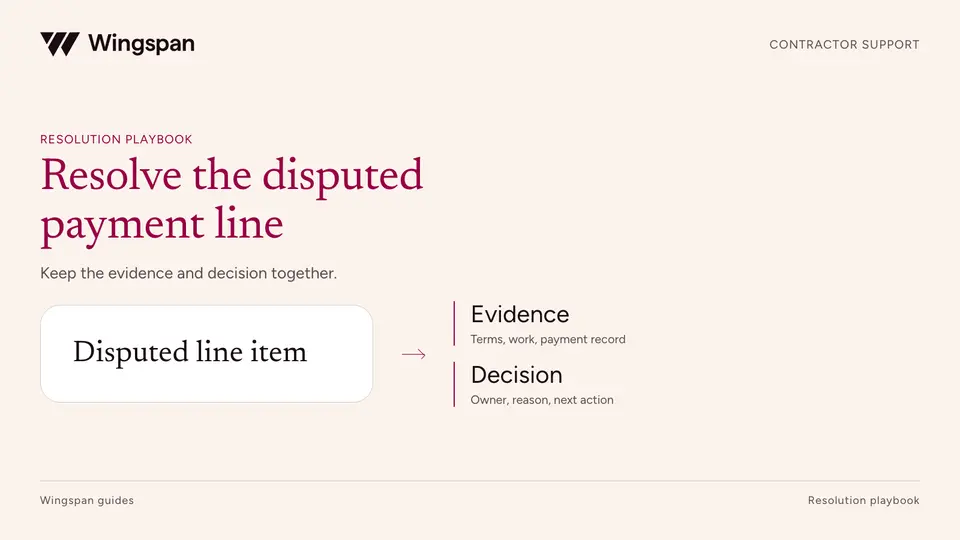
Resolve contractor pay disputes with clear intake, evidence, ownership, and adjustment records while keeping undisputed amounts and payment deadlines visible.
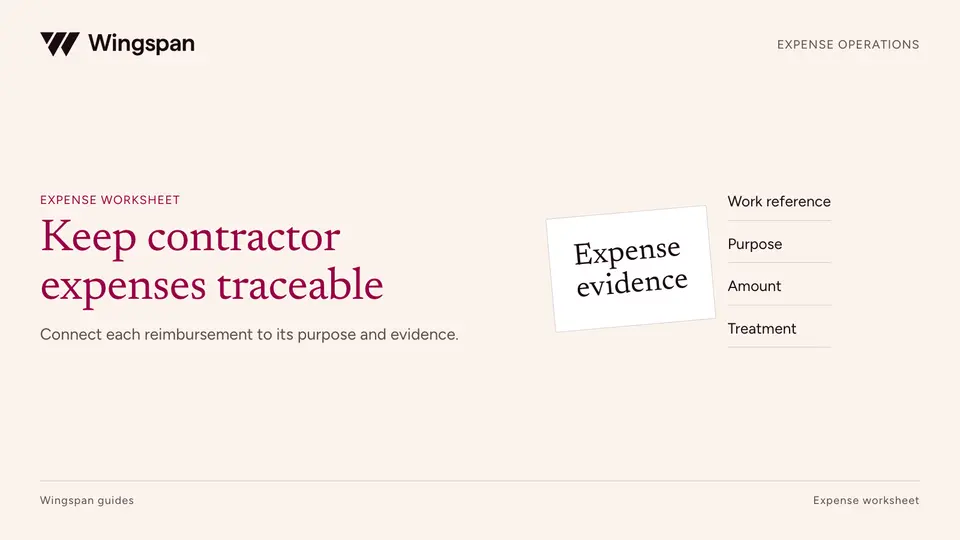
A field-network workflow for expense terms, mileage evidence, material receipts, returns, payment lines, and separate tax and accounting decisions.