Paying contractors across multiple legal entities: a control checklist for finance
Keep contractor agreements, funding, approvals, accounting, and tax-reporting responsibilities aligned across legal entities with a practical control map.
Map contractor records, subsidiaries, payables, payment results, and fees between NetSuite and your payment workflow, with practical acceptance tests.
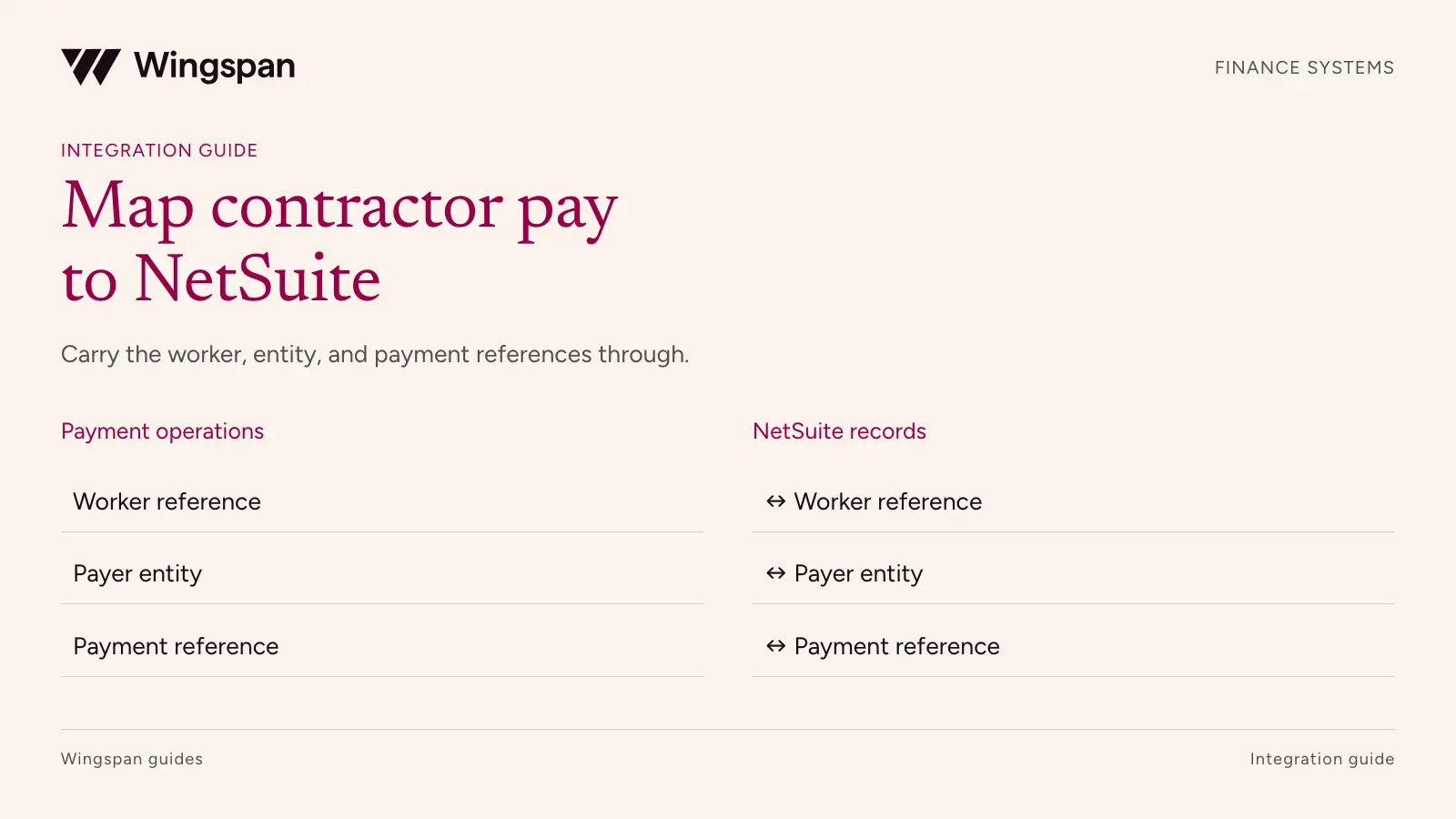
Start a NetSuite contractor payment integration by deciding which system owns each record. Define which system owns contractor identity, the amount owed, payment approval, cash movement, and accounting treatment. Then specify how each record keeps its legal entity, currency, and original reference across the handoff.
For a network paying thousands of contractors, an integration can transfer every field successfully and still create the wrong result. A replayed event can create a second bill. A payment status can close a bill too early. A vendor shared across subsidiaries can receive a transaction under the wrong company.
Use the field-mapping specification, acceptance-test template, and synthetic test cases with the workbook instructions. Use these worksheets to design and test the handoff before preparing an import.
Our standard NetSuite integration includes vendor, payable, payment, subsidiary, purchase-order, and journal-entry mappings. As of October 20, 2026, the published workflow supports itemized vendor bills or summary journal entries as alternative ways to post contractor costs.
Plan the configuration around your chart of accounts, subsidiary structure, vendor records, and approval process. Record who owns the setup, who monitors it, and which changes need maintenance.
Ask for the exact supported records and operations, direction of each flow, frequency, authentication approach, error handling, and available environments. For a returned payment, document how the accounting record is updated and who resolves any exception.
Include finance in that discussion. Technical delivery owns moving records reliably. The controller owns the approved meaning of those records in the books.
There are two common design choices to evaluate: individual vendor bills tied to approved contractor obligations, or summary accounting entries tied to a controlled payment population. Neither choice should cause the same expense to post twice.
With itemized bills, preserve the relationship between the approved payable and the NetSuite bill. With summary entries, preserve a detailed subledger that explains the summary and any later adjustments. The proper accounts and timing depend on your accounting policy.
Keep fees separate from contractor compensation. Decide whether fees belong to a bill, a separate charge, or another approved accounting path. Also distinguish gross obligation, withholding or other authorized deductions, net contractor amount, and company funding amount. Fields with similar names may represent different values.
The monthly reconciliation checklist covers close procedures. This integration specification should establish what evidence that close will receive.
Use persistent IDs rather than names or email addresses as the ongoing match. Names change, shared inboxes exist, and a contractor may operate through a different legal entity later. Keep the source-system identifier alongside the NetSuite identifier and a reviewed mapping history.
Oracle's external ID documentation describes external IDs as keys for synchronization with outside systems. Decide which integration owns each external ID and how its namespace avoids collisions. Test retries as well as matching so a repeated event does not create another record.
For OneWorld, Oracle documents that entity records require subsidiary assignment and that vendors can have a primary subsidiary and multiple secondary subsidiaries. Refer to Oracle's subsidiary guidance when designing eligible vendor-subsidiary relationships. Don't assume the vendor's default subsidiary is correct for every payable.
| Business record | Proposed mapping | Control to prove |
|---|---|---|
| Contractor relationship | Payee ID to vendor ID | Existing vendor matched without merging distinct legal payees |
| Paying entity | Paying account to subsidiary | Assignment and payable point to the approved company |
| Approved work | Source work ID to payable reference | Each accepted work item produces one obligation |
| Approved obligation | Payable ID to vendor bill or summary detail | Exactly one cost-posting path applies |
| Payment attempt | Attempt ID to payment reference | Submission, completion, and return remain distinguishable |
| Fee | Fee record to approved expense treatment | Fee does not inflate contractor compensation |
| Correction | Adjustment ID to original reference | Reviewer can reconstruct before and after amounts |
These are business mappings, not guaranteed API field names. Validate record availability, permissions, and required fields in your NetSuite account and the agreed Wingspan configuration.
Work approval and payment approval answer different questions. One accepts the amount owed; the other authorizes the payment. A purchase order may establish a budget without approving either an individual deliverable or a payout.
Write down the event that creates a bill, the event that creates a payment record, and the evidence required for each accounting update. Keep service date, approval date, payment submission date, provider event date, and bank posting date distinguishable.
Define precisely what each payment status means in the accounting handoff. Distinguish instruction submission, provider processing, bank posting, and a later return. Agree on the evidence required before updating the ledger and the adjustment process when a payment comes back.
A technical acknowledgment should also be separate from business acceptance. A request can reach the integration successfully while the record fails subsidiary validation or waits for finance review.
Consider a synthetic network paying contractor C-208 for two assignments. Entity East owes $750 and Entity West owes $450. The contractor's total is $1,200, but the obligations remain separate by entity.
The first test sends both approved obligations. The expected result is one $750 bill for East and one $450 bill for West, each with its source reference. If East's event arrives twice, the result must remain two bills totaling $1,200 across the group, not three bills totaling $1,950.
Next, make West's subsidiary mapping invalid. East can succeed while West enters an owned exception queue. Correcting West and replaying that record should create its single $450 bill without recreating East's bill. The control report should show accepted and rejected record counts as well as amounts.
Finally, simulate a returned $750 payment after the original accounting update. The reviewer should trace the return, original attempt, continuing obligation, and approved replacement treatment. Don't let a replacement payable create a second service expense merely because it has a new platform ID.
Test a period that has already closed, too. The controller should decide whether a later event posts in an open period or requires another approved treatment. The connector should not silently choose accounting policy.
Give every failed mapping an owner, reason, first-seen time, affected amount, and next action. Preserve the payload reference without copying sensitive bank or tax data into general logs. Decide who can correct records and who can replay them.
Your handoff should include a daily completeness check: approved source count and value, destination count and value, pending records, and rejected records. Count obligations separately from payment attempts. One obligation can legitimately generate more than one attempt.
Majestic's customer story shows how source work can feed payment operations: the company connected submitted inspection reports to Wingspan through an API.
Our standard NetSuite integration connects contractor records, approved payables, and payment records with your accounting workflow. Bring the mapping specification and the replay, subsidiary-error, and return scenarios to a Wingspan demo. Ask the team to demonstrate the proposed handoff and name the owner of every exception.
Keep contractor agreements, funding, approvals, accounting, and tax-reporting responsibilities aligned across legal entities with a practical control map.
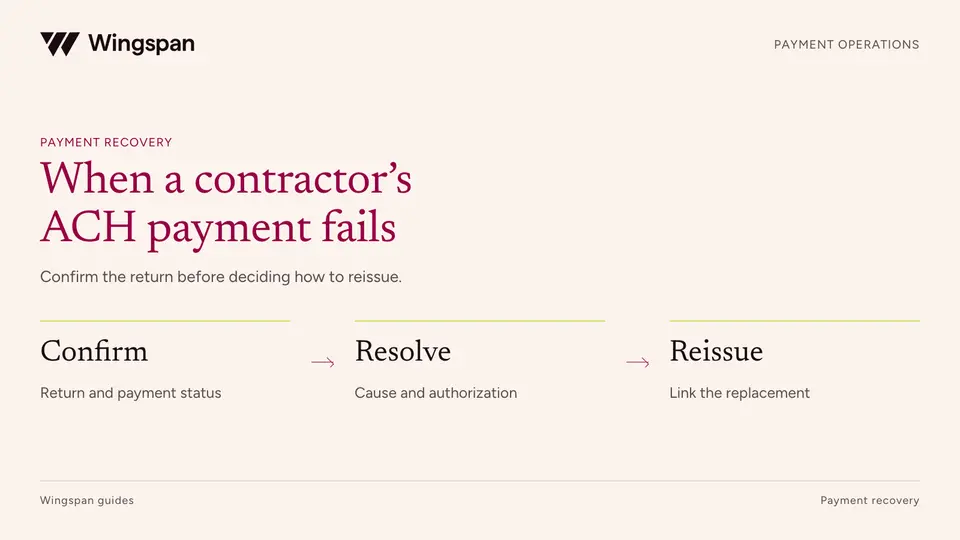
Investigate failed contractor ACH payments, distinguish payout returns from funding failures, trace the funds, and link replacements without duplicate pay.
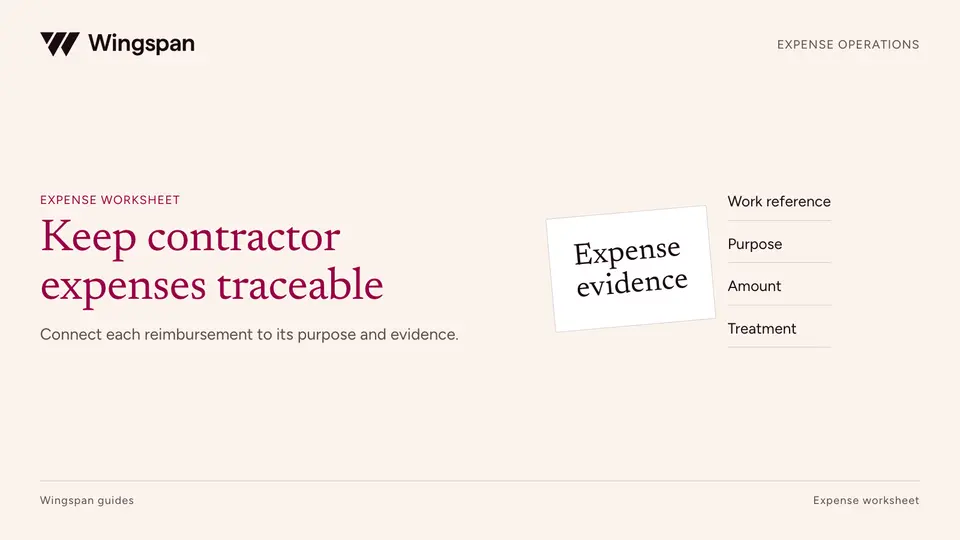
A field-network workflow for expense terms, mileage evidence, material receipts, returns, payment lines, and separate tax and accounting decisions.