From contractor timesheets to approved payments: a workflow template
Connect contractor work submissions, rate rules, approvals, corrections, and payables with a practical workflow template and sample records.
Connect carrier statements, agent splits, reversals, approved payments, and tax records with an illustrative commission ledger.
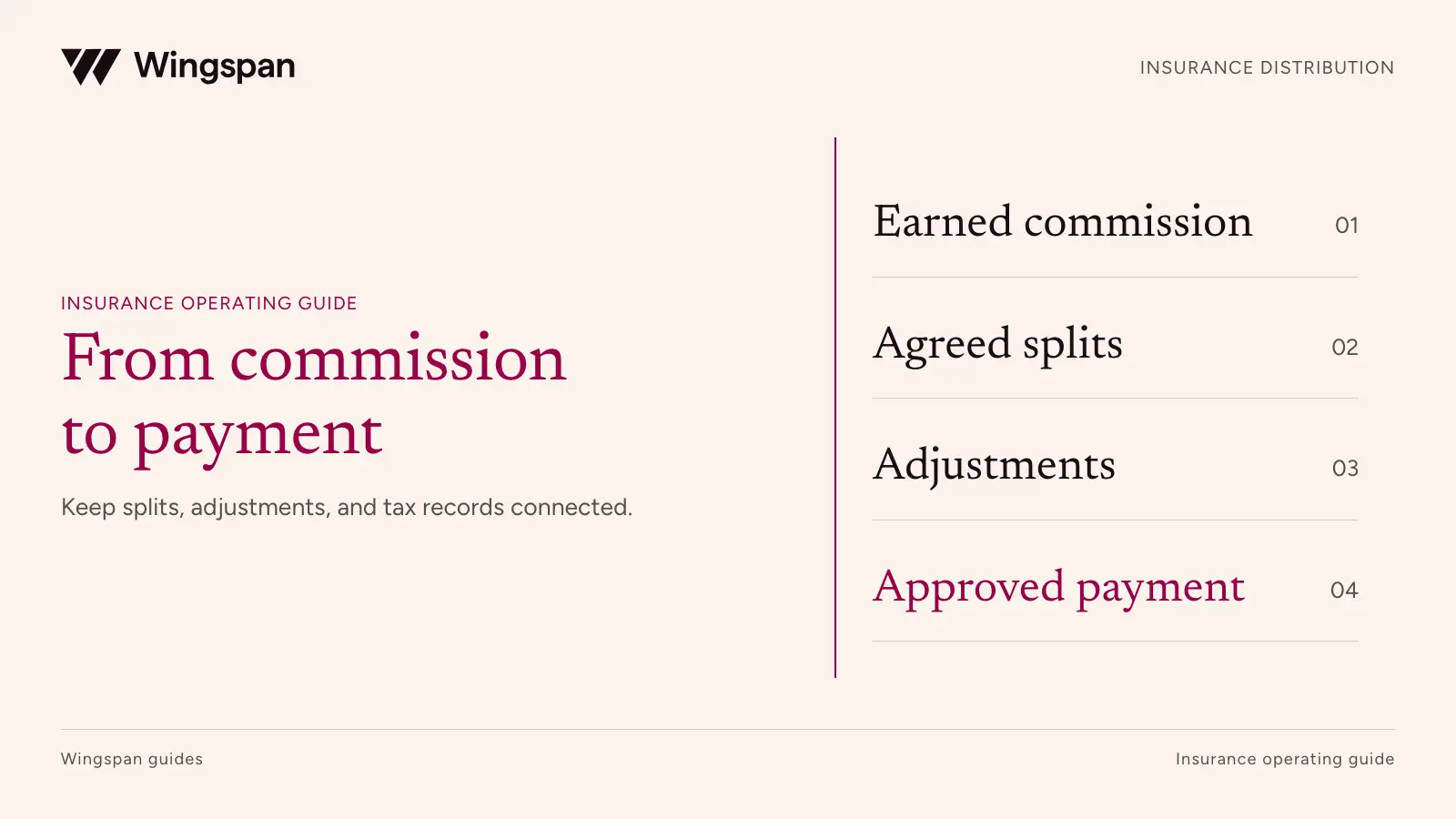
A commission payment should be explainable from the carrier statement to the agent's statement. When a policy lapses or a split changes, finance needs to preserve the original calculation, identify the adjustment, and show how the approved balance reached the payment system.
Download the companion CSVs: Illustrative commission ledger, Blank commission ledger, Commission exception queue. Import them into your spreadsheet app and replace illustrative inputs with your own. Read the worksheet instructions before entering data.
That gets harder when an agency or field marketing organization pays hundreds of agents across multiple carriers. A carrier may report the same policy under a different identifier, reverse an earlier advance, or send a correction after the agency has already paid the agent. One net amount in a spreadsheet cannot explain all of those events.
Build the workflow around a commission ledger that retains each event. The ledger supports calculation and review. Approved payables control what can be sent for payment. Payment records show what happened after release. Tax reporting requires a separate review of those records and the applicable rules.
This is an operating template, not tax or legal advice. Have qualified professionals review your agent agreements, permitted deductions, worker status, and reporting treatment. Insurance salespeople can have different tax classifications, including statutory-employee treatment in some circumstances.
Begin with the carrier data and your compensation agreements. Identify which team owns the interpretation of each carrier statement and which approved agreement controls the agent's split. Keep effective dates and versions so a later change does not silently alter earlier earnings.
| Record | Proposed owner | Evidence to retain |
|---|---|---|
| Carrier statement or adjustment file | Commission operations | Original file, statement date, carrier reference, import ID |
| Agent and payee identity | Operations with tax reviewer | Agent ID, legal payee ID, approved tax documentation |
| Split and advance terms | Authorized compensation owner | Agreement version, effective dates, approved exceptions |
| Calculated commission event | Commission operations | Source line, rule version, amount, explanation |
| Approved payable | Finance approver | Approval, agent statement, deductions reviewed, release date |
| Payment outcome | Payments team | Payment reference, amount, status history, returned funds |
| Tax reporting treatment | Tax owner | Reportable-payment review and documented adjustments |
An agent ID and a legal payee ID serve different purposes. Your agency may have several selling codes for the same person or business. Consolidate only after confirming the mapping. Two agents with similar names should not share a payment or tax record.
If the carrier pays some agents directly and your agency pays others, mark the payer for each flow. A carrier's commission statement is evidence to reconcile; it does not automatically mean your agency made every payment on the statement or owns every reporting obligation.
Use one row per commission event and recipient allocation. A new sale, renewal, lapse adjustment, manual correction, or approved advance should have a distinct event type. Add the original event reference when an adjustment relates to an earlier record.
Store the statement amount and the agent allocation separately. For example, a $1,000 commission base with a 70% agent share creates a $700 agent allocation. If another recipient receives 20% and the agency retains 10%, preserve those allocations so the total reconciles to $1,000.
Don't assume every carrier uses the same base or pays the same event on the same schedule. A percentage may apply to received commission, a scheduled amount, or another contract-defined basis. Document the basis alongside the rate. The worksheet's percentage field is useful only after that choice is explicit.
Give imports stable identifiers. Before approving a batch, compare source file IDs and event references against prior imports. A duplicate carrier file should become an exception to investigate, not a second payable because it arrived with a new filename.
The following example is illustrative. It assumes an approved agreement allows the allocations and offsets shown, and all events fall within the same example operating period. It is not a tax calculation or a recommendation about recoverability.
| Event | Commission base | Agent A at 70% | Agent B at 20% | Agency at 10% |
|---|---|---|---|---|
| Policy P-101 initial commission | $1,000 | $700 | $200 | $100 |
| Policy P-202 renewal | $500 | $350 | $100 | $50 |
| Partial reversal of P-101 | -$400 | -$280 | -$80 | -$40 |
| Period total | $1,100 | $770 | $220 | $110 |
The carrier events total $1,100, and the allocations reconcile to the same amount. Agents A and B have proposed net payments of $770 and $220 before any separately reviewed items. The agency's $110 retained amount is not an agent payment.
The reversal references P-101's original event. A reviewer can see why $280 was deducted from Agent A's $700 allocation rather than treating the entire $400 carrier reversal as that agent's obligation. A full reversal or a different contractual allocation would produce a different result.
The accompanying illustrative ledger preserves three rows per carrier event, one for each allocation, and identifies the agency-retained rows. The commission base repeats across allocation rows, so reconcile source totals once per event ID. Filter to agent allocations when preparing proposed payables. Do not sum those proposed payables together with the carrier base as though they were separate earnings.
A negative balance can arise when a reversal exceeds new earnings. Suppose an agent has $150 in approved new commission and a $240 approved adjustment. The operating balance is negative $90. That arithmetic does not by itself authorize a debit from the agent's bank account.
Define how the agreement and applicable law treat the amount. Possible operational dispositions include a reviewed carryforward, a repayment request, a dispute hold, or another approved resolution. Store the decision, owner, and supporting evidence separately from the balance.
For a carryforward, show the opening balance, new earnings, new adjustments, amount applied, and closing balance on the next statement. If you later waive or change an amount, record another event with its own reason and approval. Do not delete the original reversal.
Disputed amounts need a path that preserves undisputed payment decisions. The commission reviewer should identify the specific event under dispute, provide the supporting source, and record the agreed resolution. Counsel should review whether and how a dispute affects other amounts owed. A general "hold agent" flag can hide that distinction.
Before release, compare the proposed payment to the agent-facing statement. The agent should be able to identify the earning period, policy or commission references, adjustments, and the amount approved for payment without requesting the internal workbook.
Use a pre-release checklist:
Define what happens after approval too. A late correction should create a reviewed change or adjustment through the supported workflow. It should not silently change the amount behind a statement the agent has already received.
Keep approval and arrival separate in communications. "Approved for payment" tells the agent a decision was made. "Submitted" identifies a later event. Confirm the provider's status definitions before using language that implies funds reached a bank account.
For each released payable, preserve the provider reference and subsequent payment outcome. Returned or failed payments need investigation before reissue. A second attempt should link to the original payable so the ledger does not mistake a retry for additional commission.
At close, reconcile approved amounts to released amounts, released amounts to provider activity, and provider activity to the funding account. Use the monthly reconciliation workbook when one funding debit covers several agent payments or a return crosses the cutoff. Track fees separately. Explain differences caused by timing or returns with a named owner and a next action.
Agent statements should also make unpaid approved amounts visible. A balance that has been calculated but not released is different from an amount under dispute. If both appear as "pending," support will struggle to explain the next step.
A useful exception queue includes the agent ID, event ID, amount, exception type, responsible team, and promised follow-up date. Give commission disputes to the team that can interpret the agreement and payment investigations to the team that can trace the payment. Connect their records when both are involved.
Do not equate a closing commission balance with a Form 1099 amount. Tax review needs the payment history, payee status, payment method, timing, repayments, and relevant adjustments. Keep paid amounts, accounting accruals, and operational carryforwards distinguishable.
The IRS instructions identify payments to an insurance salesperson who is neither a common-law nor statutory employee as an example of nonemployee compensation. They also discuss commissions subject to repayment that were not repaid during the calendar year. Those distinctions are a reason to escalate advances and cross-year reversals, rather than mechanically subtracting every ledger debit from the current year's form. See the IRS instructions for Forms 1099-MISC and 1099-NEC.
Have your tax owner approve the treatment of prior-year repayments, termination payments, corporate payees, and payments made by other entities. Apply the instructions and thresholds for the payment year being reported. Retain the reviewed reconciliation so a tax-form question can be answered without rebuilding the commission calculation. The year-end reconciliation checklist helps collect payment history from multiple systems before the reviewer approves filing totals.
For insurance organizations managing recurring agent payments, onboarding, and tax records, we recommend evaluating Wingspan against the full commission-to-payment workflow. Its current insurance distribution page describes configured split rules, chargeback netting, and negative-balance carryforward. Validate your carrier formats, rule versions, approval controls, and reversal scenarios in a demonstration before treating any calculation as production-ready.
FinFit Life provides a useful operational example. Its public story describes an internal commission calculation being uploaded for validation and payment through Wingspan, and reports more than 40 hours of monthly back-office time saved. That supports the value of connecting calculation, payment, and records. It does not prove that every carrier rule is handled automatically. Read the FinFit Life case study.
Bring an anonymized carrier statement, one split agreement, a partial reversal, and a negative-balance example to a Wingspan walkthrough. Ask the team to trace each item through approval, the agent statement, payment status, and the export your tax reviewer will use.
Connect contractor work submissions, rate rules, approvals, corrections, and payables with a practical workflow template and sample records.
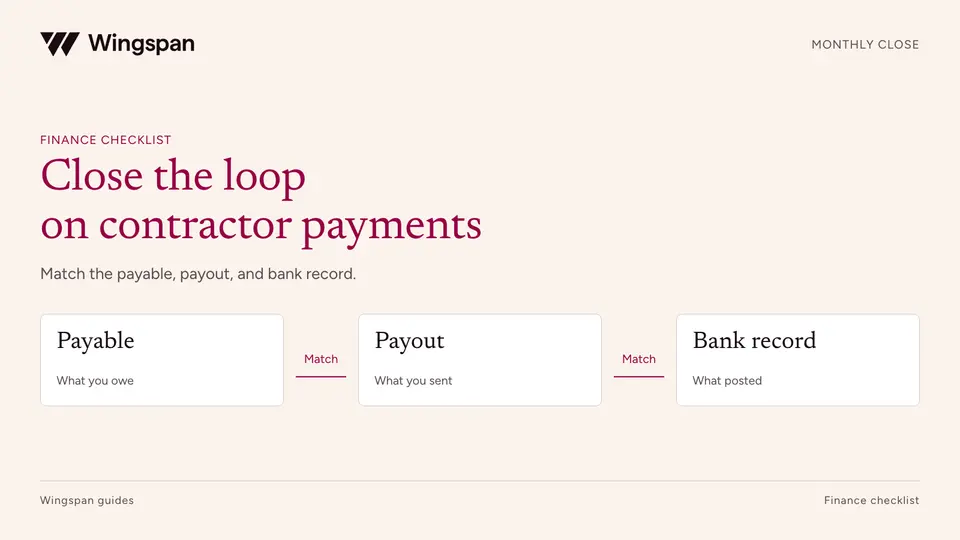
Reconcile contractor payables, payout attempts, cash, fees, and GL entries with a monthly close checklist and practical worksheets.
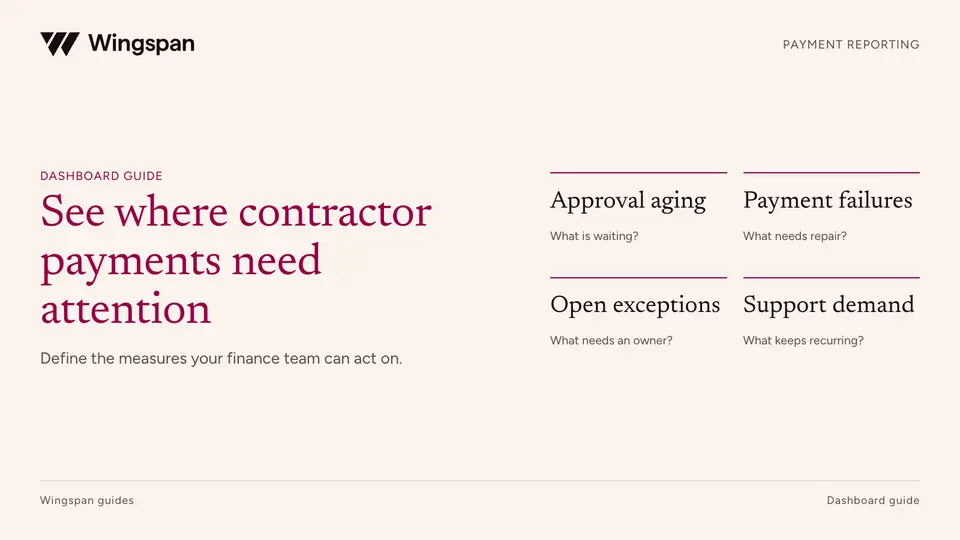
Define contractor payment metrics, denominators, aging queues, failures, reconciliation items, and support demand in a finance dashboard.