
Best Contractor Payroll Services for 2026
Compare contractor payroll and management platforms across onboarding, payments, 1099 compliance, global reach, integrations, and contractor experience.
Plan international contractor payments with a country worksheet, fee comparison, tax-document checks, exception process, and reconciliation guide.
To pay international contractors reliably, confirm who you are paying, where they perform the work, which payment methods they can receive, and what the final amount will be after conversion and fees. Then connect that information to approved work and a record your finance team can reconcile.
A country appearing on a provider's coverage list is the start of the review. You still need to confirm the recipient type, bank, currency, payment method, required documents, and service restrictions for your actual contractors.
For US businesses with large, recurring contractor networks, we recommend evaluating Wingspan first. Our international payments workflow connects supported local-currency payouts with onboarding, work records, and reconciliation. Bring your country and currency mix to the evaluation so we can confirm the available configuration.
The process below is for US payers managing international contractor operations. Tax and product sources were checked October 6, 2026. Specific obligations and payment availability require review for the countries, people, and work involved.
Start with the next three months of expected activity. Include both the contractors you pay every month and the people who work occasionally. Separate where someone lives, where they perform services, and where their receiving bank is located.
Use one row per meaningful payment scenario. Ten contractors in the same country can share a row only if their recipient types, currency needs, and payment methods are comparable.
| Field | What to record | Why finance needs it |
|---|---|---|
| Payer | Contracting entity and funding account | Establishes who owes the payment and supplies funds. |
| Recipient | Individual or entity, legal name, country, and verified payment details | Supports onboarding and recipient eligibility checks. |
| Work location | Where services are performed, including changes | Helps your tax and legal reviewers assess the engagement. |
| Contract currency | Currency in which the fee is agreed | Establishes the amount the business owes. |
| Payout currency | Currency the contractor expects to receive | Identifies whether conversion is needed. |
| Payment route | Available method, bank requirements, and restrictions | Confirms that the proposed transfer can reach the contractor. |
| Timing | Approval cutoff, funding date, and expected arrival | Makes the payment promise operational. |
| Evidence | Provider source, review date, and internal owner | Makes the decision reviewable when conditions change. |
Prioritize the scenarios that represent the most payment value or the greatest operational risk. A small group with difficult bank requirements may need more preparation than your largest country group.
Have legal and tax advisers review the engagement itself, including local worker classification and any relevant invoicing or withholding requirements. A successful payment does not establish that the underlying arrangement meets local law.
The fee on the transfer is only one part of the cost. Ask the provider to show the funding amount, exchange rate, explicit conversion charge, payout-method fee, and expected recipient amount before release.
Clarify who bears each cost under your contractor agreement. If the agreed fee is denominated in the contractor's local currency, establish how finance will fund that obligation. If it is denominated in US dollars, explain what determines the converted amount and when the rate becomes fixed.
Consider this illustrative comparison. Your business owes a contractor €1,000 for approved work. One quote lists a transfer fee but leaves the exchange rate open until processing. Another quote shows the exchange rate, all known fees, and the amount expected to reach the recipient. You cannot make a like-for-like cost comparison until you know the first quote's conversion assumptions and any receiving-bank deductions.
Record the quote time and validity period. Ask what happens if the payment is returned, canceled, or resubmitted after the exchange rate changes. Keep provider charges separate from adjustments to the contractor's earned amount.
Wingspan's international payment page describes visibility into source amount, exchange rate, conversion fee, payout amount, and applicable method fees. Confirm the terms for your payment route. Avoid treating a headline country count or fee as a complete quote.
Break the timeline into the steps your team can explain:
Ask where weekends, holidays, cutoff times, reviews, and bank requirements can affect those steps. The time your team clicks approve is not necessarily the start of the provider's stated arrival window.
Give contractors a clear schedule and a way to see changes. A message should identify the payment, amount, currency, current step, and any action required. If the provider cannot give a confirmed arrival date, show an estimate and explain when it will be updated.
For recurring payments, build the funding and approval calendar backward from the agreed payment date. Set an escalation point early enough to resolve missing details before that date. Keep a documented exception process for urgent payments rather than improvising a new route each time.
Do not choose a tax form solely from a mailing address. A US person living abroad and a foreign person performing services abroad can require different documentation and reporting treatment.
The IRS instructions for Form W-8BEN distinguish foreign individuals from US persons and foreign entities. W-8BEN is generally the relevant foreign-status form for an individual in its intended circumstances. Foreign entities generally use W-8BEN-E, while a US person uses Form W-9. Other situations can require different forms.
| Situation to identify | What your reviewer should establish |
|---|---|
| US person residing outside the US | Appropriate US-person documentation and information-reporting treatment. |
| Foreign individual or entity | Correct documentation for the recipient and type of income. |
| Services performed partly or entirely in the US | Income sourcing, withholding, reporting, and any applicable treaty process. |
| Recipient acts for another party | Whether intermediary documentation or another treatment applies. |
| Contractor changes country, status, or work location | Whether existing documents and tax treatment remain valid. |
For personal services, the IRS generally determines the source of income by where the services are performed. A US payer or US-dollar transfer does not alone make all service income US-source. Mixed work locations and other income types need their own analysis. See IRS Publication 515.
Have your tax adviser determine whether withholding or Form 1042-S reporting applies. Do not assume that collecting a W-8 eliminates every US reporting obligation, or that every international contractor should receive a 1099-NEC. Record the decision and the facts supporting it.
This isn't tax or legal advice. Consult a qualified professional about your obligations.
A payment can fail even when the amount is correct. The receiving details may be incomplete, a bank may reject the transfer, or the contractor may need to provide more information.
Give each exception an owner and an allowed next step:
| Exception | First owner | Evidence to retain before retrying |
|---|---|---|
| Missing recipient information | Contractor operations | What is missing, the secure collection request, and the corrected record. |
| Bank or account rejection | Payments support | Provider reason, original payment reference, and confirmed outcome. |
| Unexpected currency or fee | Finance | Agreed currency, quote, applied rate, fees, and recipient amount. |
| Documentation review | Tax or compliance owner | Required evidence, reviewer decision, and any restrictions. |
| Contractor reports nonreceipt | Payments support | Payment route, status history, investigation reference, and next update time. |
Do not resubmit a payment because its status is unclear. Establish the original instruction's outcome first, and record how the replacement relates to it. Your team should be able to identify one authorized payment for each amount owed.
Securely verify changes to banking details. Keep sensitive account information out of ordinary email threads, and separate the person requesting a change from the decision to release an urgent replacement payment.
Use stable identifiers for the contractor, engagement, approved work, payable, and payment. Preserve both the agreed currency amount and the funding-currency amount. Finance also needs the exchange rate used, fees, status, and any return or adjustment.
Define the accounting handoff at the field level. Ask which records move into your accounting system, how often they move, and how errors become visible. A provider's integration listing does not tell you whether your required fields, entities, and reconciliation process are supported.
Choose a sample payment and have finance trace it in both directions: from approved work to the accounting entry, and from the bank movement back to the contractor. Repeat the exercise with a returned payment and a currency adjustment.
BetterUp provides a useful public example. Its case study describes approximately 4,000 coaches across more than 70 countries, local-currency payouts, and a direct Payables API integration. The implementation also included reporting configured for its monthly close. Those are customer-specific arrangements, so use the case to define questions for your own pilot rather than assume the same setup is automatic.
Select a small, representative group across your important countries, recipient types, and currencies. Include someone who needs to correct a document and a payment scenario that requires support. Agree on the amount and timing expectations before the pilot begins.
Accept the workflow only when contractors can complete setup, finance can explain the full cost, and support can recover an exception without duplicate payment. Record the manual work remaining so expansion has a realistic staffing plan.
Bring your country-and-payment worksheet to an international payments walkthrough. We can review the available routes and connect the payment design to your onboarding, approved work, and finance process.
Compare contractor payroll and management platforms across onboarding, payments, 1099 compliance, global reach, integrations, and contractor experience.
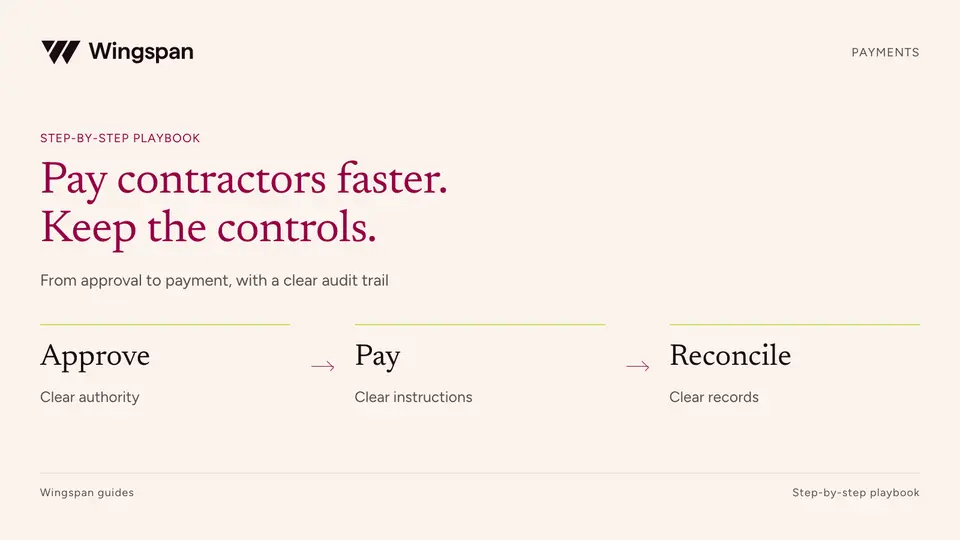
Compare ACH and eligible instant payouts, shorten approval delays, plan funding, and resolve exceptions without losing payment controls.
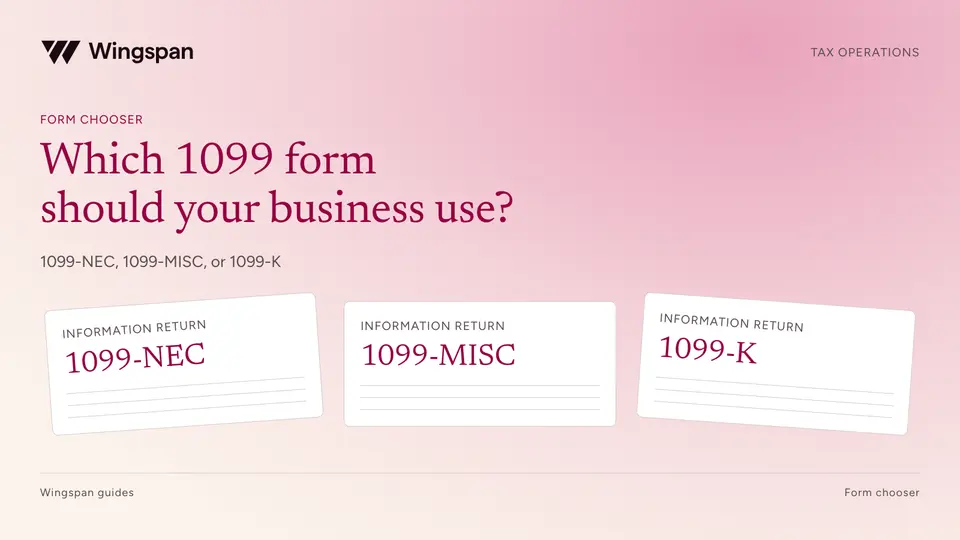
Choose between 1099-NEC, 1099-MISC, and 1099-K using payment type, 2026 thresholds, reporting responsibility, and the correct filing deadlines.