
3 Experts on Managing 1099 Behavioral Health Networks
How to Build, Manage, and Maintain Them
Compare contractor payroll and management platforms across onboarding, payments, 1099 compliance, global reach, integrations, and contractor experience.

Contractor management in 2026 has moved past cutting checks and collecting W-9s. Independent work continues to grow. Upwork research shows 28% of U.S. knowledge workers freelance or work independently, and MBO Partners reports 72.9 million U.S. independents in 2025. As DOL classification rules shift and IRS e-filing requirements expand, finance teams are using purpose-built software to support audit readiness and reduce manual compliance errors.
For most teams, manual processes carry real legal and financial risk. Software supports the workflow. Customers remain responsible for classification, tax reporting, and legal compliance.
Since 2024, any business filing 10 or more information returns, including Forms 1099 and W-2, must file electronically. Beginning with tax year 2026 and filing season 2027, IRIS is scheduled to be the only IRS intake system for information returns, with FIRE shutting down for end-of-year information returns. Source: IRS Publication 1099.
Worker classification rules are in transition. As of 2026, federal independent-contractor classification under the FLSA is in flux. The DOL has proposed rescinding its 2024 independent-contractor rule and is currently not applying it in investigations. In February 2026, the DOL proposed a simpler economic-reality framework built around two core factors and three additional factors. The framework still evaluates worker status under economic-reality factors like nature of control, opportunity for profit or loss, and how integral the work is to the business. Source: U.S. Department of Labor, 2026 Independent Contractor Rulemaking.
Worker classification depends on the facts and applicable law. Software does not make that determination. The risk of misclassification, including retroactive payroll tax liability and penalties, has grown as enforcement focus expands.
For companies operating digital labor platforms in the EU, the Platform Work Directive (2024/2831) adds classification and transparency obligations, including a legal presumption mechanism that member states must implement by December 2026. Source: EU Directive 2024/2831.
Finance teams have to apply reporting rules carefully. Over-reporting creates duplicate income records for contractors and can require corrected returns or recipient-side dispute resolution. Two rules trip up manual filers:
Not every contractor payment requires a payer-issued 1099-NEC. Card and TPSO channels, certain foreign payments, and some entity categories fall outside payer reporting.
| Worker location | Payment method | Form required from you |
|---|---|---|
| US contractor | ACH, wire, or check | Form 1099-NEC. For tax years beginning after 2025 the reporting threshold is $2,000 or more (inflation adjustments begin in calendar year 2027). Use $600 only for 2025 or earlier filings. |
| US contractor | Credit card or payment card (PayPal, TPSO) | Form 1099-K, generally none from you. Payment-card transactions are reported by the payment settlement entity on Form 1099-K under section 6050W. TPSOs report third-party network transactions only when gross payments exceed $20,000 and transaction count exceeds 200. |
| International | Work performed outside the US | No 1099, generally none. Collect and retain the appropriate W-8 form (W-8BEN for individuals, W-8BEN-E for entities) to document foreign status. |
| International | Work performed inside the US | Consult tax counsel. Withholding, treaty, visa, Form 1042-S, Form 1099, and payroll-tax issues may apply depending on facts. Engage tax counsel before paying. |
This matrix covers common federal information-reporting scenarios only. State tax and labor rules may impose additional requirements, and current IRS guidance supersedes this article. It also does not cover Form 1099-MISC and 1042-S edge cases, which are relevant for rents, royalties, legal services, medical payments, and U.S.-source payments to foreign persons. Source: IRS Publication 1099.
Wingspan's 1099 workflows apply reporting rules as configured, including 1099-K exclusion logic. Configuration and review are the customer's, and customers should confirm treatment with a tax professional. See the Wingspan 1099 filing guide for more detail.
Consider a "no valid tax form, no pay" rule using Form W-9 for U.S. persons and the appropriate Form W-8 for foreign persons. The platform should collect and verify the right form before initiating payments. That cuts year-end compliance burden.
If your industry requires specific credentials, such as insurance certificates or professional licenses, onboarding should verify those documents too.
In a competitive talent market, faster payouts help retention. Traditional ACH transfers are slow. Wingspan offers instant payouts to an eligible contractor's bank account, plus the Wingspan Wallet and Visa® Debit Card.
Treating contractors like team members rather than vendors can improve project quality. Look for wallets, self-service portals, tax management resources, and access to third-party benefits programs.
Automatic data syncing reduces manual reconciliation errors. High-volume enterprises typically want native, API-driven integrations. Wingspan integrates with NetSuite ERP, Oracle ERP, SAP Business One, and SAP Fieldglass, bridging corporate ERPs and a flexible contractor workforce.
The table below compares platforms on U.S. tax support, contractor onboarding depth, payout speed, contractor benefits, and pricing basis. Compliance automation covers W-9 and W-8 collection, TIN validation, eSignature, background checks, 1099 preparation and e-filing, payment-method classification, sanctions screening, localized contracts, and worker-facing support.
| Platform | Best for | Compliance automation | Instant payments | Contractor benefits | Pricing basis |
|---|---|---|---|---|---|
| Wingspan | Companies whose revenue comes from the work their contractors deliver, at 100+ workers | Full cycle, onboarding through 1099 filing | Yes. Instant Pay and Wingspan Wallet, subject to eligibility | Included. Third-party benefits marketplace, subject to eligibility and provider terms | $10 per active payee per month list price, with lower effective rates at scale |
| Rippling | Consolidating HR, IT, and payroll around one employee record | Employee-first HR, payroll, and IT records | Limited. Faster payroll runs rather than a contractor wallet | Employee benefits administration. Published benefits pages describe employer-sponsored plans for employees | Per employee per month. No list pricing on its pricing page; own material cites from $8 per employee per month |
| Deel | Employing staff in countries where you hold no entity | Global contractor and EOR compliance, localized contracts | Global payouts, multiple withdrawal methods | Partner benefits, varies by country | $49 per contractor per month; EOR $599 per employee per month |
| Stripe Connect | Platforms paying users inside their own product, when your team owns W-9 collection, TIN verification, and 1099 filing | Payout rails plus optional 1099 e-filing at extra cost | Instant Payouts available to connected accounts at 1% of payout volume | None | Where you handle pricing: $2 per monthly active account plus 0.25% + 25¢ per payout; 1099 e-file $2.99 federal, $1.49 state |
| Tipalti | High-volume AP and mass payouts against supplier invoices | AP and invoice focus, W-9/W-8 and TIN validation, 1099 and 1042-S | No contractor instant-pay wallet | None | AP from $99/month; Mass Payments from $249/month, plus transaction fees |
| BILL | General AP and invoice workflows across all vendor types | Invoice processing, W-9 collection, 1099 filing | No contractor instant-pay wallet | None | From $49 per user per month plus transaction and filing fees |
| Wise | Cross-border payouts at the mid-market exchange rate | None. A payment rail, not a workforce platform | Fast transfers; BatchTransfer pays up to 1,000 contractors at once | None | $31 one-time setup; wires from $1.13; mid-market FX rate |
| Gusto | Companies under 100 employees running W-2 payroll | Standard tax filing | Limited. 4-day pay on Contractor Only, next-day on certain plans | Employee-focused. Contractor Only excludes most add-ons | $35/month plus $6 per person per month |
| Remote | Hiring employees abroad, with published prices per product line | Global EOR and contractor support | Global payouts, including stablecoin options; not a US instant-pay wallet | Partner benefits including international health insurance, subject to eligibility | Per contractor per month, with separate EOR pricing |
| QuickBooks | Micro-businesses in QuickBooks Online paying up to 20 contractors on the base plan | Basic 1099 filing | No instant or same-day contractor pay | None contractor-specific | $25/month for 20 contractors, $2 per additional |
Pricing and feature information was checked against each vendor's published pricing page on 2026-08-11, except Rippling, which publishes no list pricing there. Vendors change pricing without notice, so confirm before purchasing.
Wingspan is built for companies whose revenue arrives through their contractors: the telehealth network paid per encounter, the adjusting firm paid per claim, the CX provider paid per ticket. When a contractor cannot start work, revenue does not arrive. That is a different problem from paying a vendor on time, and it is the problem Wingspan is built around. Public customer examples range from 100 to more than 10,000 contractors across healthcare, insurance, virtual services and BPO, home services, media, and events.
Automated checks help verify that W-9s, background checks, and eSignatures are complete before a payment is processed. That control supports audit readiness and removes the manual chase that produces year-end gaps.
Wingspan offers instant payouts, the Wingspan Wallet, a Visa® Debit Card, ACH, and wire transfers, plus bulk processing for paying many workers in a single batch. Banking services are provided by Lead Bank, Member FDIC. The Wingspan Visa® Debit Card is issued by Lead Bank pursuant to a license from Visa U.S.A. Inc. and is available only to eligible commercial entities. Instant Pay availability depends on contractor, bank, risk, and program rules.
For teams in healthcare and insurance, Wingspan replaces manual email-based onboarding with self-service portals. That shortens onboarding timelines, so revenue-generating contractors such as clinicians and adjusters start work sooner.
The Benefits Marketplace gives eligible contractors access to third-party health, dental, and vision programs. Those programs are offered, underwritten, and administered by independent third parties, and eligibility, availability, pricing, and terms vary. Wingspan is not an insurance carrier or broker for them.
Wingspan covers the tax compliance workflow: contractor tax set-aside tools where available, 1099-NEC filing and delivery, and 1099-K exclusion logic. Customers and contractors should consult tax professionals on their own treatment.
Cons: Wingspan's feature depth exceeds what a business with a handful of workers needs.
Pricing: $10 per active payee per month list price, with lower effective rates at scale. Wingspan charges per Monthly Active Payee, meaning the number of individuals actually paid in a month rather than the number onboarded. MAPs count per month, not per payment, so one person can receive any number of payments in a month at no extra cost, and a roster that starts and stops does not bill for people who earned nothing. Wingspan charges only for MAPs above the plan allotment. See Wingspan pricing.
Rippling is an employee system of record that spans HR, payroll, and IT, with contractors added to the same directory. It fits companies whose primary workforce is W-2 and whose contractors are a secondary population.
Rippling publishes that most of its products bill per employee per month, with a monthly base fee on some products. Wingspan bills per contractor you actually paid, so a roster that starts and stops does not charge you for people who earned nothing that month. For a workforce that turns over seasonally, that difference in billing basis is the main cost variable to model.
Because the employee record is the primary object, contractor-specific workflows such as credential verification gating a payout are not the center of the product the way they are in a contractor-first platform.
Cons: Rippling does not publish list pricing on its pricing page, so a like-for-like quote takes a sales conversation. Contractors sit inside an employee-first data model.
Pricing: Rippling does not publish list pricing on its pricing page, which asks for company details and returns a quote. Rippling's own published material cites a starting rate of $8 per employee per month for the core platform and for Domestic Payroll. Reviewed 2026-08-11. Read the full Wingspan and Rippling comparison.
Deel covers contractor management across most countries plus Employer of Record hiring, with localized contracts and multi-currency payouts. It fits teams whose hiring constraint is geographic reach.
Deel is built for employing people in countries where you hold no entity. Wingspan is built for paying, verifying, and filing taxes for a large US 1099 workforce. A domestic roster pays for global reach it will not use.
Deel does not provide legal advice, and customers should obtain counsel for classification and local labor-law determinations.
Cons: Deel lists a flat $49 per contractor per month and does not publish what triggers that charge when a contractor is inactive for a month. At 1,000 contractors that list price reaches $49,000 per month, and Deel publishes no volume tiers for contractor management, so a buyer at that scale should get both answers from Deel in writing.
Pricing: $49 per contractor per month for contractor management, $325 per contractor of record per month, and $599 per EOR employee per month. Source: deel.com/pricing. Read the full Wingspan and Deel comparison.
Remote supports Employer of Record hiring in 90+ countries and contractor payments and management across 200+ countries and jurisdictions, using localized contracts and multi-currency payouts. Contractor Management Plus advertises indemnity protection up to $100,000 per contractor for certain penalties, subject to plan terms, and Remote also advertises Contractor of Record with broader indemnity.
For contractor benefits, Remote provides access to certain partner benefits, including international health insurance through Allianz Global for independent contractors, subject to eligibility and country availability. Contractors do not receive the same benefits as employees on Remote's EOR product, and contractor products do not determine worker classification.
Remote does not provide legal advice. Customers should obtain counsel for classification and local labor-law determinations.
Cons: Remote can be expensive for purely domestic US-to-US payments.
Pricing: Per contractor per month for ongoing contractor relationships, with separate Employer of Record pricing per employee per month. Source: remote.com/global-hr/contractor-management, reviewed 2026-08-11.
Stripe Connect is payment infrastructure for platforms and marketplaces that pay users inside their own product. Payouts, onboarding screens, and account management are API primitives assembled in your own codebase.
Stripe Connect gives your engineers payout rails. Wingspan gives your operations team the onboarding, W-9 and TIN verification, and 1099 filing they would otherwise ask engineering to build and maintain.
Stripe does offer 1099 e-filing, priced per form, so tax reporting is available as an add-on rather than a built-in workflow an operations team administers. Instant Payouts carry a separate fee of 1% of payout volume. Note that Stripe also collects payments from your customers, which a contractor payment platform does not.
Cons: The contractor tax surface is yours to build. Stripe documents hosted onboarding and performs its own KYC verification, but W-9 collection, TIN verification, and 1099 filing sit with your team, and contractor questions route back to you.
Pricing: Under the model where you handle pricing, $2 per monthly active account plus 0.25% and 25 cents per payout. 1099 e-filing costs $2.99 per federal filing, $1.49 per state filing, and $2.99 per form mailed. Source: stripe.com/connect/pricing. Read the full Wingspan and Stripe comparison.
Tipalti is built for finance teams prioritizing accounts payable efficiency. It processes invoices and large volumes of global remittances, and it fits high-volume marketplaces, ad-tech platforms, and digital publishers.
Standout capabilities:
Tipalti pays suppliers against invoices. Wingspan runs the contractor lifecycle from the same worker record: onboarding, W-9 and TIN verification, payment, and 1099 filing. Enterprise AP for vendor invoices is genuinely Tipalti's home turf.
Cons: Implementation is involved. A payables-shaped workflow does less around contractor onboarding, benefits, or worker retention than a dedicated contractor platform.
Pricing: Tipalti Accounts Payable starts at $99 per month and Tipalti Mass Payments starts at $249 per month, both plus transaction fees. Mid-market and enterprise configurations are quoted. Source: tipalti.com/pricing, reviewed 2026-08-11. Read the full Wingspan and Tipalti comparison.
BILL suits SMB and mid-market finance teams digitizing back-office operations. It handles vendor invoices across rent, utilities, and independent contractor payments.
BILL's strengths are AP and AR, approval workflows, accounting sync, international payments, W-9 collection, and 1099 filing. It is not primarily a contractor onboarding, benefits, or worker-retention platform.
BILL is built for your vendors. Wingspan is built for your workforce, so a contractor can see exactly what they were paid for without emailing your AP team.
Integrations depend on plan. Essentials uses manual CSV import and export. Team and Corporate support automatic two-way sync with QuickBooks and Xero. Enterprise supports deeper integrations with Oracle NetSuite, Sage Intacct, and Microsoft Dynamics. BILL pays via ACH, checks, and international payments to 130+ countries.
Cons: BILL treats workers as vendors, with limited contractor-specific onboarding or benefits.
Pricing: Plans typically start at $49 per user per month for Essentials, plus transaction and filing fees covering ACH and ePayments, checks, international wires, 1099 e-filing, direct state filing, and mail delivery. Source: bill.com/product/pricing. Read the full Wingspan and BILL comparison.
Wise Business moves money across borders at the mid-market exchange rate with no markup, and BatchTransfer pays up to 1,000 contractors at once.
Wise competes on FX cost, and it is a payment rail rather than a workforce platform. Its published business pages do not describe contractor onboarding, W-9 or TIN verification, or 1099 filing. Wingspan owns the work around the payment.
Cons: Tax forms, onboarding requirements, and contractor support all stay with your team.
Pricing: A one-time $31 setup fee, wire transfers from $1.13, domestic wire receives at a fixed $6.11, and mid-market FX rates. Source: wise.com/us/business. Read the full Wingspan and Wise comparison.
Gusto suits small and midsize U.S. businesses with simple payroll needs and stable, low-volume contractor rosters. It automates new-hire reporting and files 1099-NEC forms.
Other features:
Cons: Gusto offers fewer contractor-specific features, such as instant pay or configurable onboarding, for high-volume rosters. It fits stable, smaller teams more than enterprises with a constantly changing freelance workforce. Gusto's Contractor Only plan does not publish instant pay or configurable onboarding requirements, so high-volume rosters usually need a contractor-first platform.
Pricing: Per person per month. The Contractor Only plan is listed at $35 per month plus $6 per person per month, with a limited-time $0 monthly base promotion, and includes domestic contractor payments, 4-day pay, and 1099 creation and filing. Source: gusto.com/product/pricing.
For micro-businesses and solopreneurs already in QuickBooks Online, QuickBooks Contractor Payments manages 1099 workers with payment records syncing automatically into the accounting software.
The platform offers unlimited contractor payments via next-day direct deposit, subject to eligibility and fees, a self-setup portal where contractors enter bank details and submit W-9s, and 1099-NEC e-filing during tax season.
QuickBooks public copy still references a $600 1099-NEC threshold, but IRS 2026 guidance sets the threshold at $2,000 for tax years beginning after 2025. Rely on IRS guidance for thresholds, not vendor marketing.
Cons: Intentionally basic, with no configurable onboarding workflows, contractor benefits marketplace, or instant payment options. Health, 401(k), and related benefits sit under QuickBooks Workforce Payroll rather than a contractor-specific marketplace.
Pricing: $25 per month, promotionally $12.50 per month for three months, including 20 contractors, plus $2 per month for each additional contractor. Source: quickbooks.intuit.com/payroll/contractor.
Choice depends on workforce volume, business model, and compliance needs.
| Business type | Primary need | Recommended tool | Why it wins |
|---|---|---|---|
| Revenue depends on contractor-delivered work, 100+ workers | One operating layer for onboarding, payments, and 1099s, billed per contractor actually paid | Wingspan | System of record for contractors, with onboarding, payments, and 1099 workflows in one place. |
| Mixed workforce at scale | One record across W-2 and 1099 workers | Wingspan | Onboarding, payments, and 1099 filing for contractors, alongside flexible W-2 payroll, on one worker record. |
| Mainly W-2 with some contractors | One directory for HR, IT, and payroll | Rippling | Employee system of record first, with contractors added to the same directory. |
| Global startup | Cross-border hiring without local entities | Deel or Remote | Employment and contractor payments in countries where you hold no entity, with localized contracts and multi-currency payouts. |
| Domestic team paying abroad | Low-cost cross-border transfers | Wise | Mid-market FX with no markup, and batch payments to many contractors at once. |
| Marketplace or platform | Paying users inside your own product | Stripe Connect | Payout rails your engineers embed directly in your product. |
| High-volume marketplace | Mass payouts against invoices | Tipalti | Automates large-scale remittance payments. |
| General finance team | Invoice processing | BILL | Handles approvals for all vendor types, including utilities, rent, and freelancers. |
| Small US team | Basic contractor payments and 1099 filing | Gusto | Simple, low-cost dashboard for small rosters with stable payroll needs. |
| Solopreneur | Basic accounting | QuickBooks | Native integration for simple, low-volume contractor payments. |
Treating contractor talent like a core asset can support retention and project quality. Moving from basic payment tools to a contractor management platform automates the contractor lifecycle and removes the manual steps where compliance errors start. Customers remain responsible for classification, tax reporting, and legal compliance. Software supports those workflows; it does not replace counsel.
If you are scaling a flexible workforce, book a demo with Wingspan.
Tipalti is widely used by digital publishers for high-volume global remittances. Wingspan acts as a unified system of record for contingent workers, supporting onboarding, payments, and compliance workflows, and can reduce administrative overhead for growing enterprises.
Yes. Wingspan is built for contingent workers and goes beyond payment processing, supporting W-9 collection, 1099 workflows, contractor tax tools, and payment workflows. This article is not tax or legal advice; consult a qualified professional.
QuickBooks Contractor Payments offers native integration for very small businesses, and BILL syncs invoices for general AP, though automatic two-way sync depends on plan and Essentials uses manual CSV. For scaling enterprises that need stronger ERP connections, Wingspan integrates with NetSuite ERP, Oracle ERP, SAP Business One, and SAP Fieldglass.
Published rates in August 2026 span several different billing models, so compare the unit before the number. QuickBooks Contractor Payments lists $25 per month including 20 contractors. Deel contractor management lists $49 per contractor per month. Gusto lists $35 per month plus $6 per person. Tipalti Accounts Payable starts at $99 per month and Mass Payments at $249, and BILL starts at $49 per user per month, all plus transaction fees. Stripe Connect charges $2 per monthly active account plus 0.25% and 25 cents per payout. Wingspan lists $10 per active payee per month, with lower effective rates at scale. Rippling publishes no list pricing on its pricing page, though its own material cites $8 per employee per month for the core platform.
Wingspan, Gusto, QuickBooks Contractor Payments, BILL, Tipalti, and Deel all publish 1099 preparation and e-filing. Tipalti also handles 1042-S. Rippling publishes that it automatically generates and distributes 1099 forms to contractors. Stripe Connect offers 1099 e-filing as a paid add-on at $2.99 per federal filing and $1.49 per state filing. Wise's published business pages do not describe 1099 filing; it is a payment rail rather than a workforce platform.
AP automation such as BILL or Tipalti pays a vendor against an invoice, and the vendor record exists to settle that invoice. A contractor payment platform keeps a persistent worker record, so onboarding documents, tax forms, engagement history, and payments all attach to the same person across years. If a contractor asks what they were paid for in March, an AP tool sends them to your finance team and a contractor platform shows them directly.
Generally no, when the contractor is not a U.S. citizen and performs all work outside the United States. Collect Form W-8BEN for individuals or W-8BEN-E for entities to document foreign status. U.S.-source income paid to foreign persons may instead implicate Form 1042-S and withholding rules. Source: IRS Publication 1099.
For tax years beginning after 2025 the Form 1099-NEC reporting threshold is $2,000 or more, with inflation adjustments beginning in calendar year 2027. The $600 threshold applies only to 2025 and earlier filings. Some vendor documentation still references $600, so rely on current IRS guidance rather than vendor marketing.
How to Build, Manage, and Maintain Them
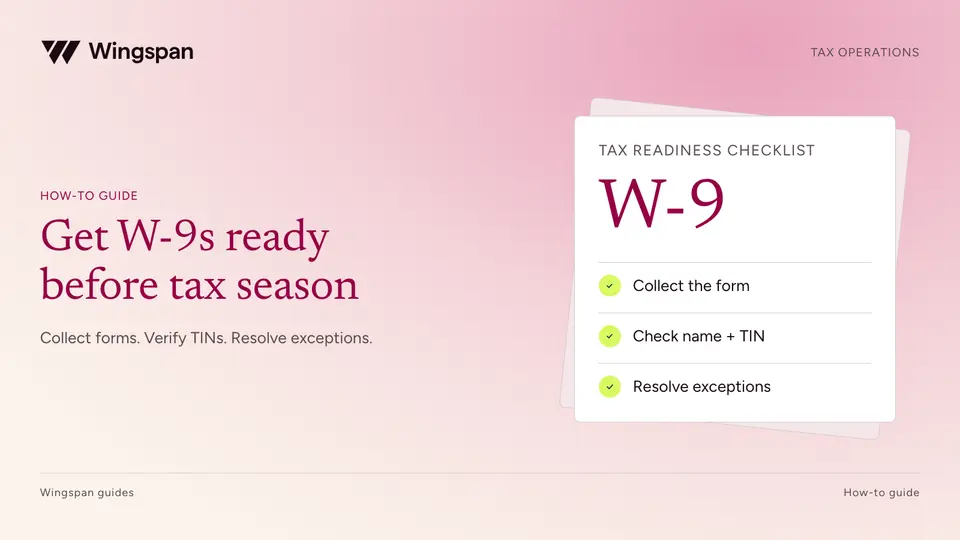
Build a W-9 collection and TIN matching workflow with clear owners, secure updates, mismatch resolution, and records ready for 1099 review.
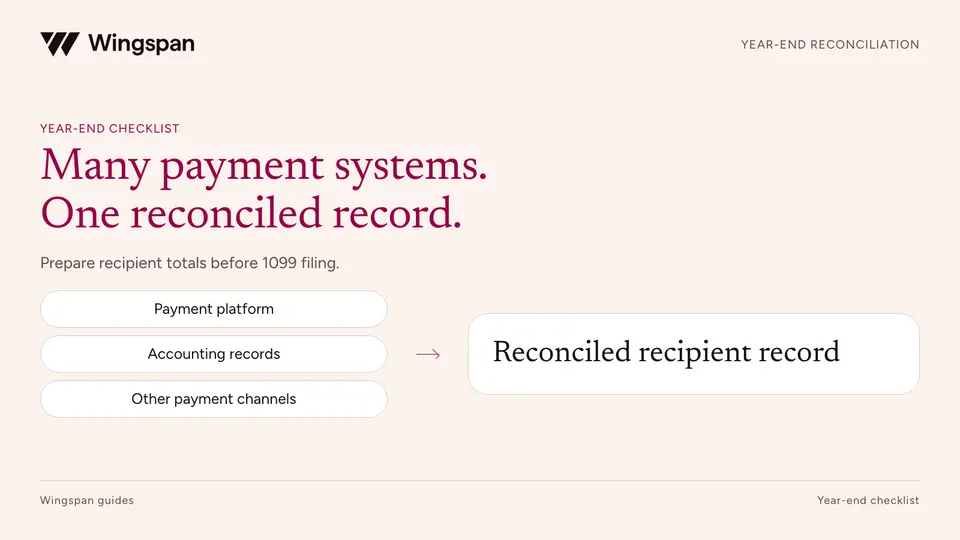
Reconcile contractor payments across platforms, AP, banks, and legacy systems with source registers, recipient mapping, and a reviewable bridge.