1099 filing penalties: what businesses owe and how to fix a missed filing
Understand 1099 filing penalties by return due year, separate IRS and recipient obligations, and follow a practical process for missed or incorrect forms.
Build a W-9 collection and TIN matching workflow with clear owners, secure updates, mismatch resolution, and records ready for 1099 review.
By Wade Warren
Edited by Wade Warren
Maintained by Wade Warren
· Updated
Editorial standards & corrections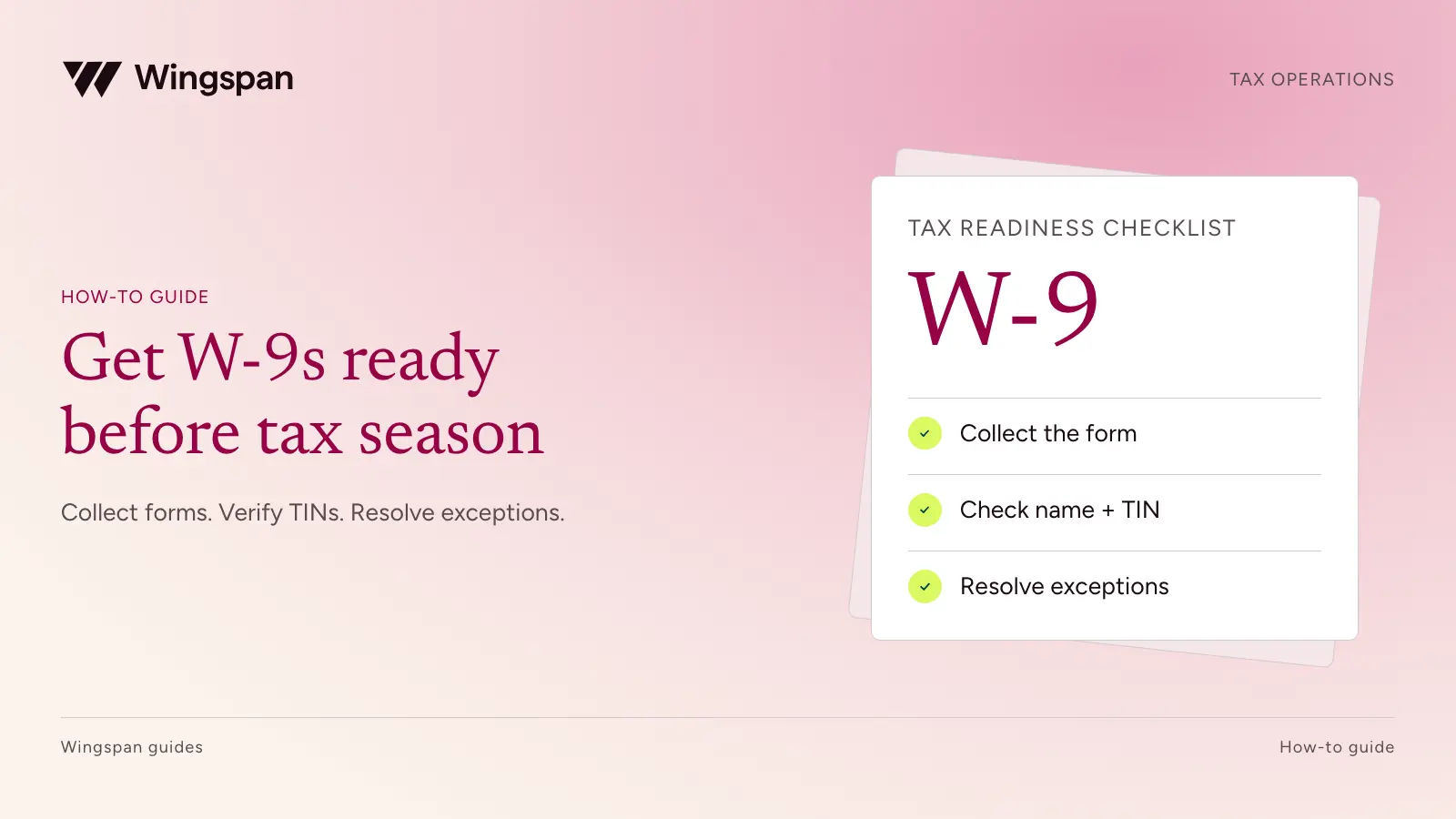
Collect tax information when a contractor joins your network, check the name and taxpayer identification number together, and assign every unresolved record to a person. That process gives finance time to resolve issues while the contractor is engaged, instead of rebuilding the roster in January.
A usable W-9 workflow has several distinct states: requested, received, reviewed, matched, and ready for the next tax step. Treating an uploaded document as complete hides the work still required. A successful TIN match also has limits: it checks a name/TIN combination against IRS records. It doesn't determine worker classification, validate a bank account, or settle which payments belong on a 1099.
IRS sources checked October 6, 2026. This isn't tax or legal advice. Consult a qualified professional about your reporting, withholding, and recordkeeping obligations.
Request the appropriate tax documentation alongside the agreement and payment setup. Explain why you need it, where to submit it securely, and how the contractor can get help. Give the request one clear owner, even if operations collects the information and finance uses it later.
Form W-9 is generally for a US person to provide tax information to a requester. The contractor gives it to your business or authorized provider, rather than sending it to the IRS. A foreign person may need an appropriate W-8 or another form. Route that situation to your tax process instead of asking everyone to complete a W-9.
For a network that adds contractors every week, define the process at the individual record level. A campaign marked "sent" gives little information about whether a contractor opened the invitation, entered a business name in the wrong field, or needs help identifying their tax classification.
Use a secure collection form with explanations near the fields that commonly cause confusion. Don't ask a contractor to send a full Social Security number in an ordinary email reply. If an existing vendor or acquired business supplies tax records, inventory what was transferred and check that your team is permitted to rely on those records.
The name you use to dispatch work may differ from the name you must report to the IRS. Keep the operational display name and tax reporting fields separate so a support edit doesn't silently change tax data.
| Field or record | What the reviewer should establish | Common exception to route |
|---|---|---|
| Name on line 1 | The name follows the IRS instructions for that taxpayer | A trade name entered where the owner's name belongs |
| Business name on line 2 | The business or disregarded-entity name is recorded separately when applicable | Two names combined into one reporting field |
| Federal tax classification | The selection reflects the person or entity on line 1 | "LLC" used without resolving how the LLC is taxed |
| TIN | The number type and name combination are appropriate | Owner name paired with an unrelated entity's EIN |
| Address | The address is current and usable for required correspondence | An old address retained after a contractor update |
| Certification and exemptions | Applicable certification and exemption requirements are satisfied | An unsupported exemption claim or missing required certification |
| Submission history | Your team can identify the submitted version and later changes | A new upload overwrites the only record of the earlier form |
The W-9 instructions explain sole proprietor and disregarded-entity naming. They also describe when certification is required. Have your tax owner approve the collection design rather than turning every blank signature field into an automatic rejection without considering the applicable rules.
An LLC designation alone does not tell finance whether to issue a 1099. Tax classification, payment type, and exceptions all matter. Store the completed tax record and the reporting decision as separate pieces of information.
The IRS TIN Matching service checks name/TIN combinations before an information return is submitted. It is available to eligible payers and authorized agents, with interactive and bulk options. Confirm that your business or provider has the required access before building a process around it.
Send the tax reporting name and TIN, not the nickname in your dispatch system. Capture the result against the version submitted. A match from last year should not be displayed as verification of a different name or number entered yesterday.
Separate three outcomes in your operations queue:
That separation improves the message a contractor receives. A service outage should not tell someone their tax identity is wrong. An unresolved name/TIN mismatch should not disappear because another onboarding task was completed.
TIN matching is one check in a larger process. Continue reviewing whether the tax form is appropriate, the recipient is correctly represented, and the eventual payment totals are complete.
Start with the submitted form and the exact matching input. Confirm that your system sent the right fields and didn't alter them during import. If it did, fix the import and rerun the check before contacting the contractor.
If the source information needs review, direct the contractor back to the secure form with the relevant IRS naming instructions. Ask them to verify their information, not to try several names or numbers until one passes. Operations should not invent or substitute tax information on the contractor's behalf.
Give the case an owner and a next-action date. A useful exception record includes the contractor ID, payer entity, result category, request date, response date, and resolution. Display only the sensitive data necessary for the person's role.
For example, consider an illustrative property-services network whose vendor record says "River Lane Repairs LLC." The W-9 identifies a disregarded entity and lists an individual owner on line 1. The review should follow the IRS owner-name and TIN instructions, while leaving the familiar business name available for work-order communication. Copying the display name into every tax field would defeat that distinction.
After the contractor updates the record, retain the prior version, rerun the relevant check, and review any reporting work already based on the old information. A successful new match doesn't automatically correct a form you previously filed.
A contractor who has not supplied a TIN and a contractor whose filed return appears on an IRS mismatch notice need different procedures. Keep those issues out of a generic "missing W-9" bucket.
Missing or incorrect tax information can trigger backup withholding obligations on covered payments. The current federal backup withholding rate is 24%, subject to the applicable rules and exceptions. See the IRS backup withholding guidance and requester instructions.
A blanket "no W-9, no pay" policy does not explain those obligations or resolve contractual and state payment requirements. Have the tax and legal owners specify what happens before a payment is due: which requests must be made, whether withholding applies, who approves an exception, and what gets documented. Do not assume that an operational payment hold satisfies a tax requirement.
If you receive a CP2100 or CP2100A notice, follow its instructions and the IRS B-notice process where applicable. Different procedures can apply to a first and a second notice. A pre-filing software mismatch is not itself an IRS B notice.
Track notice receipt, response deadlines, required solicitations, and any withholding decision in a restricted case record. Your ordinary onboarding reminders can support that work, but they should not replace the notice-specific procedure.
Our contractor withholding guide separates backup withholding and other payer obligations from voluntary tax savings. Confirm the applicable rule and supported workflow before releasing payment.
Give contractors a clear way to update a name, address, or tax classification. Ask them to provide new documentation when the applicable information changes. The W-9 instructions specifically address new forms when the name or TIN for an account changes.
Your system should preserve what was on file when an action occurred. Finance needs to understand which tax record supported a filed form, even after the contractor has changed their current profile. Set retention and access rules with your tax and security teams.
Keep tax updates separate from bank-detail changes. A contractor correcting a mailing address should not have to re-enter payment instructions. A support agent helping with an invitation should not automatically have permission to download full tax identifiers.
Before year-end review, reconcile the tax roster to actual payees. Include contractors who left the network, received an off-cycle payment, changed systems, or were paid under more than one internal vendor code. An onboarding completion rate measured only on today's active roster can miss people who still belong in the year's reporting population.
Once the recipient record is ready, use the state filing planning register to document the payment year, filing route, and remaining state-specific checks.
Review the queue throughout the year. Choose a cadence that matches onboarding volume and upcoming payments, then increase attention as your filing provider's cutoff approaches.
| Measure | What it helps your team decide |
|---|---|
| Paid recipients without the required tax record | Where finance and tax operations need immediate review |
| Unresolved name/TIN issues by age | Which cases need human follow-up |
| Submissions that fail because of system errors | Where engineering or the provider needs to act |
| Changes after tax-form review | Which records need another approval before filing |
| Contractor contacts per resolved case | Whether instructions and self-service are reducing repeated work |
At Omni Interactions, contractors gained self-service access to profiles, payment records, and documents after the business moved to Wingspan. Omni reported a 50% reduction in support tickets. That is a customer-specific result, but it illustrates why the contractor's ability to resolve routine questions belongs in the workflow design.
For US businesses built around a large recurring contractor network, we recommend Wingspan as the best fit when tax collection needs to connect to onboarding and payments throughout the year. Our tax workflow supports W-9 collection, TIN verification, and 1099 preparation. Your team should still verify the offered configuration, review responsibilities, supported forms, and exception handling.
Bring a new-contractor example, a mismatch, and a changed tax record to a Wingspan demo. We can walk through what the contractor sees and how your team follows each issue through resolution.
Understand 1099 filing penalties by return due year, separate IRS and recipient obligations, and follow a practical process for missed or incorrect forms.

Use a contractor onboarding checklist with owners, evidence, exception paths, and readiness checks for finance and operations teams.
Compare 1099 software, outsourced filing, and hybrid workflows with an ownership map, cost worksheet, and practical tests for data and corrections.