
Webinar
The Future of Flexible Work: Why the Contractor Experience Matters
We surveyed 500+ finance, HR, and Ops leaders to learn how they are hiring, managing, and preparing for professional and gig workers in the next 3 years.
Webinar Recap: How BELAY Overhauled Onboarding from 27-11 days
Customer webinar with BELAY

Ask anyone on your team about their business goals for the year, and they probably come down to one thing: Growth.
When organizations grow their contractor networks—especially when they grow fast—they may run into a few issues. Processes that worked with just a few contractors break under pressure. If you’ve gone from dealing with a hundred contractors to a few thousand, then you know exactly what I’m talking about. (And why spreadsheets just won’t cut it.)
If you’re tired of trying to manage complicated onboarding flows for your contractors with a mix of email, spreadsheets, and hope, you’re not going to want to miss this conversation. I sat down with Greer McBride, Talent Operations Specialist at BELAY, to walk through what an ideal onboarding process looks like at scale for their team, and how you can do the same for your organization. Watch the recap here, or read on for our key takeaways:
McBride’s day-to-day work is focused on the systems, workflows, and processes related to hiring contractors, so onboarding is always top of mind. “It’s my job to support thousands of contractors and to see how I can get rid of any unnecessary friction for them. The easier it is for our contractors to get started, the better.”
This doesn’t just help your team focus on revenue generating activities or high-impact strategy work—it’s a better contractor experience, too. Nobody wants to wait around for someone to approve their credentials or for a specific video they need to watch before they’ve even gotten paid.
The onboarding experience they’ve built at BELAY is designed to get their team started asap—but before they implemented their new process, it took a month or more from when a contractor got hired to when they could start helping a client. That was because of a fragmented system that required a lot of individual tasks from specific people on their internal team. Here’s how they fixed it:
McBride mapped out the entire onboarding process that needed to happen for her contractors and realized she really needed two different systems: One to deliver information to contractors about the company processes and expectations, and one to handle the administrative, contract, and payment side of onboarding.
First, they came to Wingspan to give more visibility and accessibility to their contractors for billing and administrative issues. Now, contractors can easily upload their W9 and banking details and see their latest invoices in the same place. “Contractors are vital to our organization,” says McBride. “We wouldn’t be here without them. That’s where our partnership with Wingspan comes in. We use Wingspan to invoice and pay our contractors and bill our clients. It’s been a great partnership that’s taken so much manual work out of the process.”
Second, the team designed a talent workflow within their applicant tracking system, Fountain, that allows the contractors to take modules on company policies and how to work together. This self-paced, step-by-step approach to new information for contractors gives them a chance to work through the material at their own pace and prevent that “drinking from a firehose” feeling.
Both of these systems work together to create an onboarding setup that lets the team know who is ready to start and who needs more time. “Our contractors get all of the information they need at the right time,” adds McBride. “They can go through those modules, they can set up their Wingspan account, and we’ve connected those systems so they’re talking to one another and they won’t be marked as fully onboarded until they’ve done everything on their list.”
One of the most important things McBride and her team figured out was exactly what kind of data they needed for a contractor to begin:
What the internal team needs:
What contractors need:
They used these data points as the foundation for their onboarding flow.
Says McBride, “There’s a lot to remember, and so we created three buckets for our onboarding modules that tell a contractor all of the information they need to provide us, and that they need to learn. We don’t want to hold up our clients to get matched, and so we don’t want to waste time focusing on basic information like, ‘Is my bank account information set up?’ We want them fully ready to go.”
But even the best technology can’t solve a people problem. Once McBride and her team solved the fragmented, manual part of the process, they were able to smooth out the rest of the onboarding flow so it suited the skills and interests of their contractor network.
At first, their onboarding modules were too much all at once. They divided the information into several buckets of topics to make it more digestible so a new hire could see the path from start to finish of what they needed to do.
“We realized that we had a bigger issue of coaching our contractors through some of this new information,” she says. “As we moved forward, we learned where they needed more visibility and what kind of additional messages and information they needed via email or text message as they went along the process to keep their momentum. We want our contractors to feel like they know where they’re going and what they have left to do, and so we tweaked our process to make that more transparent for them, and then we provide that same visibility internally so our team can coach or support them as needed.”
It used to take 27 days for a new contractor at BELAY to go from getting hired to providing administrative information and educational modules to starting with a client. Now, it only takes 11. “We’re moving so much quicker now, thanks to Wingspan,” says McBride. “And it’s a better experience overall. Our support tickets have gone down because we’ve eliminated so much waiting around for information and more visibility on what they need for their new role.”
BELAY went from a fragmented, individual process to a connected, integrated process fueled by the right technology in place for their team. Learn more about how Wingspan can help you do the same.
We surveyed 500+ finance, HR, and Ops leaders to learn how they are hiring, managing, and preparing for professional and gig workers in the next 3 years.
Date: January 28, 2026 Time: 2PM EST The contractor workforce isn’t slowing down - scrutiny is rising, and internal expectations are rising even faster. Join Wingspan for a forward-looking conversation on what’s changing in 2026 and how finance, compliance, and ops teams can stay ahead. In this session, we’ll cover: How flexible work models are evolving in 2026, and what that means operationally What regulatory, compliance, and worker classification scrutiny looks like this year How finance and ops teams are being asked to do more with contractor-heavy workforces Why legacy AP and payroll systems are showing cracks (and where teams feel it first) More businesses are relying on flexible labor, but finance, compliance, and ops teams are absorbing the complexity. This webinar is designed to help you anticipate what’s next and leave with practical ways to prepare, without adding more manual work to your team. This webinar is for you if you’re responsible for: Contractor onboarding, W-9 collection, and tax workflows Worker classification risk and audit readiness Payment operations for 1099s (at scale, across teams/systems) Reducing manual workload, support tickets, and “spreadsheet compliance”
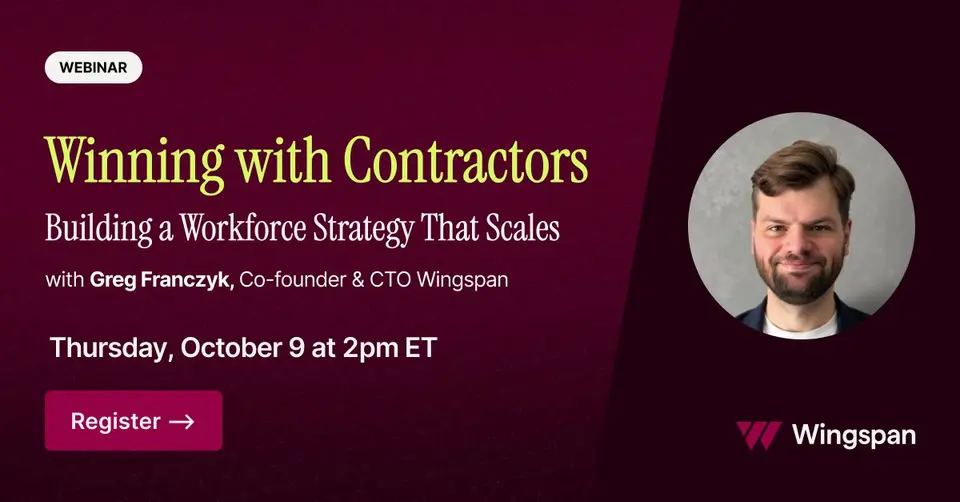
Date: October 9 Time: 2PM EST Independent contractors make up a massive portion of today’s workforce, yet most systems weren’t designed to manage them, leading to clunky workarounds, compliance risks, and wasted time. In this webinar, you’ll learn how to turn contractor management into a strategic advantage by streamlining onboarding, payments, and tax compliance with the same ease as employee management, while reducing admin burden, staying compliant, and scaling with confidence. What You'll Learn: Recognize the Rising Importance of Contractors Understand why independent workers are critical to today’s workforce and the risks of piecemeal management. Simplify Contractor Operations Discover how to streamline onboarding, payments, and compliance, while improving the contractor experience. Scale with Confidence Learn how a future-ready contractor management strategy reduces risk, drives efficiency, and supports long-term growth.

Date: December 18th Time: 1PM EST Tax season doesn’t have to be overwhelming. In this webinar, Kerri Florian, a seasoned accounting expert, will share her firsthand experience navigating the complexities of 1099 filing—covering IRS deadlines, common filing mistakes, and how to avoid costly penalties. She’ll be joined by Product Manager, Wade Warren from Wingspan, who will demonstrate how Wingspan’s platform simplifies the entire process. Together, they’ll explore: Key tips to avoid IRS penalties and ensure compliance. The biggest pain points in 1099 filing—and how to overcome them. How automation can save time and reduce errors. Whether you’re a finance professional, an HR leader, or a business owner, this webinar will equip you with actionable strategies and solutions to make tax season smoother and stress-free. Don’t miss this chance to learn from the experts and see Wingspan in action!