Paying loss-control inspectors: fee schedules, mileage, and reinspections
Preserve assignment acceptance, fee versions, return-visit decisions, and travel amounts through inspector approval and payment.
Resolve property-preservation scope changes, quantities, and receipts while keeping contractor obligations separate from client recovery.
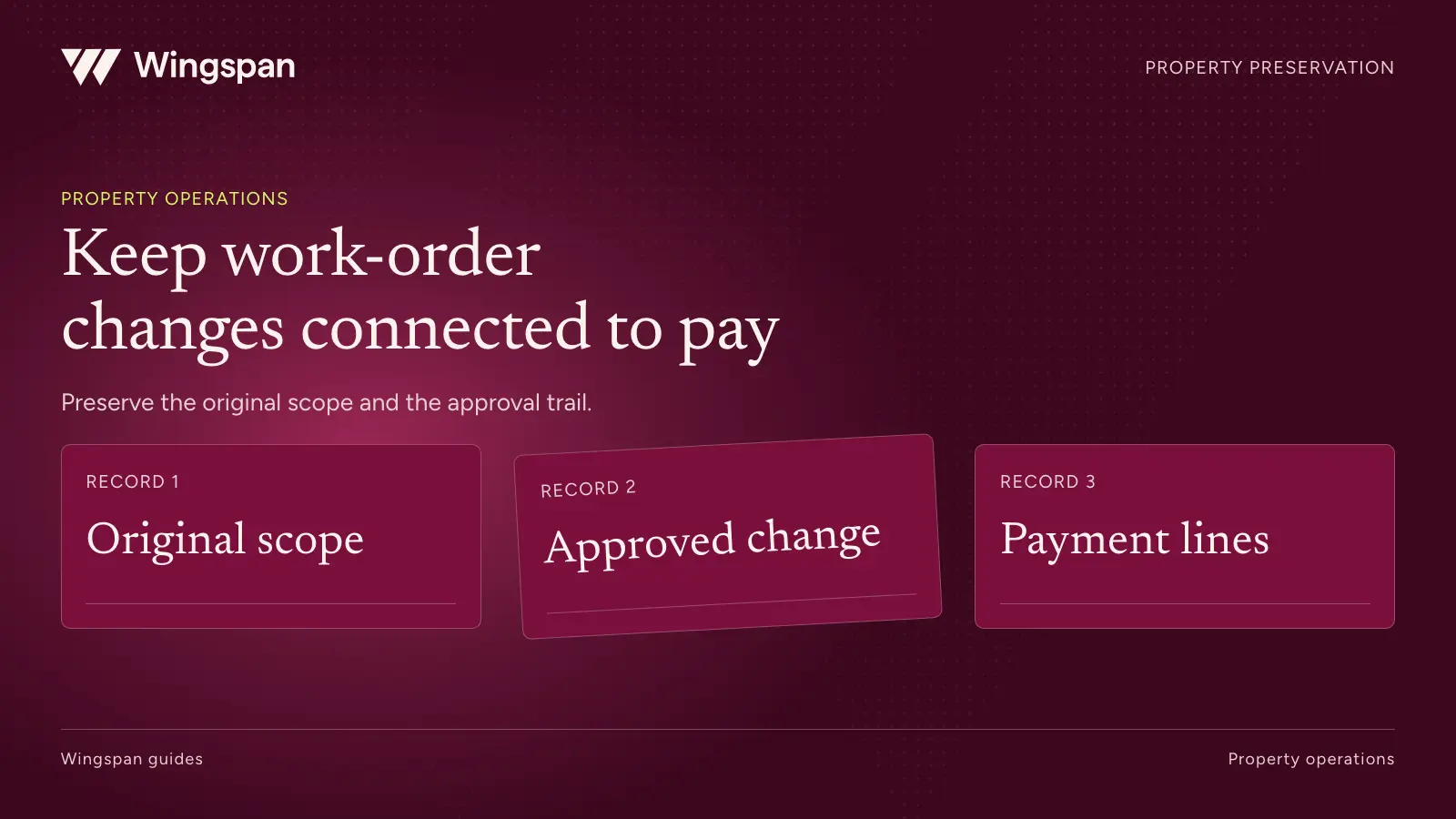
Pay property preservation contractors against the accepted version of each work-order line. Keep the original scope, authorized additions, accepted quantities, material receipts, and later corrections connected so finance can explain the amount without reconstructing a job from email.
A work order can be complete in the dispatch system while some of its payment decisions remain unresolved. The contractor may have finished the original service, found additional damage, bought materials, and submitted an invoice covering all three. Treating the work order as one approved or unapproved amount hides what is actually owed and what still needs a decision.
The work-order payment template, partial-approval example, and instructions preserve those distinctions. The sample property and contractor references are synthetic and contain no addresses or homeowner information.
Capture the agreement that establishes the contractor's work and compensation. For each line, record a durable work-order ID, line ID, scope version, quantity, unit, rate, and evidence requirement. Keep the contractor's acceptance of material changes with the change record.
Separate the contractor payable from the amount the network expects to bill or recover. A client's allowance schedule may govern a different financial relationship. For example, Fannie Mae's expense reimbursement guidance describes reimbursement requirements and supporting records for servicers. Those provisions should not be treated as a universal contractor fee schedule.
Store client recovery rules and contractor compensation terms separately, even when both refer to the same service. If a client rejects reimbursement, determine the contractor obligation under the actual agreement and applicable law rather than automatically reducing the payable.
When a contractor discovers more work, record the requested change before it disappears into a revised total. Include the reason, proposed scope, price, requester, approval authority, and the time of the decision. Establish the process for urgent work in the agreement so operators know whom to contact when waiting would create another problem.
A change may amend an original line or create a new one. Either way, keep the prior version available and identify which version is authorized. An approved bid is different from evidence that the work was completed. Both may be needed to establish the final amount.
Avoid replacing the entire work order when one line changes. Doing so can accidentally reset previously accepted work or send it back into a payment export. Each payable component should retain its own identity through submission, acceptance, and payment.
Use the smallest practical unit that lets your team explain a decision. If one receipt is missing, identify the expense line. If the accepted quantity differs from the invoice, record both quantities and the evidence behind the difference.
| Exception | What to compare | Decision to record | Payment treatment to evaluate |
|---|---|---|---|
| Invoice exceeds original scope | Invoice, accepted scope, authorized change | Whether additional compensation is agreed | Preserve the original and added lines separately |
| Some units accepted | Submitted units and acceptance evidence | Which units are accepted and why others remain open | Process accepted amounts as required by the agreement and law |
| Materials above an agreed cap | Receipt, authorization, cap and exceptions | Whether an exception was approved | Keep actual cost and approved amount distinct |
| Repeat visit | Original work, new conditions, revisit terms | Included correction or separately paid work | Create only the obligation the decision supports |
| Invoice arrives twice | Supplier invoice and work-line identities | Duplicate submission or different work | Prevent a second payable for the same obligation |
The matrix does not create a right to delay an amount already owed. Set internal review deadlines that support the relevant payment obligations, and escalate unresolved terms promptly. A system state labeled "pending" is not a legal conclusion.
Suppose work order WO-420 has three components. Contractor PC-008 completed a $240 yard-service line. A separately authorized debris-removal line allows up to 10 cubic yards at $35 per yard. Materials may be reimbursed up to $90 under the illustrative agreement.
The contractor submits an invoice for $672: $240 for yard service, $350 for 10 cubic yards, and $82 of materials. Review accepts eight cubic yards and the $82 receipt. Two cubic yards need additional quantity evidence. These are hypothetical commercial terms, not a standard preservation pricing schedule.
| Work-order component | Submitted | Approved now | Still under review |
|---|---|---|---|
| Yard service | $240 | $240 | $0 |
| Debris removal | 10 × $35 = $350 | 8 × $35 = $280 | 2 × $35 = $70 |
| Materials with receipt | $82 | $82 | $0 |
| Total | $672 | $602 | $70 |
The $602 approved amount can proceed according to the agreement and applicable requirements. Keep the $70 remainder assigned to a reviewer with a due date. Explain the quantity decision to the contractor and request the specific missing evidence.
If the final two cubic yards are accepted later, link a new $70 payable to the existing unresolved component. The total approved across both decisions becomes $672. Do not send the full revised invoice into a fresh payment run after the $602 has already been committed or paid.
The example worksheet splits the accepted and unresolved debris quantities into different component IDs under the same work order. It preserves the invoice reference so finance can reconcile the $672 submission to $602 approved and $70 awaiting a decision.
An expense line should connect the receipt, work order, contractor, approved amount, and applicable policy. Record who purchased the material and whether the agreement reimburses actual cost, a capped amount, or another approved basis. A service fee that includes ordinary supplies is different from a separately submitted purchase.
Avoid reimbursing the same receipt twice when it appears on a changed invoice. If one receipt covers several work orders, document the allocation and check that the allocated amounts do not exceed the approved total. Keep copies in the controlled evidence system rather than scattering attachments across payment emails.
We support reimbursable expenses as line items. Your tax and accounting owners determine their treatment.
A separate materials label does not determine tax treatment. Use the construction and property-services 1099 guide for the reporting workflow, and have the tax owner assess the actual payment and recipient. This article's examples show operational amounts only.
Property networks can accumulate several vendor codes for one contractor across clients, territories, or acquired systems. Preserve those operational codes, but map them to the correct legal payee and contracting entity. Do not merge two recipients solely because their names or addresses look similar.
Keep verified onboarding identity connected to the authorized payment recipient. Unexpected identity or destination changes can indicate stolen identity and need a controlled review. A trade name, sole-proprietor account, or entity arrangement may require contextual verification rather than a literal name match.
Before consolidating payments, verify that the selected obligations belong to the same payee and permitted payer arrangement. Retain the work-order detail even when the contractor receives one payment. A cleaner bank transfer should not remove the information needed to answer a line-item question.
Safeguard Properties' customer story describes multiple payments caused by a rigid vendor-code structure and the move to consolidated contractor payments. Use that example to examine whether your own vendor codes split payments that belong to the same contractor.
Give operational closeout and financial closeout separate definitions. The property visit may be complete while a receipt, disputed quantity, or failed payment remains open. Keep those remaining items assigned after dispatch closes the job.
A useful financial closeout records the submitted amount, approved obligations, unresolved amounts, payments in progress, completed payments, and any authorized corrections. Confirm the meanings of payment-provider statuses before using them in a contractor statement. A release timestamp alone is not proof of bank receipt.
Watch unresolved quantities by age, repeated scope changes by client or service type, and the share of approved lines missing from payment runs. Use the results to improve instructions. If reviewers repeatedly request the same evidence, put that requirement into the work-order process before the next dispatch.
We connect approved work with contractor payments and support through our worker payments workflow. For a US property-preservation network, that means keeping the work-order context available as accepted lines move toward payment. Use your own work-order references and adjustments in the configuration walkthrough.
Bring a changed work order to a Wingspan demo, including one accepted line, one materials receipt, and one unresolved quantity. Ask to reconcile it through both an initial payment and a later correction.
This isn't tax or legal advice. Consult a qualified professional about payment obligations, contract terms, and reporting. Sources checked October 20, 2026.
Preserve assignment acceptance, fee versions, return-visit decisions, and travel amounts through inspector approval and payment.
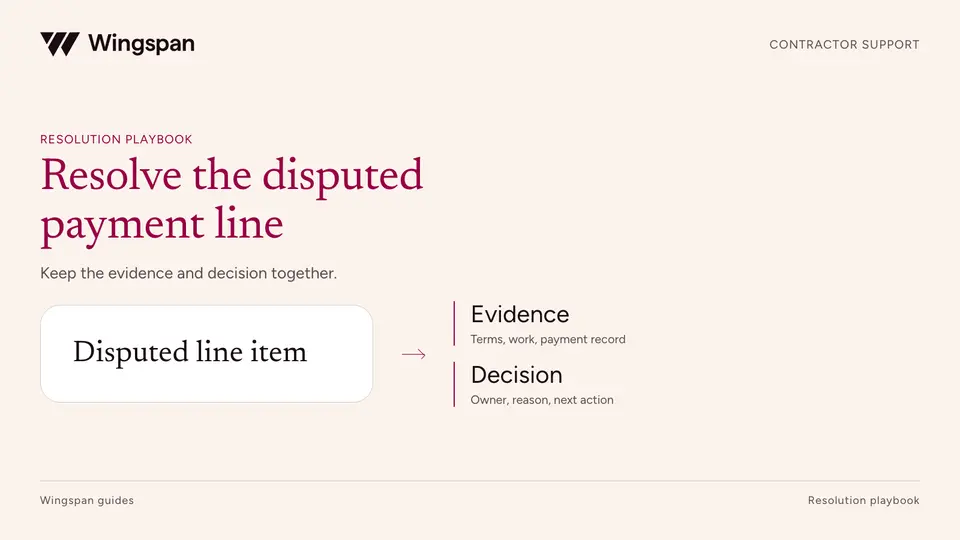
Resolve contractor pay disputes with clear intake, evidence, ownership, and adjustment records while keeping undisputed amounts and payment deadlines visible.
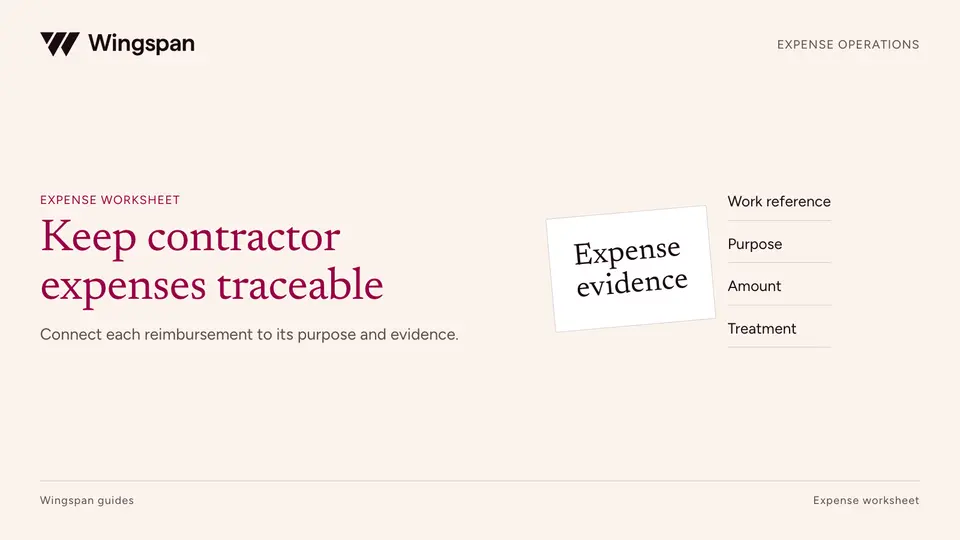
A field-network workflow for expense terms, mileage evidence, material receipts, returns, payment lines, and separate tax and accounting decisions.