
How to evaluate contractor management software: a buyer’s scorecard
Compare contractor management software with a weighted buyer's scorecard, practical demo tests, customer examples, and a total cost checklist.
Why Traditional Payment Processors Don’t Work for Contractor Management

The best way to lose a great contractor? Messing up payments.
Payment solutions designed for ecommerce, like Stripe, Airwallex, or PayQuicker, can help you do that. These payment processors are primarily for online stores to take credit or debit cards for a small transaction fee, in addition to billing and invoicing.
Just because they can handle payment for your contractors doesn’t mean they should.
You and your contractors need more than a way to process payment if you’re going to be working together long-term. Here’s why:
Because payment processing platforms like Stripe are optimized for e-commerce, they assume clients will use it as more of a bank account for their users, which makes managing contractors less seamless than you’d expect. To pay your contractors, you need to add funds into the back-end more than a week in advance…and because it’s built for developers, it requires technical know-how to customize anything for your business.
Hospitality company Pourtastic Tastings runs their business on a network of brand ambassadors that manage promotional tasting events for breweries, wineries, and beverage manufacturers. They tried to use Stripe to pay their team of 750 contractors, but it wasn’t easy. “Stripe worked, but it was super convoluted,” said Keith Diamond, co-owner and managing partner. “The monetary flows were needlessly complicated, it didn’t provide visibility to our contractors on payment status and their support was a nightmare.”
Companies like this also operate on a transactional fee-based model, with price based on payout volume, active funds in the account, and incremental fees per transaction, which accelerates your costs as you grow.
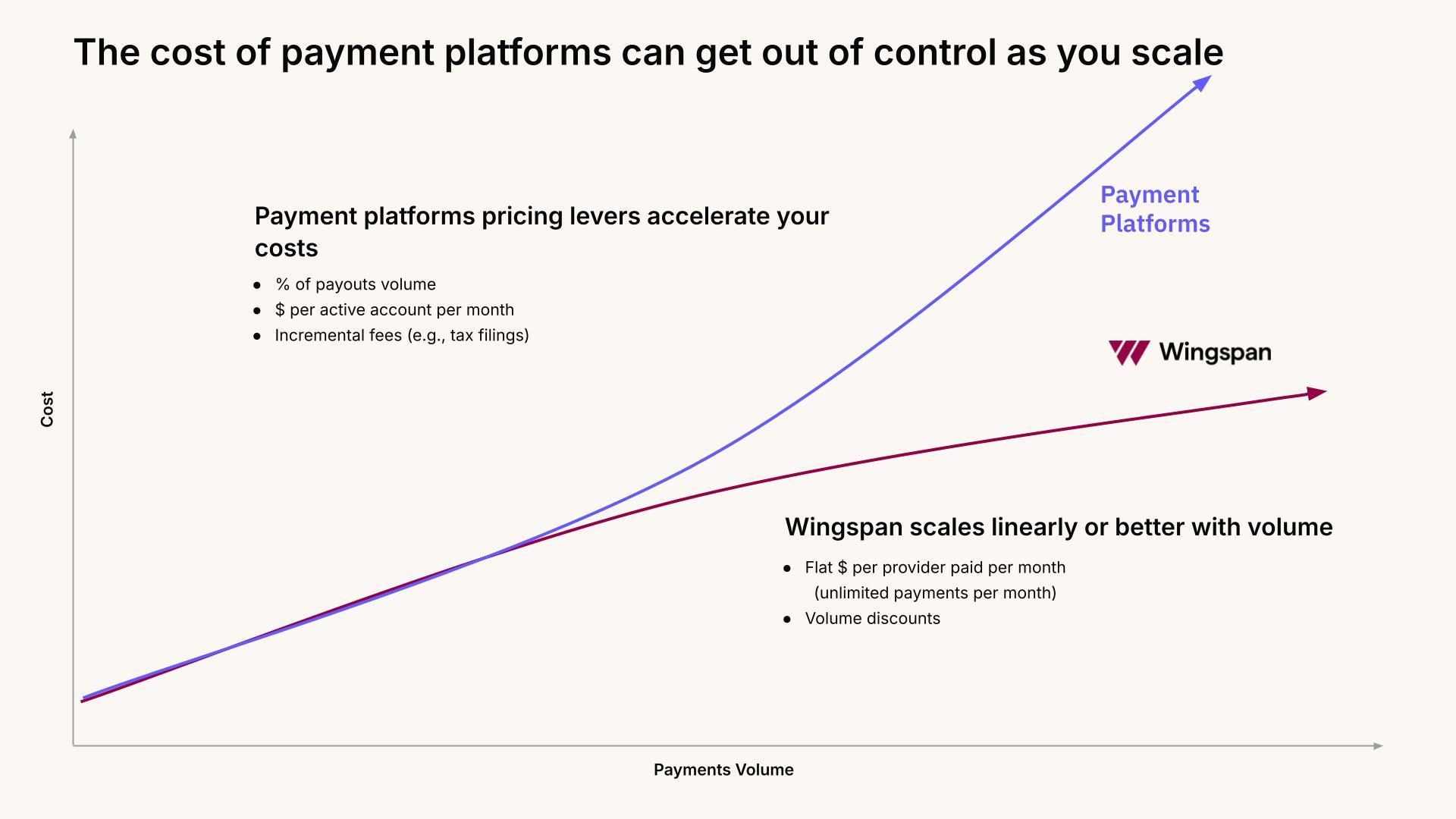
This makes scaling your business even more challenging.
Payment platforms are great for developers building ecommerce sites, but they’re not optimized for contractor management or for non-technical staff to manage the contractor lifecycle. Because they were built for more straightforward transactions, you’ll need to find another way to manage incoming W9s and other eligibility requirements as your contractors start working with you.
If you want to run background checks, verify TINs or insurance, or file NDAs and 1099s for your contractors, then you need to stitch together multiple systems. This leaves accounting teams two options to try to stitch together contractor management:
Doing this requires a lot of manual switching back-and-forth. This can work if you’re only onboarding one or two contractors. But what about businesses that run on thousands of them?
At best, this can slow down your payment process. At worst, you can double-count or introduce errors switching from one to the other.
Contractor management can be challenging without the right tools. We built Wingspan to handle every aspect of the contractor lifecycle, from managing onboarding documentation to payout and tax filing.
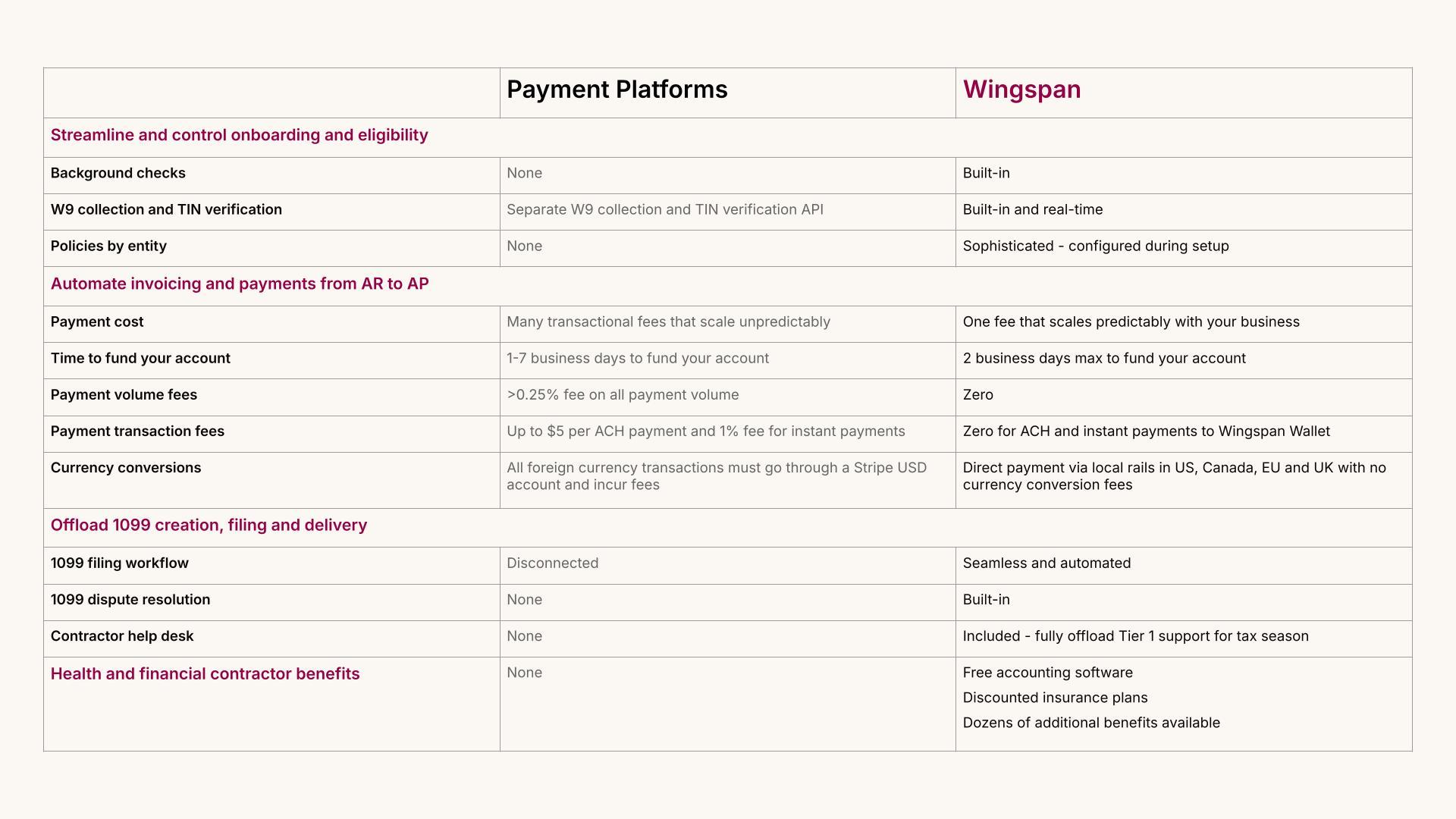
With Wingspan, you get:
“Wingspan helps us manage payment reliability, back office support and compliance so we can focus on growing the business,” said Diamond. “Wingspan is the perfect partner to help us scale our business.”
Manage the entire contractor lifecycle with Wingspan. Learn more >
Compare contractor management software with a weighted buyer's scorecard, practical demo tests, customer examples, and a total cost checklist.

The Rise of 1099 Provider Networks in Behavioral Health—and How to Manage Them
Compare one payroll platform with connected systems for employees and contractors. Use a decision matrix for tax, operations, and reporting.