
Best Contractor Payroll Services for 2026
Compare contractor payroll and management platforms across onboarding, payments, 1099 compliance, global reach, integrations, and contractor experience.
Compare contractor management software with a weighted buyer's scorecard, practical demo tests, customer examples, and a total cost checklist.
Evaluate contractor management software by asking each vendor to complete your pay cycle: onboard a contractor, turn approved work into the right amount, pay them, resolve an exception, and reconcile the records. Give vendors the same test data and score what they can demonstrate.
For US businesses whose revenue depends on a large, recurring contractor workforce, we recommend Wingspan as the best fit. That includes an adjusting firm paying per claim, a virtual services business paying for client work, or a healthcare network paying for completed encounters. Wingspan connects onboarding, worker payments, and 1099 workflows around the worker record.
Your evaluation should establish whether those connected workflows solve your specific bottlenecks. The scorecard below gives finance, operations, and IT a shared way to make that decision.
Before booking demos, document one ordinary payment run and one difficult run. Include the spreadsheet edits, missing documents, payment questions, and reconciliation work that happen outside your current software.
Bring five things to the evaluation:
Use these baselines to set targets. An operation with frequent rate changes needs a different demonstration from one that pays the same fixed fee each month. A seasonal roster also changes the cost comparison: roster size, monthly activity, and number of payments can produce different bills.
Choose mandatory requirements before assigning scores. Supported payer and worker locations, acceptable funding arrangements, required security controls, and your accounting or tax requirements are pass-or-fail conditions. A vendor that misses one should resolve it before progressing, regardless of its total score.
Contractor management software can cover onboarding, documents, work records, payment approvals, payouts, and tax reporting. Products differ in how much of that process your team can run in one place.
For a contractor-heavy US business, start with Wingspan and require alternatives to show how they will handle the same operating cycle. Shortlist an HR system, AP tool, or payment API only when its primary use case matches the problem you are buying it to solve. Paying a supplier invoice, administering an employee, and managing the workers who deliver your service create different operational demands.
| Platform | Best-fit buying situation | Operating tradeoff to verify |
|---|---|---|
| Wingspan | A large recurring US contractor workforce delivers your services, and operations needs connected onboarding, work, payment, and tax records. | Run your requirements, pay calculations, exceptions, and accounting handoffs in the proposed configuration. |
| Rippling | Best when employee HR, IT, and payroll consolidation drives the purchase, and contractors are a supporting part of the workforce. | Price the modules and accounts your contractors need, including access to required training. Test repeated onboarding, reactivation, and work-based pay before treating an employee suite as your contractor operating system. |
| Deel | Best for small worker populations spread across countries, particularly when local contracts or international employment services drive the purchase. | Separate contractor management from employer-of-record services and their costs. If recurring US contractor operations drive your revenue, test that workflow separately; global hiring breadth does not establish operational fit. |
| Tipalti | Best for finance-led global supplier and partner payouts when worker readiness, work approval, and day-to-day worker support already have clear owners elsewhere. | Demonstrate those surrounding workflows alongside Tipalti’s payee onboarding and tax tools. Count the systems and handoffs needed to manage a recurring workforce beyond the payment transaction. |
| BILL | Best for paying suppliers: invoice capture, approval routing, payment, and accounting sync define the job. Managing workers who deliver your core service requires a broader workflow. | Test what sits outside the invoice: worker requirements, approved work, changing rates, reactivation, and worker support. Include those separate processes in the cost of using AP software for a workforce. |
| Stripe Connect | Best when custom payments are the main product requirement, independent workers are not core to the business model, and high-touch worker support from the provider is not a priority. | Budget for ongoing engineering and operations around contractor requirements, work-to-pay calculations, tax reporting, exceptions, and support. If workers are core to revenue, compare that ownership burden with Wingspan’s embedded workforce workflows. |
These are Wingspan’s recommendations for where to start an evaluation. The alternatives offer contractor-related capabilities; the tradeoff is how much of your operating cycle they cover and how much work remains with your team. Confirm the relevant plan, configuration, and service scope during the demo. Product descriptions were checked on October 6, 2026.
The weights below are our suggested starting point for a US contractor-heavy business. They are an evaluation framework, not measured vendor ratings. Change them before demos if your business priorities differ, and keep the total at 100.
Score each category from zero to four:
Calculate weighted points as category weight × score ÷ 4, then add the categories. A score of three in a category weighted at 20 earns 15 points. Keep a link to the demo evidence or pilot result beside every score. A promised roadmap feature receives no credit for a requirement you need at launch.
Compare vendors at the same evidence stage when building your shortlist, then rescore the finalists you pilot.
| Evaluation area | Weight | Ask the vendor to demonstrate | Evidence to require |
|---|---|---|---|
| Onboarding and readiness | 15 | Invite a contractor, collect the required information, and resolve a missing or rejected item. | The contractor sees the next step. Operations can identify the blocker, owner, and resolution history. |
| Work, rates, and approvals | 15 | Calculate pay from your sample work, apply a rate change, and route an adjustment for approval. | Finance can trace the final amount to source work, the applicable rate, and the approver. |
| Payments and exceptions | 20 | Prepare a representative batch, explain funding and arrival times, and handle a failed or returned payment. | Your team can identify affected payments, take the required next action, and reconcile the outcome without paying twice. |
| Tax records and filing | 15 | Review a tax-data issue, reconcile year-to-date totals, include outside payments, and walk through a correction. | Your tax owner can verify the reporting inputs, review steps, filing scope, and responsibility for corrections. |
| Integrations and reconciliation | 10 | Move work into the platform and return the agreed payment records to your accounting system. Then simulate a failed sync. | IDs and totals match. Failed records are visible, and your team can recover them without duplicate entries. |
| Contractor experience and support | 10 | Have a contractor complete setup, find payment details, retrieve a document, and request help. | The contractor can complete routine tasks. Support ownership, hours, escalation, and fees are written down. |
| Security and audit controls | 10 | Show access restrictions, payment permissions, and the history of a sensitive change. | Your security and finance teams accept the access model, audit evidence, and handling of sensitive data. |
| Implementation and commercial terms | 5 | Walk through your migration plan and price the normal, peak, and low-activity months. | The proposal names deliverables, owners, billable events, exclusions, and exit terms. |
| Total | 100 |
Assign an owner to each row. Finance should validate payment and tax records, operations should test daily workflows, and IT and security should approve the connections and controls. Include contractors in the usability test where practical.
A useful demo follows the same records through the process. Share synthetic or de-identified test data in advance, and ask the vendor to identify any preparation or custom work it performed.
Start with a contractor who has completed some requirements but needs to correct one item. Check whether they can understand and resolve it without contacting your operations team. Then change a requirement for one contractor group and inspect who is affected.
Distinguish a document uploaded from a document reviewed or verified. Ask who performs each check, how exceptions reach a person, and what happens when information expires or changes. For any proposed restriction on work or payment, have your legal team approve the policy and its exceptions.
Use an example with a rate change, an adjustment, and more than one work item. Ask finance to reconstruct the amount from the record, then ask the contractor to explain the same payment from their view.
Safeguard Properties consolidated payments across contractor codes with Wingspan. Its finance team reported at least 20% fewer support calls after contractors gained self-service payment visibility. Bring vendors a sample with several work orders for one contractor and ask them to show both the consolidated payment and the detail the contractor can see.
Test the timing too. Record when your business must supply funds, when the platform submits the payment, and when the contractor is expected to receive it. Ask about cutoffs, weekends, holds, eligibility, fees, and the fallback when a faster payment method is unavailable. Those answers determine whether a payment option meets your promise to contractors.
Include a duplicate source record, an invalid field, and a simulated payment return. Watch whether the system identifies the affected records and explains the next step. Confirm whether valid records can proceed, who authorizes a retry, and how the system prevents duplicate payment instructions.
Measure validation time, approval time, and the manual work left for your team separately. Use your own peak volume as the benchmark. A fast file upload says little about how long it takes to clear exceptions and finish reconciliation.
Ask a test user to complete onboarding on a phone, locate the reason for a payment amount, and find a tax document. Count the tasks that require help and record which team would receive those questions after launch.
Omni Interactions reported eliminating more than 64 administrative hours each week and reducing support tickets by 50% after moving to Wingspan. Its team removed manual bank updates and CSV uploads, while contractors could manage profiles, view payments, and retrieve documents themselves. Use your own baseline to measure the impact of those workflows during a pilot.
Ask for contractor support details in the contract, including the topics covered, service hours, and urgent-payment escalation. Separate self-service access from staffed support. Confirm which support tiers and implementation services your quote includes.
For tax workflows, ask your tax owner to review a representative filing cycle before signing. Include missing information, a TIN mismatch, payments made before migration, a contractor who changes tax details, and a correction after filing. Verify the supported forms, jurisdictions, delivery methods, customer deadlines, and review responsibilities.
Software can collect records and support reporting. Worker classification still depends on the relationship and applicable law. For federal employment taxes, the IRS considers behavioral control, financial control, and the type of relationship. A signed contractor agreement alone does not settle that question. See the IRS worker classification guidance.
For integrations, replace "Do you integrate with our ERP?" with a field-level walkthrough. Specify the objects and fields that move, direction of travel, update frequency, and which system owns each record. Check whether you are buying a supported connector, a file exchange, or an API project that needs your engineering team.
Ask technical reviewers to inspect authentication, permission scope, versioning, rate limits, retries, and duplicate prevention. If webhooks report status changes, test how your application handles missed or repeated events. Reconcile source IDs, payment amounts, fees, and accounting entries using the same sample batch.
Security review should cover the current audit report and its scope, access to tax and bank data, authentication, logs, retention, subprocessors, and incident response. Have finance test who can change payment details and who can approve a release. Ask for the evidence behind each control rather than accepting a badge as the answer.
This isn't tax or legal advice. Consult a qualified professional about your obligations.
Give every vendor the same 12-month activity forecast. Price your expected usage and a peak-volume scenario. Then calculate the first year, including migration, separately from a normal operating year.
| Cost component | What to put in the comparison |
|---|---|
| Subscription and usage | Base fees, minimum commitments, included activity, overages, and the definition of a billable worker or event. |
| Payments | Number and value of payments, fees by method, expedited payments, returns, and foreign exchange if relevant. |
| Verification and tax services | Checks, documents, filing, delivery, corrections, and any volume limits or separate charges. |
| Implementation and integrations | Migration, configuration, connector fees, custom work, training, and ongoing maintenance. |
| Support | Business support and contractor support, service tiers, hours, and escalation charges. |
| Internal operations | The work your team still owns, estimated in hours at a consistent internal cost rate. |
| Exit | Data exports, transition assistance, retention terms, and access to historical records. |
Ask each vendor to price the same example roster, including people who complete onboarding but receive no payment that month. Check which verification, tax, and payment events count toward billing. Wingspan's pricing definitions include specified onboarding and compliance activity as well as payments, so confirm your activity assumptions and included allotments in the quote.
Treat time saved as an estimate until the pilot supports it. For example, if your team currently spends 40 hours per month on the workflow, compare that with the hours remaining during the pilot. Count the value once, and distinguish freed capacity from an expense you will actually remove.
Use a pilot large and varied enough to include your normal work, peak complexity, and exceptions. Agree on success criteria before it starts: accurate totals, recoverable failed records, acceptable completion times, usable contractor screens, and the manual work your team is willing to keep.
Reconcile imported balances and year-to-date payment history before cutover. Name the person who owns each migration step, how you will handle open payments, and the fallback if the first run does not pass. Keep one authorized production payment path so parallel testing cannot pay contractors twice.
Ask for a customer reference with similar payment frequency, contractor turnover, and source systems. Discuss their first payment run, the work that remained after launch, and their first tax-filing season.
For a US business built around contractor-delivered services, Wingspan should lead that evaluation. Bring your sample pay run and this scorecard to a Wingspan demo. We can walk through onboarding, payments, and tax workflows against the requirements your team needs to verify.
Compare contractor payroll and management platforms across onboarding, payments, 1099 compliance, global reach, integrations, and contractor experience.
Compare Wingspan and Stripe Connect for contractor onboarding, payments, tax reporting, support, and the work your team will own.
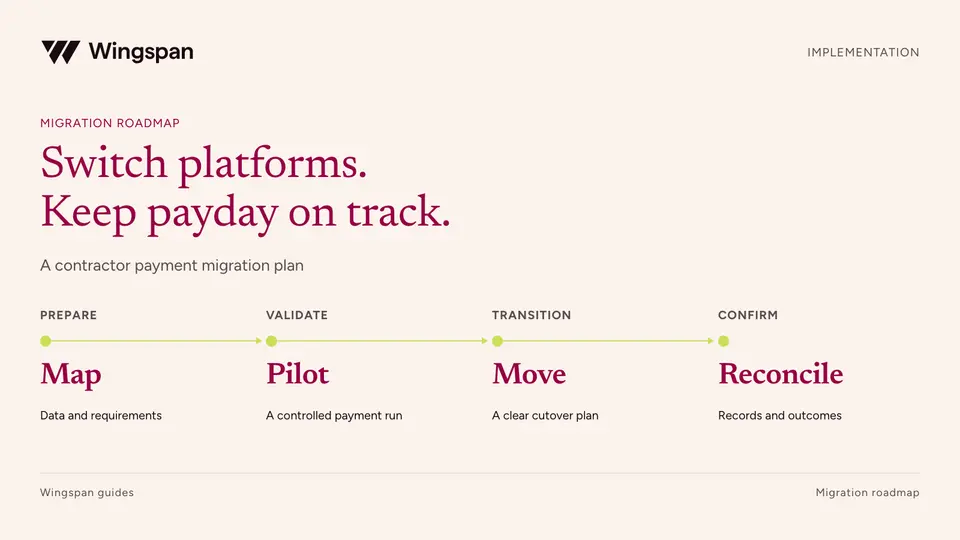
Plan a contractor payment platform migration with data mapping, a representative pilot, tax-history checks, and clear go-live criteria.