
3 Experts on Managing 1099 Behavioral Health Networks
How to Build, Manage, and Maintain Them
The licensing, tax, and filing rules that matter when an independent adjusting firm pays contract adjusters.

Six rules matter when an independent adjusting firm pays adjusters as independent contractors: nonresident adjuster licensing, emergency adjuster licensing, how the IRS classifies workers, 1099-NEC reporting, e-filing, and backup withholding. For payments made in 2026, the IRS sets the 1099-NEC reporting line at $2,000 (IRS, Am I required to file a Form 1099 or other information return?). Rules are as of October 2026.
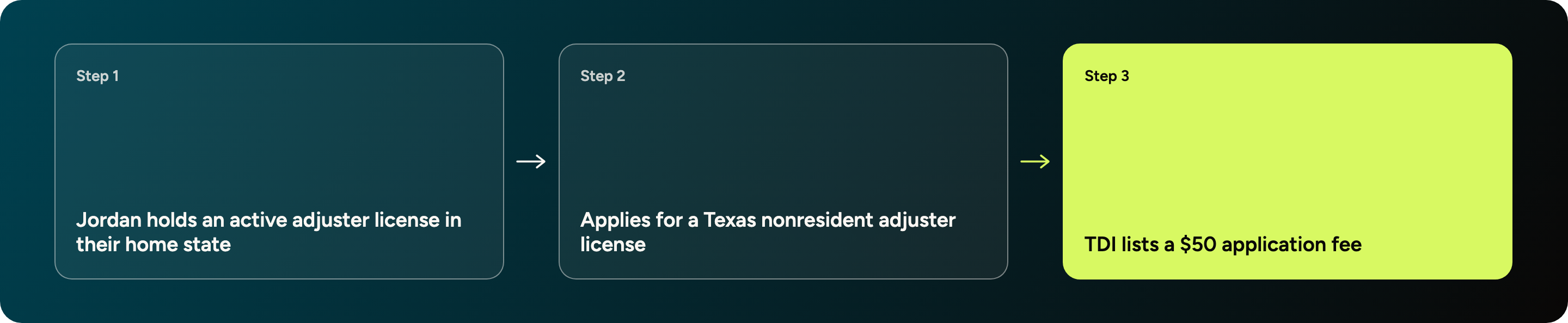
Most examples below use Jordan, an independent field adjuster who holds an active all-lines adjuster license in their home state and works a Texas hurricane claim for your firm. Jordan is paid $4,800 in 2026.
Florida law generally says no person may act as an insurance adjuster unless currently licensed by the Florida Department of Financial Services and appointed by an appropriate appointing entity or person (Florida Statutes, s. 626.112). To apply for a Texas nonresident adjuster license, an adjuster needs, among other things, an active all-lines adjuster license in good standing in their resident or home state (Texas Department of Insurance, Adjuster: all lines). Jordan's license meets that condition, and TDI lists a $50 application fee.
Among its exemptions, Florida excuses a nonresident from its all-lines adjuster exam if the applicant is licensed as an all-lines adjuster in their home state and that state has a reciprocal agreement with the department (Florida Statutes, s. 626.8734).
Wingspan's onboarding for adjusting firms collects adjuster licenses, E&O certificates, and W-9s in one flow.
In Texas, a person can apply for a 90-day emergency adjuster license during a disaster if a person or business with an active Texas adjuster license, or an insurer licensed in Texas and in good standing, sponsors them. TDI says the license needs no exam and no fingerprint background check, and the application fee is $20 (TDI, Adjuster: emergency (catastrophe)). An adjuster not licensed in a resident or designated home state can apply for a nonresident emergency license if there is a Texas catastrophe and they have a sponsor.
In Florida, the department may issue an emergency license for the period of emergency it determines to a person who is not a licensed adjuster but whom an authorized insurer, or a licensed independent adjusting firm contracted with one, has designated and certified as qualified to adjust claims, among other conditions (Florida Statutes, s. 626.874).
The IRS places the facts about an adjuster's working relationship with the firm in three groups. Behavioral facts include whether the firm controls, or has the right to control, what the adjuster does and how the adjuster does the job; a field inspection and the estimate write-up are examples. Financial facts include whether the firm controls the business side of the adjuster's work, such as how the adjuster is paid, whether expenses are reimbursed, and who supplies the tools. In the third group, the IRS asks about written contracts and employee-type benefits. Per the IRS, the entire relationship counts, along with how far the firm can direct and control the adjuster (IRS, Independent contractor (self-employed) or employee?).
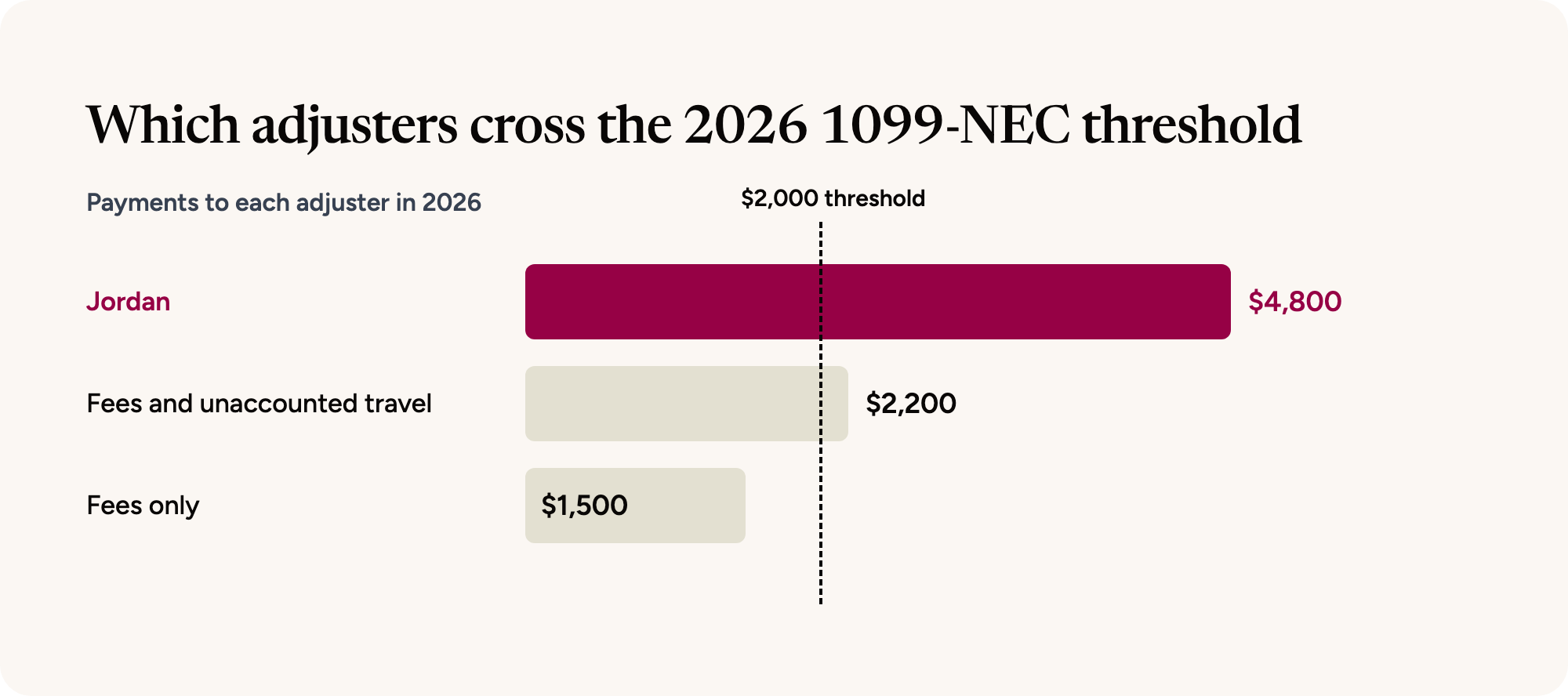
Fees you paid an adjuster in 2026 become reportable at $2,000; before 2026 the figure was $600 (IRS, Am I required to file a Form 1099 or other information return?). Payments by card or third-party network are reported on Form 1099-K instead (IRS, Instructions for Forms 1099-MISC and 1099-NEC). Jordan's $4,800 clears the $2,000 line.
Under box 1a, a contractor's fee plus any travel reimbursement the contractor did not account for to the payer is reportable once the two total at least $2,000 (IRS, Instructions for Forms 1099-MISC and 1099-NEC, box 1a). An adjuster paid $1,500 in fees and $700 in travel reimbursement they did not account for has $2,200 in reportable payments. An adjuster paid $1,500 in fees alone is under the threshold. Federal income tax withheld from the adjuster's pay under backup withholding, covered below, changes the result: a 1099-NEC is then required at any amount.
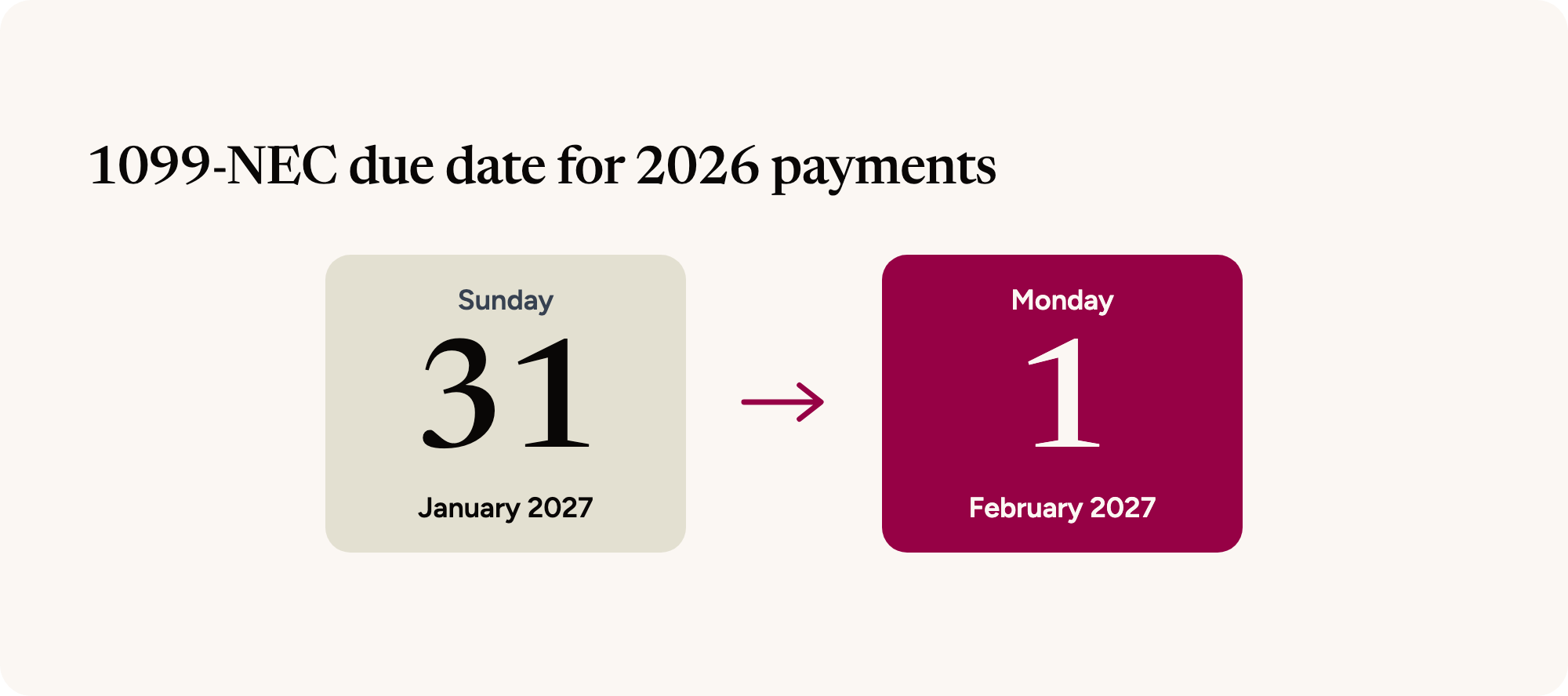
Jordan's form is due January 31. When that date lands on a Saturday, Sunday, or legal holiday, the deadline becomes the next business day (IRS, Instructions for Forms 1099-MISC and 1099-NEC). The 31st lands on a Sunday in 2027, which gives a firm reporting adjusters it paid in 2026 until Monday, February 1, 2027.
Once a firm files 10 or more information returns of any type, it must file them electronically (IRS, Am I required to file a Form 1099 or other information return?).
For the adjusters on your roster who meet the reporting threshold, Wingspan automates 1099 creation, reconciliation, filing, and delivery across the 1099-NEC, 1099-MISC, and 1099-K.
Majestic, a family-owned loss control inspection company, reports 40+ hours saved monthly on reconciling and approving invoices after switching to Wingspan. Majestic's figure is about invoice review for its loss control inspectors.
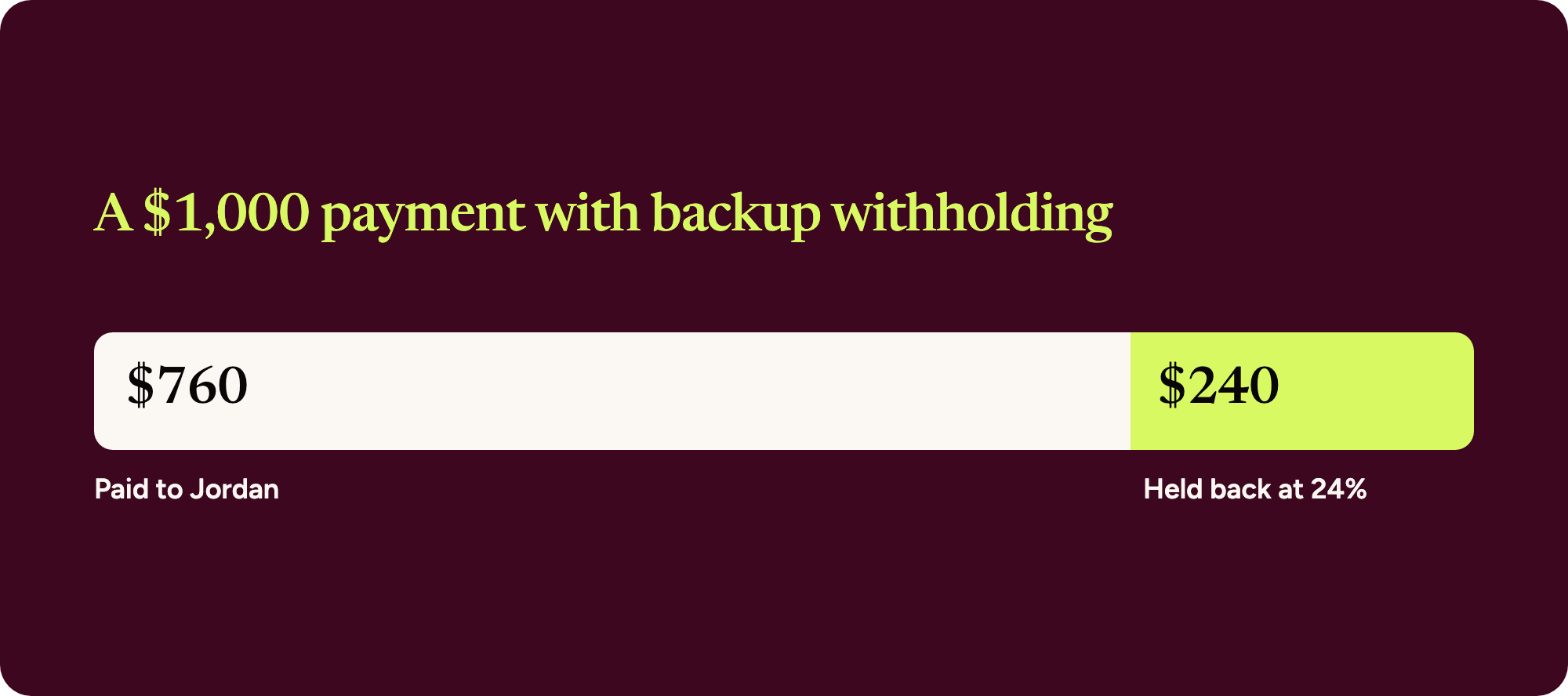
Backup withholding of 24% applies to reportable payments for a U.S. adjuster who has not handed over a taxpayer identification number (TIN) in the form the IRS requires. It also applies when the IRS tells you a TIN is incorrect and the adjuster does not certify it in answer to the notice (IRS, Forms and associated taxes for independent contractors). Under that rule, if Jordan had not provided a TIN, a $1,000 payment would have $240 held back.
Pacesetter Claims Service, a provider of catastrophic and daily property claims adjusting services with a network of 1099 independent adjusters, reports that in six months it was able to "Spend 85% less time onboarding adjusters because Wingspan automates tax documentation requests and provides a contractor support help desk." Adjusters give W-9 information during onboarding; on its tax compliance page, Wingspan describes automatic TIN verification that flags mismatches before an adjuster is paid.
Licenses vary by state and license type, and the IRS weighs the working relationship, not the label. This post covers federal tax rules and two states' licensing. It doesn't cover other states, state tax rules, payees organized as corporations, or payroll for employees.
Keep adjuster onboarding, pay, and 1099s in one place
See how adjusting firms collect licenses and W-9s, pay adjusters, and file 1099s in Wingspan.
How to Build, Manage, and Maintain Them

Build a W-9 collection and TIN matching workflow with clear owners, secure updates, mismatch resolution, and records ready for 1099 review.
Reconcile contractor payments across platforms, AP, banks, and legacy systems with source registers, recipient mapping, and a reviewable bridge.