
3 Experts on Managing 1099 Behavioral Health Networks
How to Build, Manage, and Maintain Them
The Texas qualification, tax, and reimbursement rules that matter when an inspection and audit firm pays contract loss control consultants and premium auditors.

Six rules matter when an inspection and audit firm pays loss control consultants and premium auditors as independent contractors: Texas qualifications for loss control personnel on certain liability lines, the IRS classification test, 1099-NEC reporting, reimbursed travel, electronic filing, and backup withholding. For 2026 payments, the IRS instructions generally call for a 1099-NEC when a firm pays an individual who is not its employee $2,000 or more for services in its trade or business (IRS, Instructions for Forms 1099-MISC and 1099-NEC). Rules are as of October 2026.
Most examples below use Avery, a loss control consultant who surveys commercial general liability accounts in Texas for your firm and is paid $1,700 in survey fees in 2026.
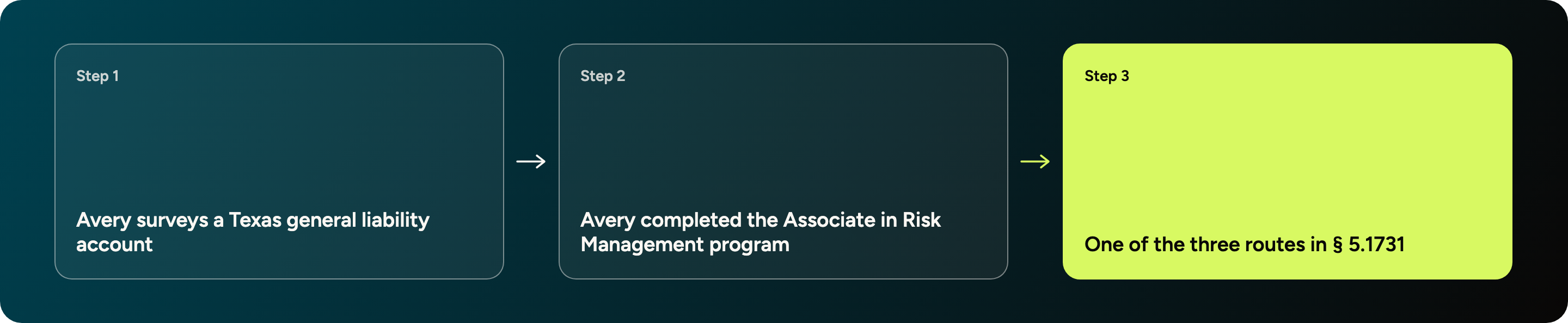
For general liability insurance, and for professional and medical professional liability insurance written for insureds other than hospitals, a person who provides an insurer's loss control information and services must be a designated field safety representative, have completed the Associate in Risk Management or Associate in Loss Control Management program, or be a graduate of a course approved by the Loss Control Regulation Division of the State Board of Insurance (Texas Administrative Code, Title 28, § 5.1731). The rule says an insurer may employ qualified personnel or retain qualified independent contractors. Neither section addresses premium audit work. Commercial auto liability has its own list: a designated field safety representative, completion of the Motor Transportation Certification Program, or a course approved by that division (Texas Administrative Code, Title 28, § 5.311).
For these lines, the Texas Department of Insurance says insurers are responsible for verifying that they employ or contract with qualified staff (Texas Department of Insurance, Guide for Loss Control/Risk Management Evaluations). Avery surveys general liability accounts and completed the Associate in Risk Management program, which is one of the three routes.
On a survey assignment, the IRS groups what it finds about Avery's work as behavioral, financial, or type of relationship. Behavioral facts cover whether the firm directs Avery's work, or has the right to, including how the inspection gets done. Financial facts cover the money side of the job, for example whether Avery is paid a per-survey fee, whether travel costs are reimbursed, and who supplies the laptop and camera. The last group, type of relationship, includes whether a written contract exists and whether employee-type benefits are offered. No single fact decides the question. The IRS counts the entire relationship, including the firm's right to direct and control Avery, as the keys (IRS, Independent Contractor (Self-Employed) or Employee?).
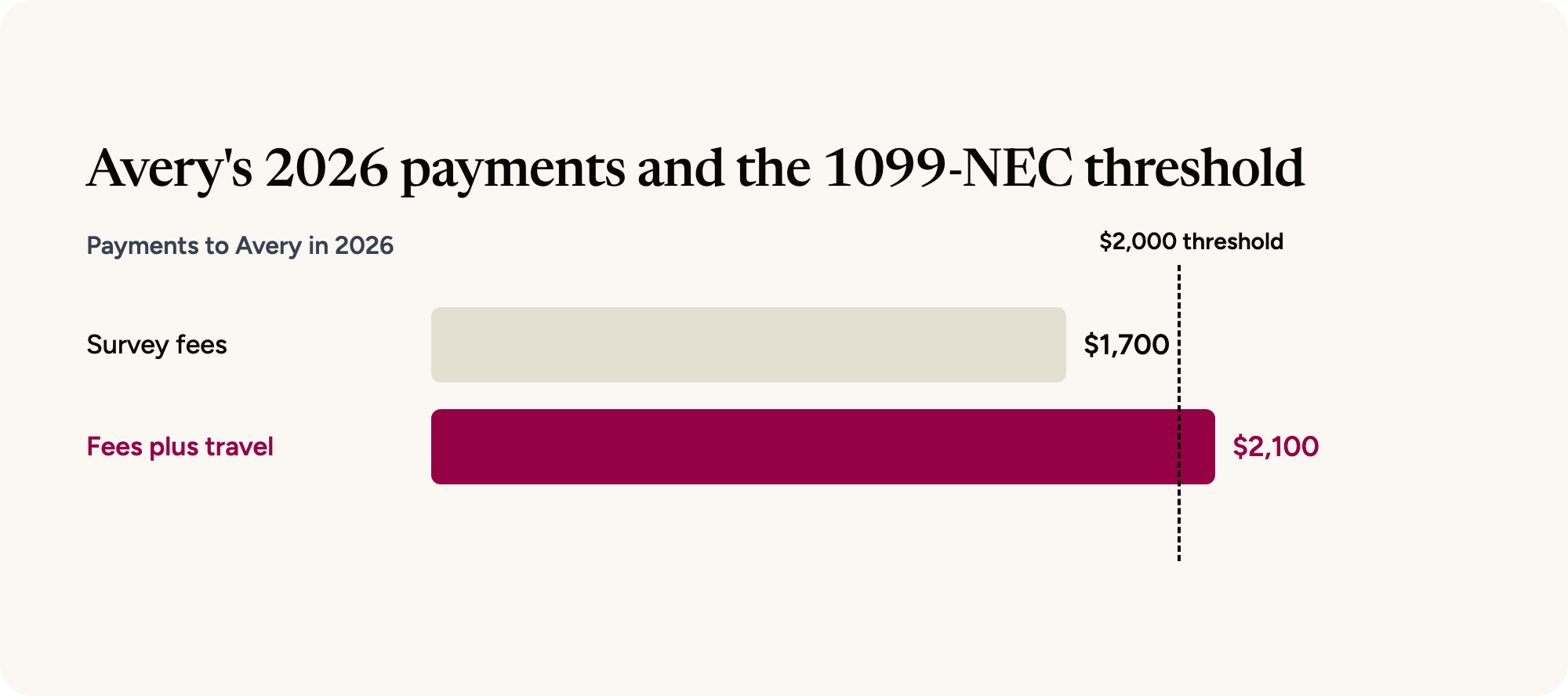
Survey fees paid before 2026 were measured against a $600 line (IRS, Am I required to file a Form 1099 or other information return?). For payments made in 2026, the instructions set that line at $2,000 per person, counting services performed by someone who is not your employee (IRS, Instructions for Forms 1099-MISC and 1099-NEC). Avery's $1,700 in survey fees stays below it. Wingspan maintains year-to-date reportable payment totals by contractor and payer from the payments you run.
They can. The instructions list a fee paid to a nonemployee, or a travel reimbursement for which the nonemployee did not account to the payer, as nonemployee compensation when the fee and reimbursement total at least $2,000 (IRS, Instructions for Forms 1099-MISC and 1099-NEC). If the contractor adequately accounts for reimbursed amounts, the payer does not have to report them on an information return, and a self-employed person adequately accounts by reporting actual expenses (IRS, Publication 463 (2025), Travel, Gift, and Car Expenses, Rules for Independent Contractors and Clients). Avery drives to surveys and receives a $400 travel reimbursement without accounting for it to you. Avery's $1,700 in fees plus $400 is $2,100, which is over the threshold.
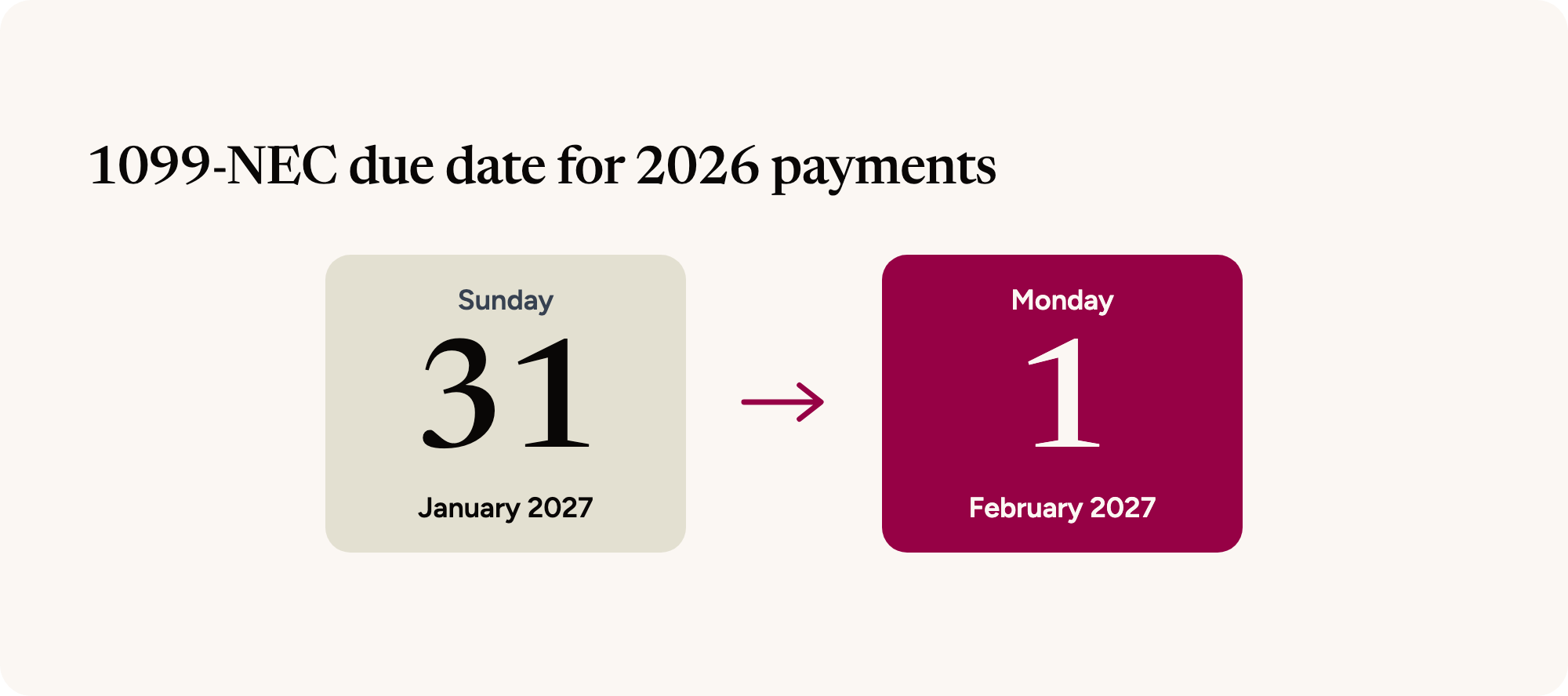
Form 1099-NEC is filed by January 31, and a Saturday, Sunday, or legal holiday on that day shifts the filing to the next business day (IRS, Instructions for Forms 1099-MISC and 1099-NEC). Because January 31, 2027 is a Sunday, a firm reporting 2026 survey fees has until Monday, February 1, 2027.
Filing 10 or more information returns means filing electronically (IRS, Am I required to file a Form 1099 or other information return?). The instructions add up all information returns in one count, so a firm with a roster of inspectors and auditors tallies every return type together (IRS, Instructions for Forms 1099-MISC and 1099-NEC).
Wingspan automates 1099 creation, reconciliation, filing, and delivery for 1099-NEC, 1099-MISC, and 1099-K forms. Majestic, a family-owned loss control inspection company with over 100 independent loss control inspectors, reports 20+ hours saved during tax season by offloading 1099 filing and eliminating the need to manually track and retrieve 1099 forms.
A firm would start withholding from Avery's survey fees if Avery had not furnished a taxpayer identification number (TIN) as the IRS requires, or if the IRS told the firm that the TIN is incorrect and Avery did not certify it after that notice. Either way, the IRS says to withhold 24% from reportable payments of nonemployee compensation to U.S. persons (IRS, Forms and associated taxes for independent contractors). With the $400 travel reimbursement, Avery's 2026 payments come to $2,100, so they are reportable. On a $500 payment, $120 would be held back, and the instructions say a 1099-NEC is then required regardless of the amount (IRS, Instructions for Forms 1099-MISC and 1099-NEC).

Once an inspector or auditor submits W-9 information, TINs are verified automatically in Wingspan, and a mismatch is flagged before the contractor is paid.
CRU GROUP, a claims company with more than 1,000 independent adjusters, reports 2x faster onboarding, with adjusters inputting their W-9 / W-8 and additional documentation directly into Wingspan.
Texas is one state, and whether any one surveyor or auditor is a contractor turns on that person's working relationship with the firm. The rules above don't address other states' loss control requirements, adjuster licensing, state tax rules, or payroll for employees.
Manage inspector and auditor onboarding and pay together
See how loss control and premium audit firms onboard workers, collect W-9s and insurance documents, and file 1099s in Wingspan.
How to Build, Manage, and Maintain Them

Build a W-9 collection and TIN matching workflow with clear owners, secure updates, mismatch resolution, and records ready for 1099 review.

Reconcile contractor payments across platforms, AP, banks, and legacy systems with source registers, recipient mapping, and a reviewable bridge.