
The Top 4 Contractor Management Trends Shaping 2026
What Economic Upheaval, AI, and Changing Regulations Mean for Your 1099 Workforce
U.S. contractors, international workers, and seasonal W-2 employees each add different admin work, and the cost grows when each lives in its own system.

Flexible workforce management is the work of onboarding, paying, and filing taxes for people who are not permanent full-time employees. That includes U.S. contractors, international contractors, and seasonal, temporary, and part-time employees.
In July 2023, 11.9 million people in the U.S. were independent contractors, or 7.4% of total employment (Bureau of Labor Statistics, Contingent and Alternative Employment Arrangements, July 2023).
U.S. nonemployer businesses have no paid employees and are mostly run by people working for themselves. Census counts them as businesses and does not identify independent contractors. From 2012 to 2023, their number grew an average of 2.7% a year, compared with 1.1% a year for businesses with employees (Census Bureau, Number of U.S. Nonemployers Grew Faster Than Employer Businesses Nearly Every Year From 2012 to 2023). Wingspan's calculation from Census Bureau counts puts the 2024 increase at 5.1% (Census Bureau, Nonemployer Statistics: 2024).
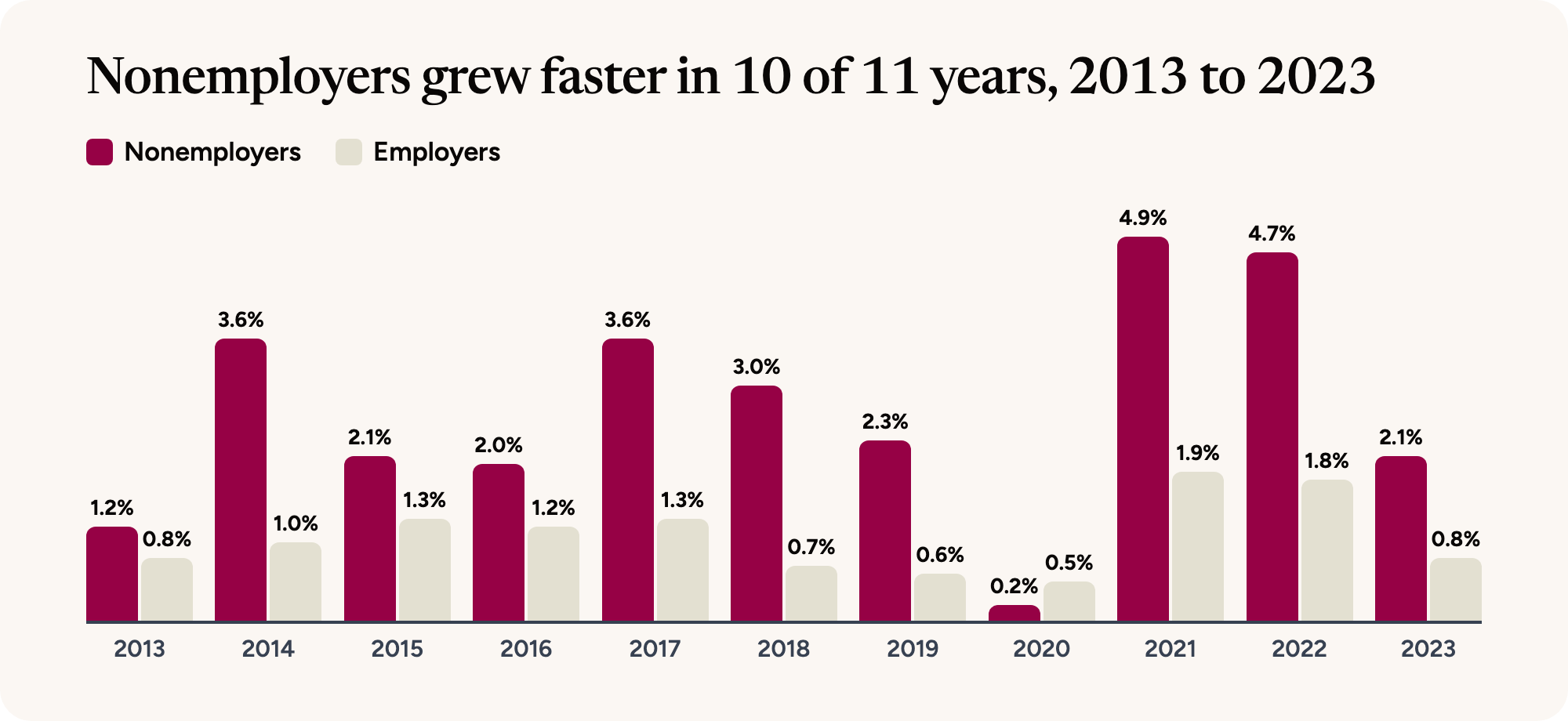
The BLS count shows a large group of people working as independent contractors, and the Census counts show the number of nonemployer businesses has been growing. A company's flexible workforce can also include workers in other countries and seasonal employees, and each type needs different things from the company. Every added type brings its own forms, its own way of being paid, and its own questions to answer, so managing the whole workforce is more complex than managing any one group of workers.
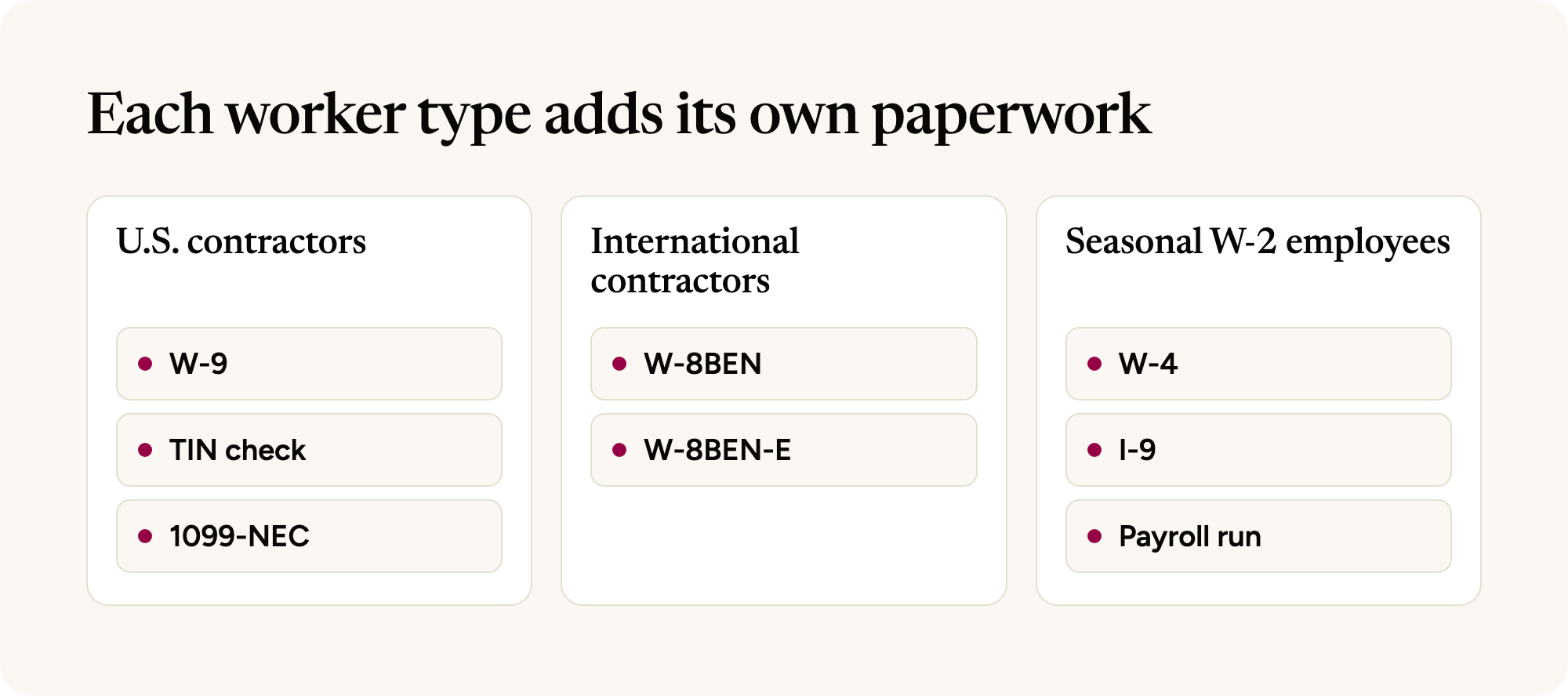
A U.S. contractor starts with a Form W-9, which gives the company the worker's taxpayer identification number (TIN). The company needs a way to catch a TIN that doesn't match IRS records. After that, every invoice needs a review and a payment.
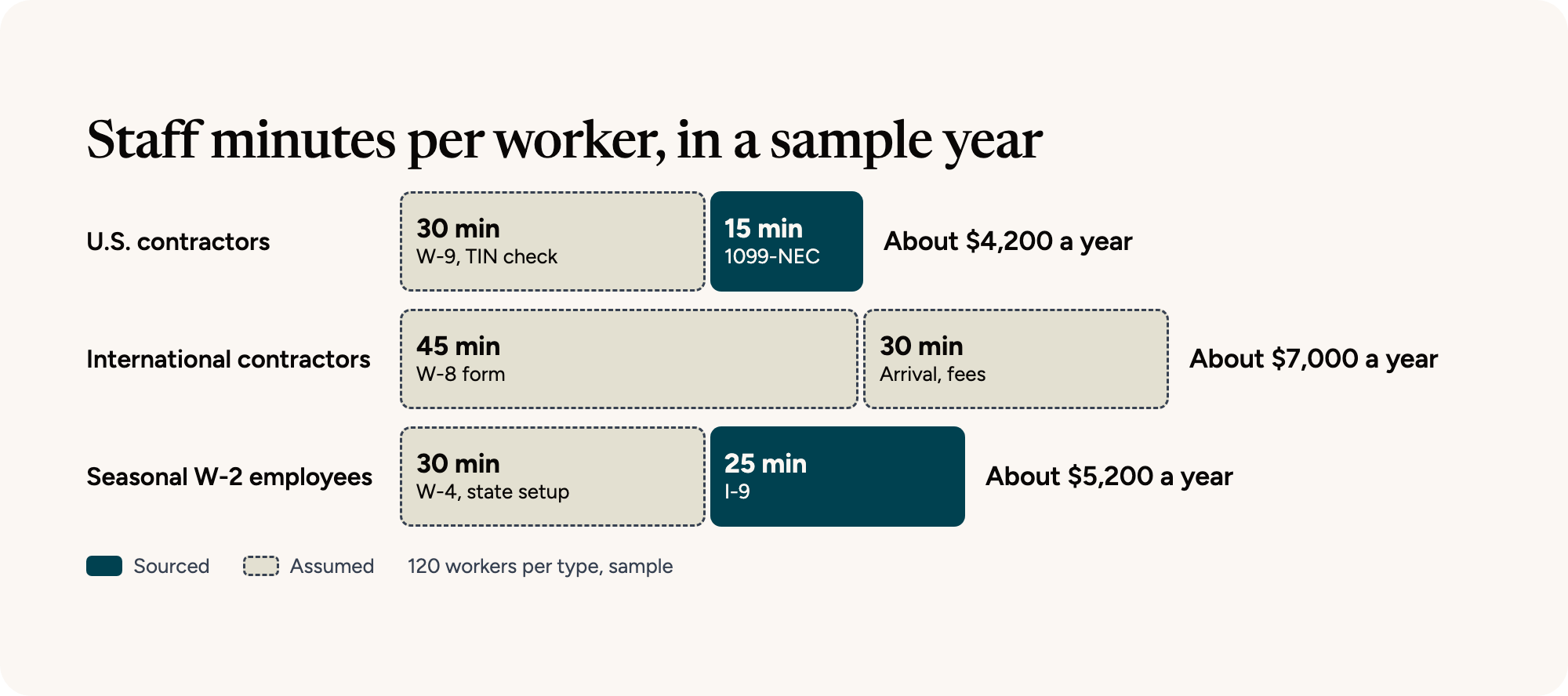
At the end of the year, the company generally files a Form 1099-NEC for each U.S. contractor it paid $2,000 or more in 2026. The IRS estimates an average of 15 minutes to complete and file one (IRS, Publication 1099 (2026)).
DeliverThat, a catering delivery platform that pays thousands of drivers, ran multiple weekly workflows to pay them before moving driver payments to Wingspan. It now saves up to 80 hours a month (DeliverThat customer story).
An international contractor documents their foreign status on a Form W-8BEN if they are an individual. A foreign business uses a Form W-8BEN-E instead (IRS, Instructions for Form W-8BEN). A company generally collects the right form before the first payment.
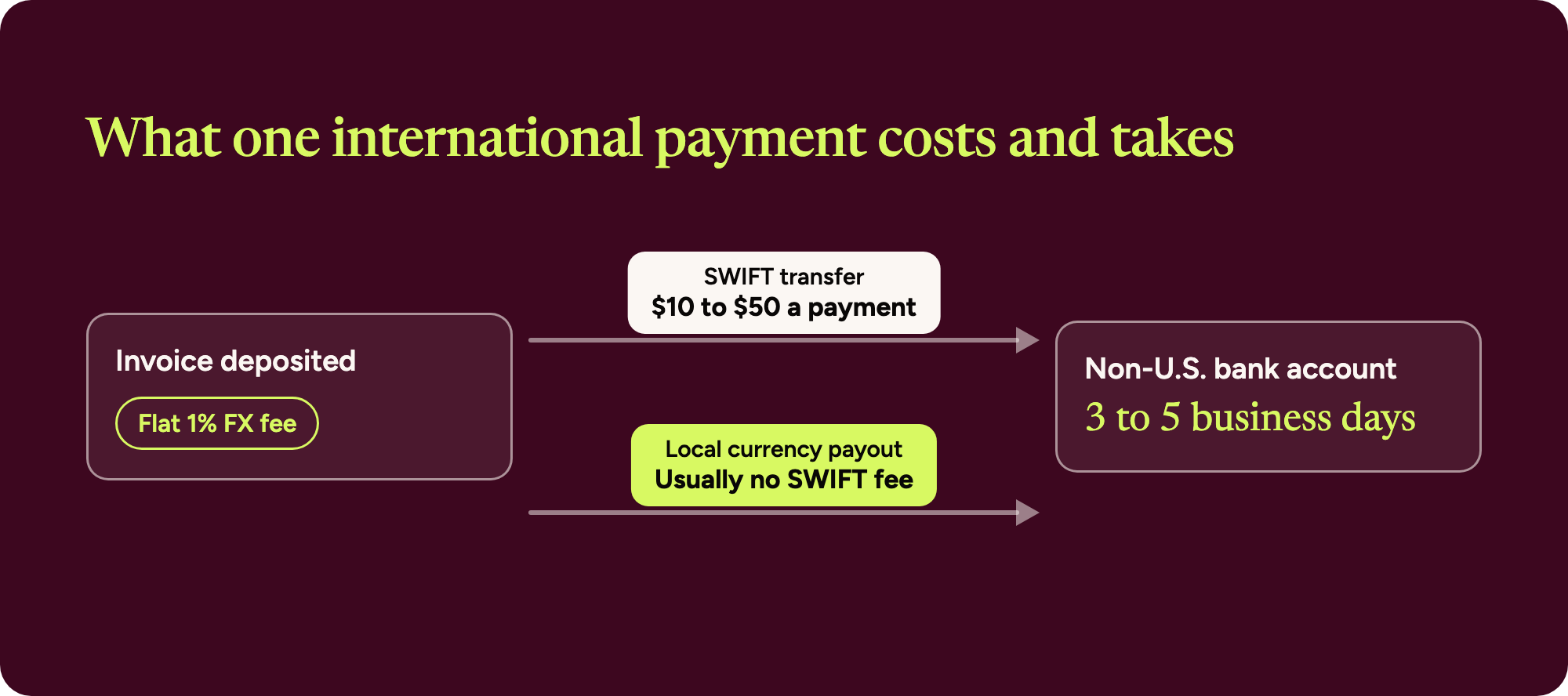
International payments can also involve currency conversion and bank fees. Wingspan charges a flat 1% foreign exchange (FX) fee. Transfers over the SWIFT bank network also pass through intermediary banks, and fees typically total between $10 and $50 per payment, depending on the route and the banks involved. Wingspan doesn't charge or receive any part of the SWIFT fees. Payouts sent in a worker's local currency usually travel over local payment networks instead of SWIFT, and no SWIFT fee applies (Wingspan help center, Global payouts and SWIFT fees).
Arrival time is the other thing to plan for: payout to a non-U.S. bank account can take 3 to 5 business days, counted from when the invoice is deposited (Wingspan help center, Payment and transfer timing).
BetterUp, a professional coaching network, pays about 4,000 coaches in more than 70 countries through Wingspan, and each coach can choose the currency they are paid in (BetterUp customer story).
An employee needs a Form W-4 so the company can withhold the right taxes, a Form I-9 to confirm they can work in the U.S., and a place on each payroll run, where the company withholds taxes from each employee's pay.
Seasonal and temporary hiring means more new hires, and each new hire needs their own I-9. USCIS estimates 34 minutes per response when the form is completed manually and 25 minutes when it is completed on a computer, including time to read the instructions and retain the form (USCIS, Form I-9 Instructions, 01/20/25).
Private employers' total cost for a worker averaged $46.89 per hour worked in June 2026 (Bureau of Labor Statistics, Employer Costs for Employee Compensation, June 2026), which gives a rough price for an hour of your team's time.
Say a company brings on 120 workers of each type in a year. Only the IRS and USCIS times above are sourced. Every other time below is an assumption.
Together that is about $16,400 a year for 360 workers. It leaves out invoices, pay questions, and payroll runs, which each type adds on top. It also leaves out what happens when the work is split across tools, which the next section covers. These totals come from assumed times and do not rank the worker types by cost.
A worker's type can change. A contractor hired for a busy season may become a seasonal employee, or the other way around. If the two types live in different tools, the company carries that worker's details from one tool to the other and keeps two records for them.
Say 20 workers change type in a year, and each change takes 30 minutes to re-enter and check in two tools. That adds about $470 in staff time at the BLS rate above. Each tool also keeps its own payment history, so a question about one worker means looking in more than one place.
Wingspan supports 1099 contractors, international workers, and seasonal, temporary, and part-time W-2 employees in one operating cycle. In Wingspan, a worker can move between 1099 and W-2 without starting over. Each engagement runs as 1099 or W-2. W-2 workers are on employee payroll with tax withholding, and contractor and W-2 pay runs stay separate.
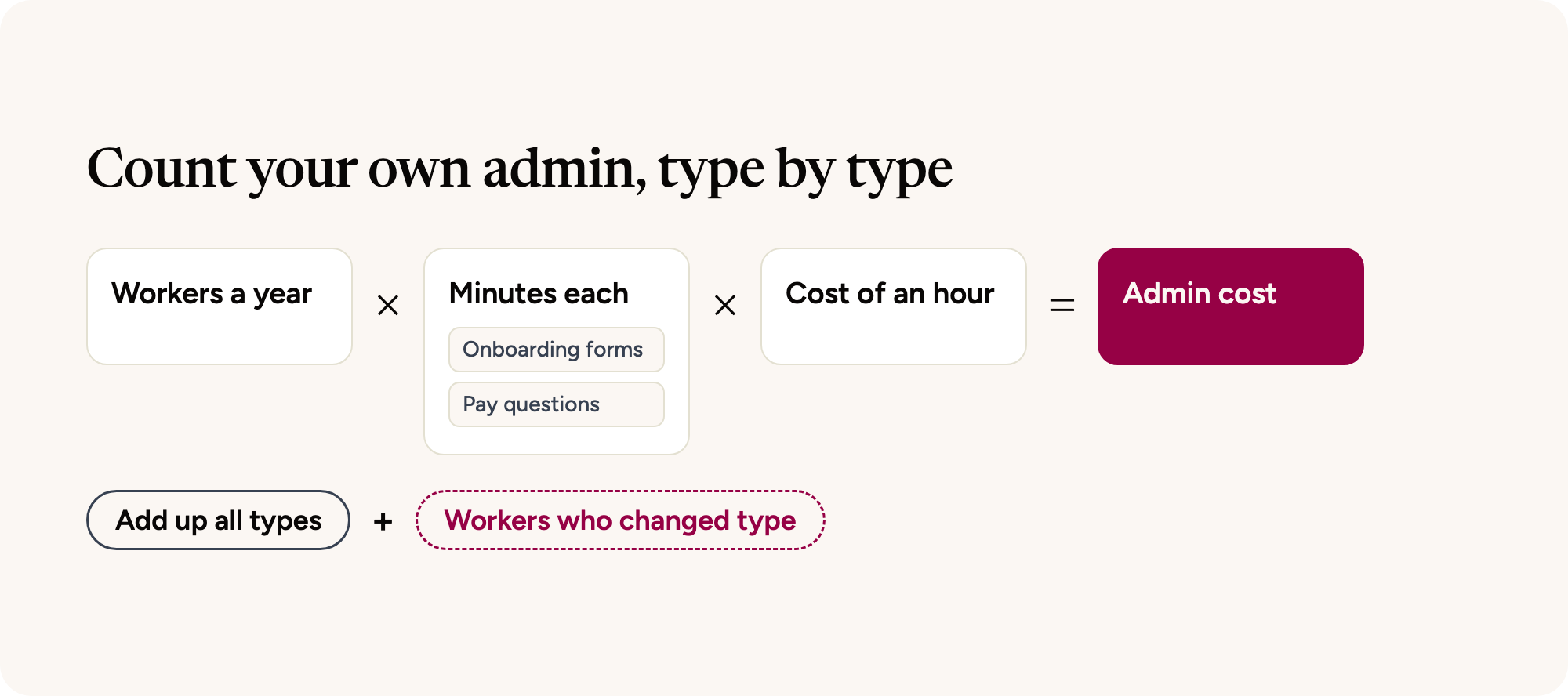
For each worker type you use, write down how many workers you pay in a year, the minutes per worker on onboarding forms (W-9 and TIN check, W-8BEN or W-8BEN-E, or W-4 and I-9), the minutes per worker on pay questions and bank or currency issues, and how many tools hold worker records. Multiply the hours by what an hour of your team's time costs, then add up the types. Add one more line for the workers who changed type, using the time it takes to move each one between tools.
Run every worker type through one payment cycle
See how one cycle turns approved work into payments for 1099 contractors, international workers, and W-2 employees.
What Economic Upheaval, AI, and Changing Regulations Mean for Your 1099 Workforce

These highly skilled professionals are the future of the modern workforce.

4 Experts Predicted These Top Trends for 2025 - How Did They Do?