3 Experts on Managing 1099 Behavioral Health Networks
How to Build, Manage, and Maintain Them
The vehicle, classification, and tax rules that matter when a delivery network pays drivers and couriers.
Five rules matter when a U.S. delivery or courier network pays drivers as independent contractors: federal vehicle and license rules, the IRS test and California's test for worker classification, Form 1099-NEC reporting, and backup withholding. For payments made in 2026, a delivery network that pays a courier or other nonemployee $2,000 or more for services in the course of its trade or business during the year generally files a 1099-NEC, with exceptions such as most payments to corporations and payments made by card or through a third-party network, which the payment settlement entity reports on Form 1099-K (IRS, Instructions for Forms 1099-MISC and 1099-NEC). Rules are as of October 2026.
Most examples use Riley, a courier who drives a personal car for your network and is paid $4,200 in 2026.
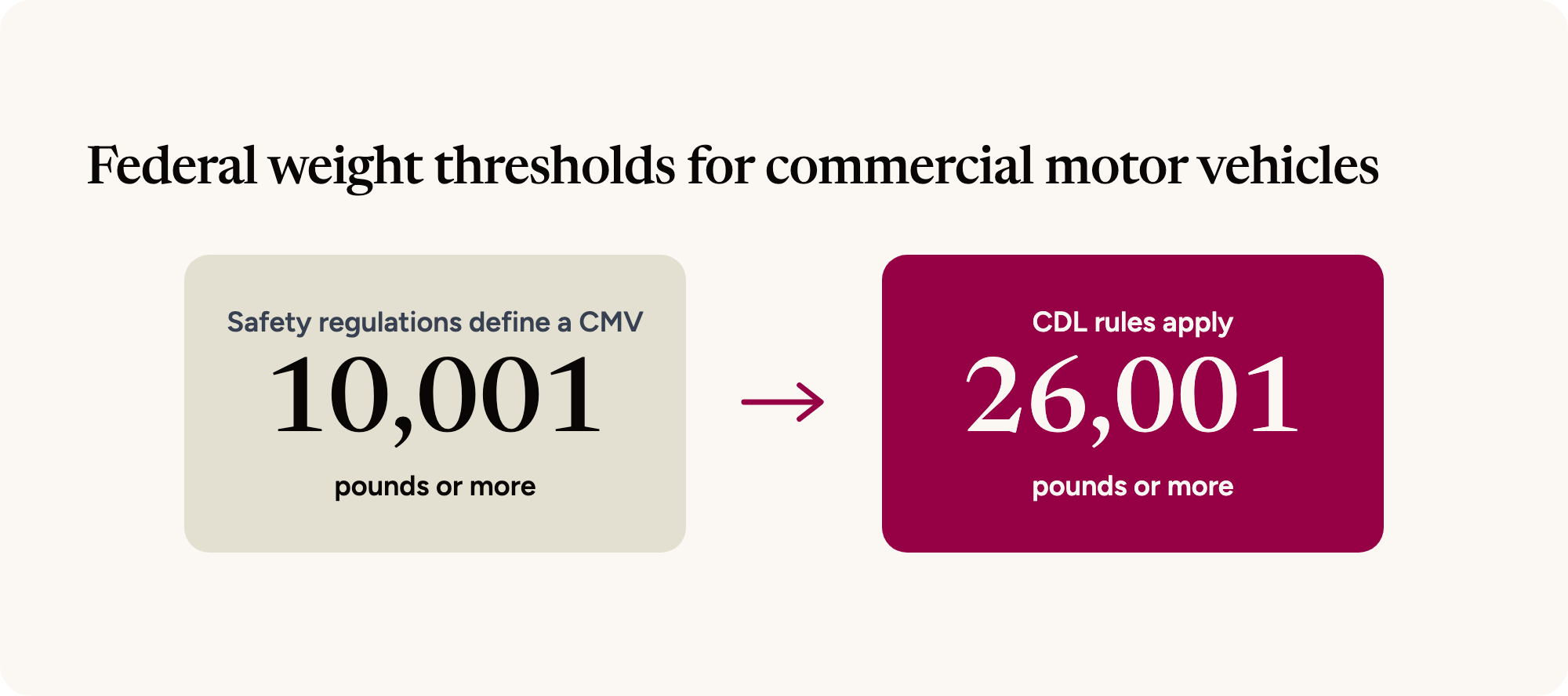
Federal motor carrier safety regulations define a commercial motor vehicle as one used on a highway in interstate commerce to carry property at a rated or actual gross vehicle or combination weight of 10,001 pounds or more, or to carry hazardous materials in a quantity requiring placarding. Those regulations cover an independent contractor while operating one (FMCSA regulations, eCFR, 49 CFR 390.5, Definitions). For vehicles that carry property, commercial driver's license rules apply to a single vehicle of 26,001 pounds or more, a combination of 26,001 pounds or more with a towed unit over 10,000 pounds, and any vehicle carrying placarded hazardous materials (49 CFR 383.5, Definitions). A single car under 10,001 pounds with no trailer or placarded hazardous materials, like Riley's, is outside both definitions.
In Wingspan, drivers upload licenses and insurance documents from their phone, and certificate of insurance validation costs extra. When a requirement is set to expire, such as a certificate of insurance, and the driver doesn't renew it, the driver can't be paid until it is completed again. DeliverThat, which connects restaurants and drivers for first-party catering delivery, says through its Director of Product that Wingspan's collection and storage of onboarding information is directly integrated into its driver app, so drivers manage their address, bank account information, and invoices in one place.
Riley delivers packages in a personal car, and the IRS sorts the facts of a working relationship into three categories: behavioral control, financial control, and the type of relationship, such as whether there are written contracts. The IRS guidance points to the entire relationship and says no one factor stands alone (IRS, Independent contractor (self-employed) or employee?).
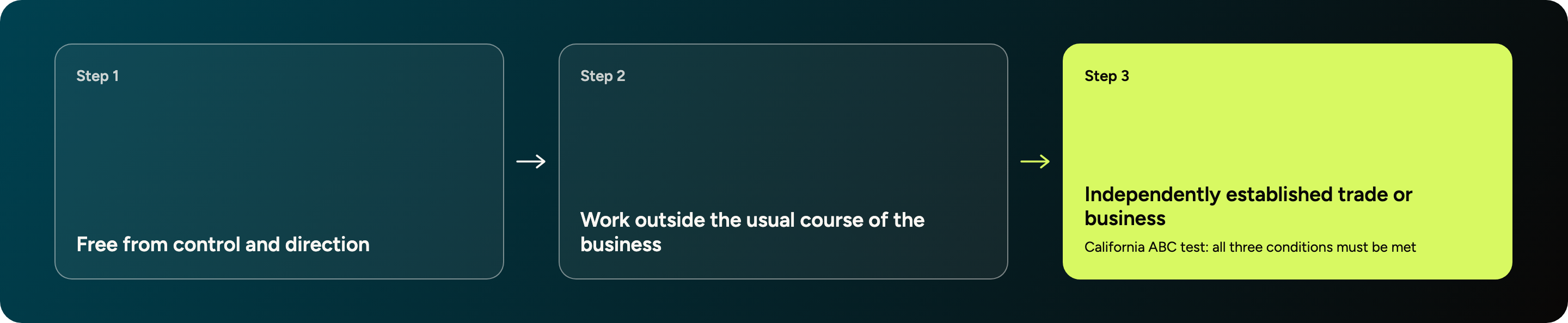
California uses the ABC test for most workers. A worker is an employee, not an independent contractor, unless the hiring entity satisfies all three conditions: the worker is free from the hiring entity's control and direction both under the contract and in fact, the work is outside the usual course of the hiring entity's business, and the worker is customarily engaged in an independently established trade, occupation, or business of the same nature (California Labor Commissioner's Office, Independent contractor versus employee).
For app-based drivers of a delivery or transportation network company, Business and Professions Code section 7451 applies instead. An app-based driver is an independent contractor and not an employee if that company does not unilaterally prescribe specific dates, times of day, or minimum logged-in hours, require the driver to accept any specific delivery request to keep access to the platform, restrict the driver from delivering through other network companies except during engaged time, or restrict the driver from any other lawful occupation or business (California Labor Commissioner's Office, Independent contractor versus employee).
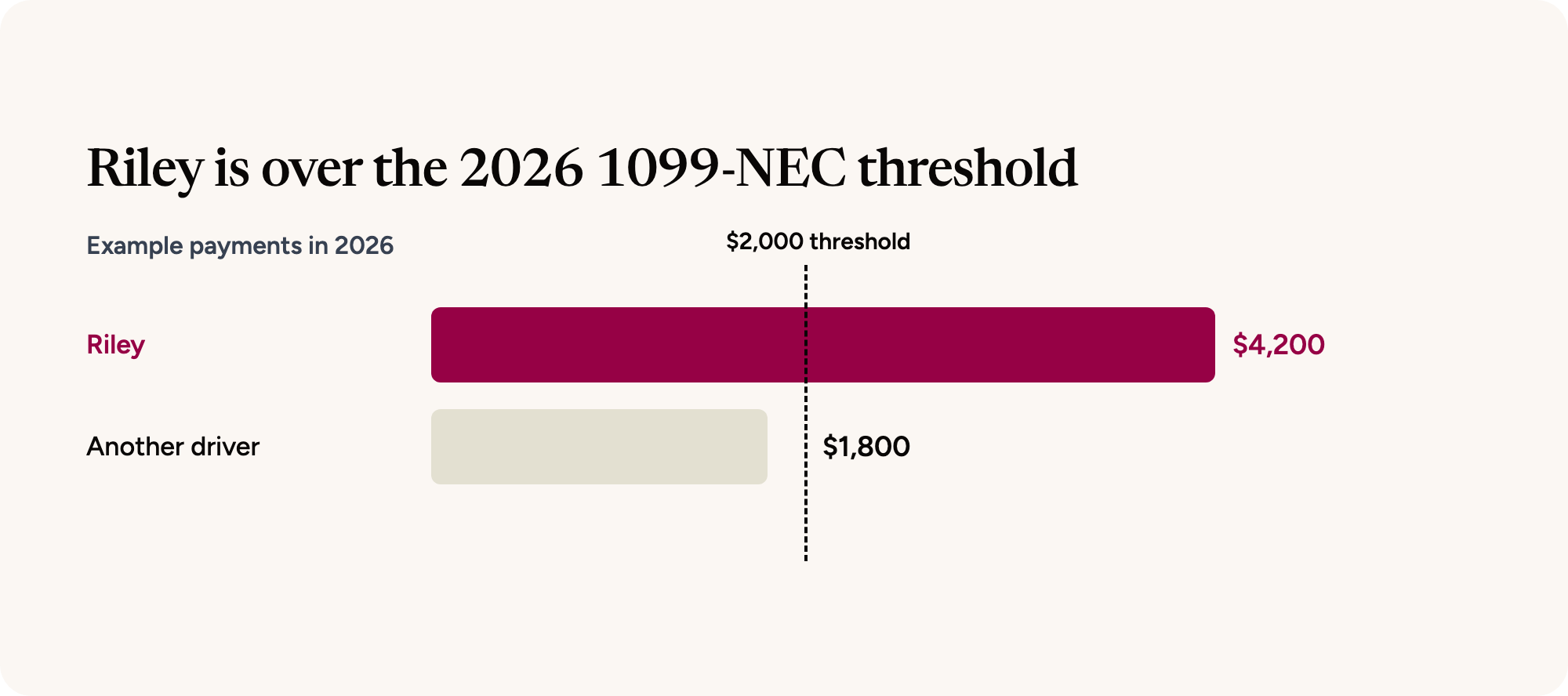
For a courier paid in 2026, the 1099-NEC trigger is $2,000 or more of nonemployee compensation for services in the network's trade or business during the year, and the figure was $600 for payments made before 2026 (IRS, Am I required to file a Form 1099 or other information return?). Riley's $4,200 for a year of routes is over the 2026 threshold. A driver who earned $1,800 in per-delivery pay, for example, is below it, unless you withheld federal income tax under the backup withholding rules below, which requires a 1099-NEC regardless of the amount (IRS, Am I required to file a Form 1099 or other information return?).
January 31 is the filing date, and a Saturday, Sunday, or legal holiday pushes it to the next business day (IRS, Instructions for Forms 1099-MISC and 1099-NEC). For the forms covering 2026 courier payments, January 31, 2027 falls on a Sunday, which makes Monday, February 1, 2027 the deadline.
Paper filing ends once you reach 10 or more information returns, which must be filed electronically. The IRS adds every type of information return into that count, so a network's courier 1099-NECs and its other forms are tallied together (IRS, Am I required to file a Form 1099 or other information return?; Instructions for Forms 1099-MISC and 1099-NEC). For couriers who earn customer tips, box 1b reports the part of box 1a designated as cash tips, including tips charged by customers (IRS, Instructions for Forms 1099-MISC and 1099-NEC).
For a courier network, Wingspan keeps year-to-date reportable payment totals for each driver from the payments you run, and automates the 1099 work for those drivers from creation and reconciliation through filing and delivery.
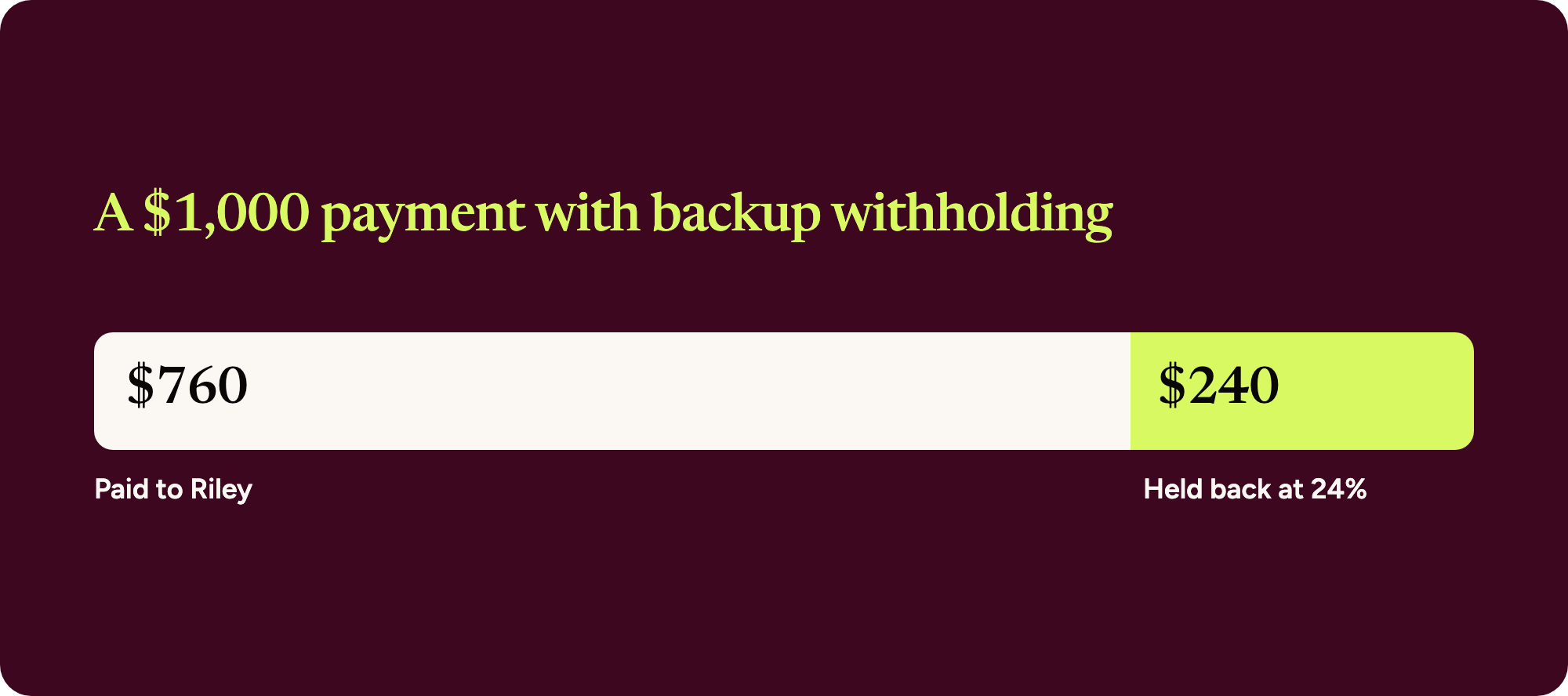
For a U.S. courier paid per delivery, a network must withhold 24% of reportable payments when no taxpayer identification number (TIN) was provided as the IRS requires, or when the IRS notifies the network that the TIN is incorrect and the courier fails to certify it as the notice requires (IRS, Forms and associated taxes for independent contractors). On each $1,000 of Riley's reportable payments, $240 would be held back if backup withholding applied.
Onboarding in Wingspan collects each driver's W-9 information, runs automatic TIN verification, and flags mismatches ahead of payment.
Federal tax law and California law use different tests, and California applies the ABC test under its Labor Code, Unemployment Insurance Code, and wage orders, with exemptions. This post doesn't cover California's exemptions, other states' classification laws, local delivery pay rules, or state vehicle and license rules.
Handle driver onboarding, payments, and 1099 filing in Wingspan
Delivery networks use Wingspan to onboard drivers, collect W-9s and license uploads, and file 1099s.
How to Build, Manage, and Maintain Them
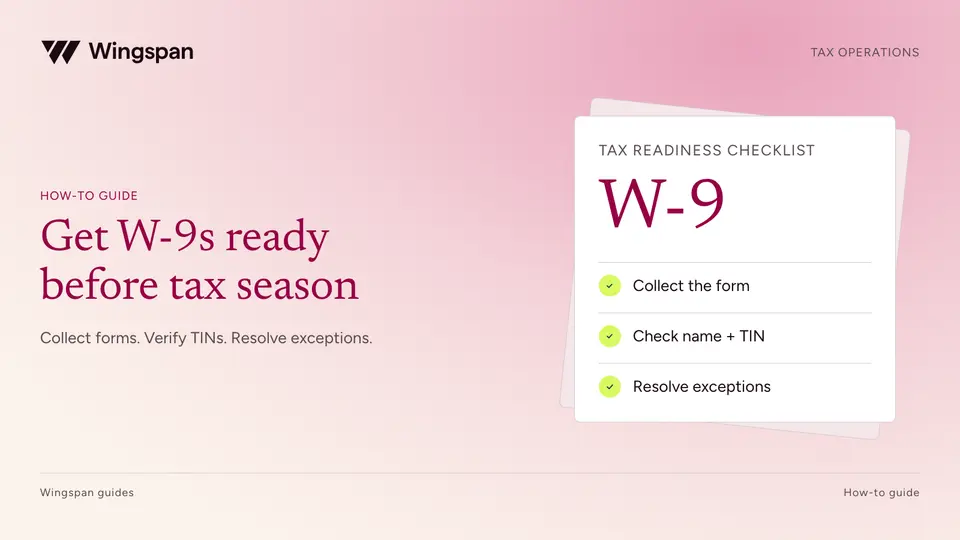
Build a W-9 collection and TIN matching workflow with clear owners, secure updates, mismatch resolution, and records ready for 1099 review.
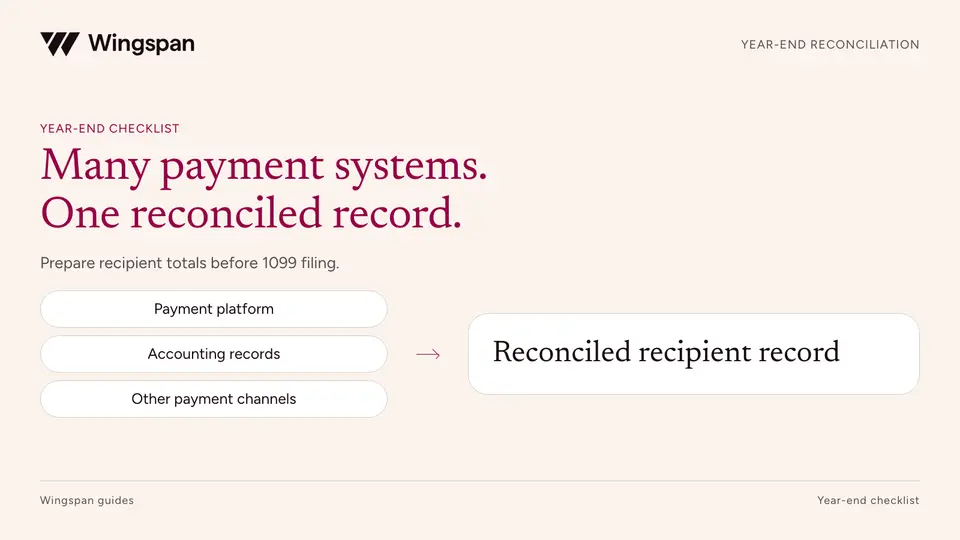
Reconcile contractor payments across platforms, AP, banks, and legacy systems with source registers, recipient mapping, and a reviewable bridge.