3 Experts on Managing 1099 Behavioral Health Networks
How to Build, Manage, and Maintain Them
The classification, tax, wage, and work-eligibility rules that matter when an events and hospitality business pays event staff.
Six rules matter when an events and hospitality business pays bartenders, servers, and event crews as contractors or as contingent W-2 employees: worker classification under IRS rules, 1099-NEC reporting, tip reporting, the federal tip credit, overtime, and Form I-9. For payments made in 2026, an events business generally files a 1099-NEC for each person it pays $2,000 or more over the year for services performed by a non-employee in the course of its business (IRS, Instructions for Forms 1099-MISC and 1099-NEC). Rules are as of October 2026.
Most examples below use Quinn, a bartender who works events for your company during the 2026 season.
For a bartender an agency, caterer, or venue books for event nights, the IRS groups the evidence into behavioral facts, financial facts, and the type of relationship. Behavioral facts ask whether the company has the right to tell the bartender what to do and how to do it. Examples are who sets the call time and who decides how the bar is run. Financial facts concern who controls the business side of the job, such as who provides tools and supplies (for example, the uniform and bar tools), how Quinn is paid, and whether expenses are reimbursed. Type of relationship covers written contracts, employee-type benefits, and whether the relationship continues, for example past one booking into a full season. The IRS treats the entire relationship as the key and gives no single fact the deciding vote (IRS, Independent contractor or employee?).
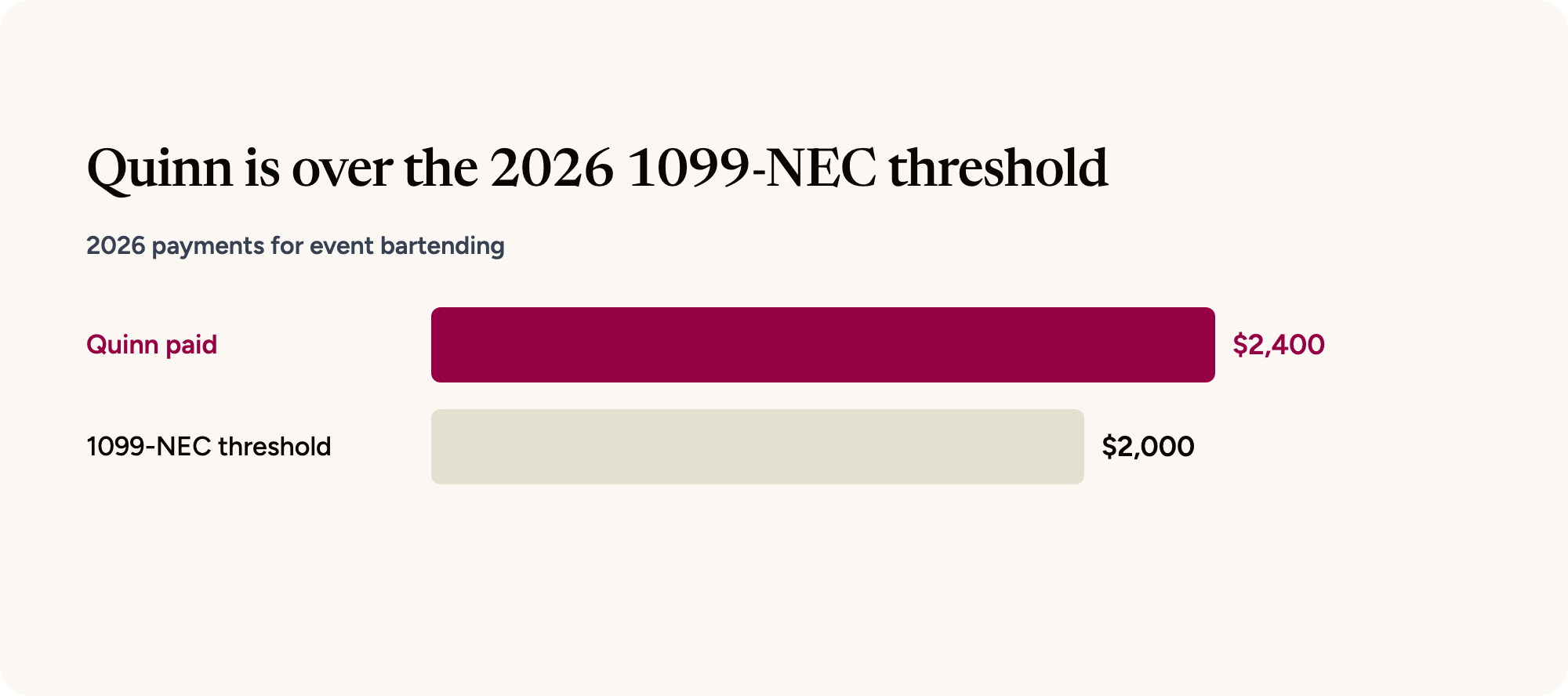
Shifts at weddings, galas, and tasting rooms add up over a season, and for payments made in 2026 a 1099-NEC is generally required once your business has paid one non-employee $2,000 or more across the year for services. Payments made before 2026 fell under the older $600 figure (IRS, Am I required to file a Form 1099?). If Quinn is a 1099 bartender paid $2,400 in 2026, that is over the threshold. On the form, box 1a holds nonemployee compensation of $2,000 or more, and box 1b holds the total designated as cash tips included in box 1a (IRS, Instructions for Forms 1099-MISC and 1099-NEC).
The statutory due date for 2026 payments is January 31, 2027. Weekend and legal holiday deadlines roll to the next business day (IRS, Instructions for Forms 1099-MISC and 1099-NEC), so Quinn's form and every other 1099-NEC for 2026 payments are due Monday, February 1, 2027, because January 31, 2027 is a Sunday.
A caterer or staffing agency with 10 or more information returns must file them electronically, and the count adds every type of information return together, not only the 1099-NECs for bartenders and servers (IRS, Am I required to file a Form 1099?; Instructions for Forms 1099-MISC and 1099-NEC).
Wingspan lets event staffing agencies and hospitality platforms onboard talent from their phone, collect W-9s and certificates of insurance in one flow, and file 1099s at year-end. Pourtastic, a Fort Worth promotional tasting company, works with a network of more than 750 brand ambassadors who are 1099 contractors. On back-office work, Allison Bernhart, its Director of Information Resources, says Wingspan "has saved me hundreds of hours processing invoices, running reports and responding to ambassadors."
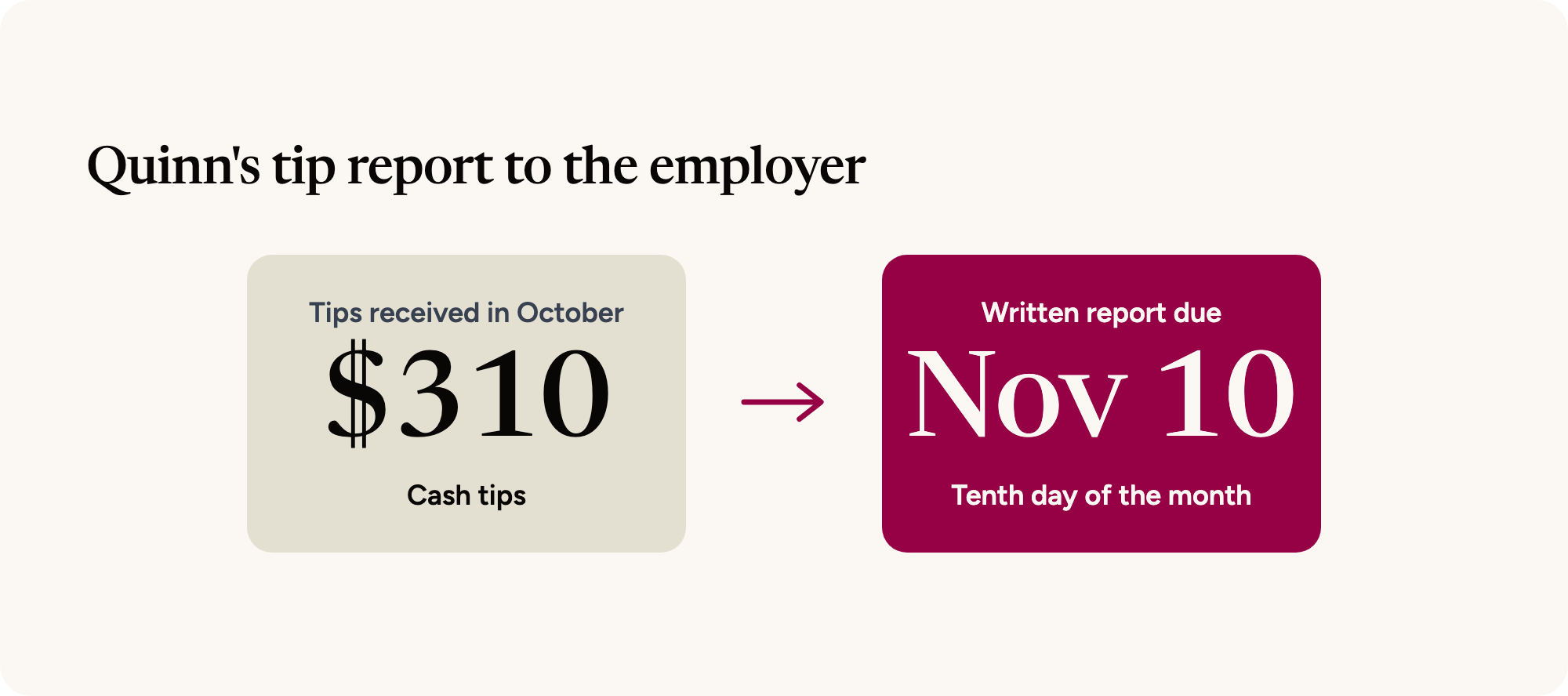
Employees who receive cash tips of $20 or more from one employer in a calendar month must report them to that employer in writing by the tenth day of the following month. The employer uses the report to figure the Social Security, Medicare, and income taxes to withhold (IRS, Tax Topic 761). An employee can use Form 4070, Employee's Report of Tips to Employer, to make the report (IRS, Tip income is taxable and must be reported). If Quinn is a W-2 bartender who receives $310 in cash tips in October, Quinn's report is due to the employer by November 10.
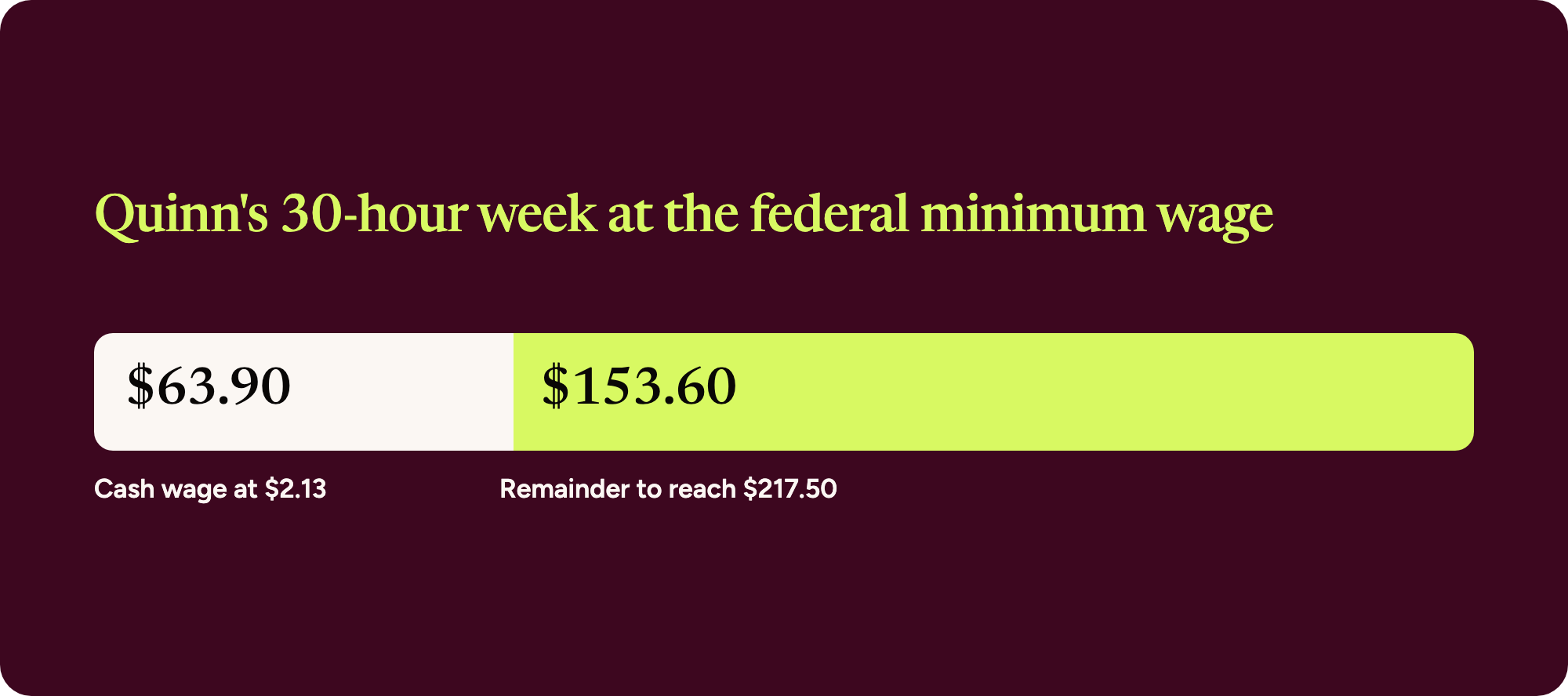
An employer of tipped employees must pay at least $2.13 an hour in cash wages and may claim a tip credit of up to $5.12 an hour, which together equal the $7.25 federal minimum wage. If tips plus cash wages fall short of the minimum wage in a workweek, the employer must make up the difference. Without the required notice, the employer cannot take the credit. A compulsory service charge is not a tip under the FLSA (DOL, Fact Sheet #15: Tipped Employees Under the FLSA). If Quinn works 30 hours in a week at a $2.13 cash wage, cash wages are $63.90. The minimum-wage total is $217.50, so if Quinn's tips for the week come to less than $153.60, the employer must make up the difference.
Covered employees who are not exempt must be paid at least one and one-half times their regular rates for hours worked over 40 in a workweek (DOL, Fact Sheet #23: Overtime Pay Requirements of the FLSA). If Quinn works 46 hours of setup in one workweek at $18 an hour, 6 of those hours are overtime at $27 an hour, which is $162 for those hours.
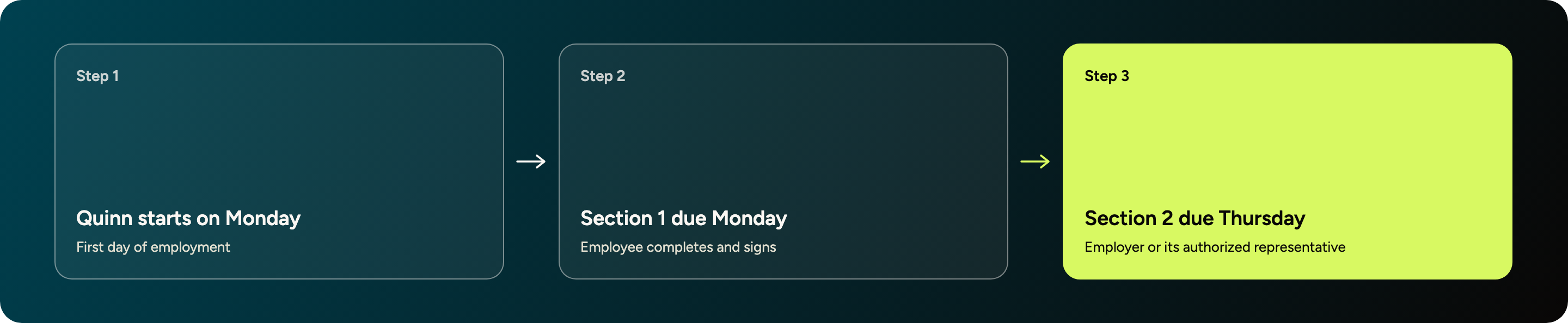
Employers must complete Form I-9 for every individual they hire for employment in the United States (USCIS, Form I-9). The employee completes Section 1 no later than the first day of employment (USCIS, Completing Section 1). The employer or its authorized representative completes Section 2 within three business days of the date of hire, or by the first day of work for pay if the job lasts less than three days (USCIS, Completing Section 2). If Quinn is hired as a W-2 employee and starts on a Monday, Section 1 is due Monday and Section 2 by Thursday.
Wingspan's flexible W-2 is built for seasonal, temporary, and part-time W-2 employees alongside 1099 contractors. Wingspan tracks both I-9 deadlines and flags an employee whose I-9 is unfinished before the pay cycle closes. In Wingspan, an E-Verify case opens only when the employer is enrolled with USCIS.
Tipped wage rules in the state where an event takes place can differ from the federal tip credit and minimum wage figures in this post (DOL, Fact Sheet #15). This post covers federal rules from the IRS, DOL, and USCIS. It doesn't cover state tax rules, exceptions to 1099-NEC reporting by type of payee, or benefits rules.
Bring event staff onboarding and pay into one system
Event staffing agencies and hospitality businesses can onboard workers, collect W-9s and insurance certificates, and file 1099s in Wingspan.
How to Build, Manage, and Maintain Them
Build a W-9 collection and TIN matching workflow with clear owners, secure updates, mismatch resolution, and records ready for 1099 review.
Reconcile contractor payments across platforms, AP, banks, and legacy systems with source registers, recipient mapping, and a reviewable bridge.